
Battery backup
Why a battery pays for itself between 6 and 9 pm in Las Vegas
Summer evening power costs about 6.3 times what off peak costs on NV Energy's time of use plan, and the sun has already gone. The arithmetic, honestly.
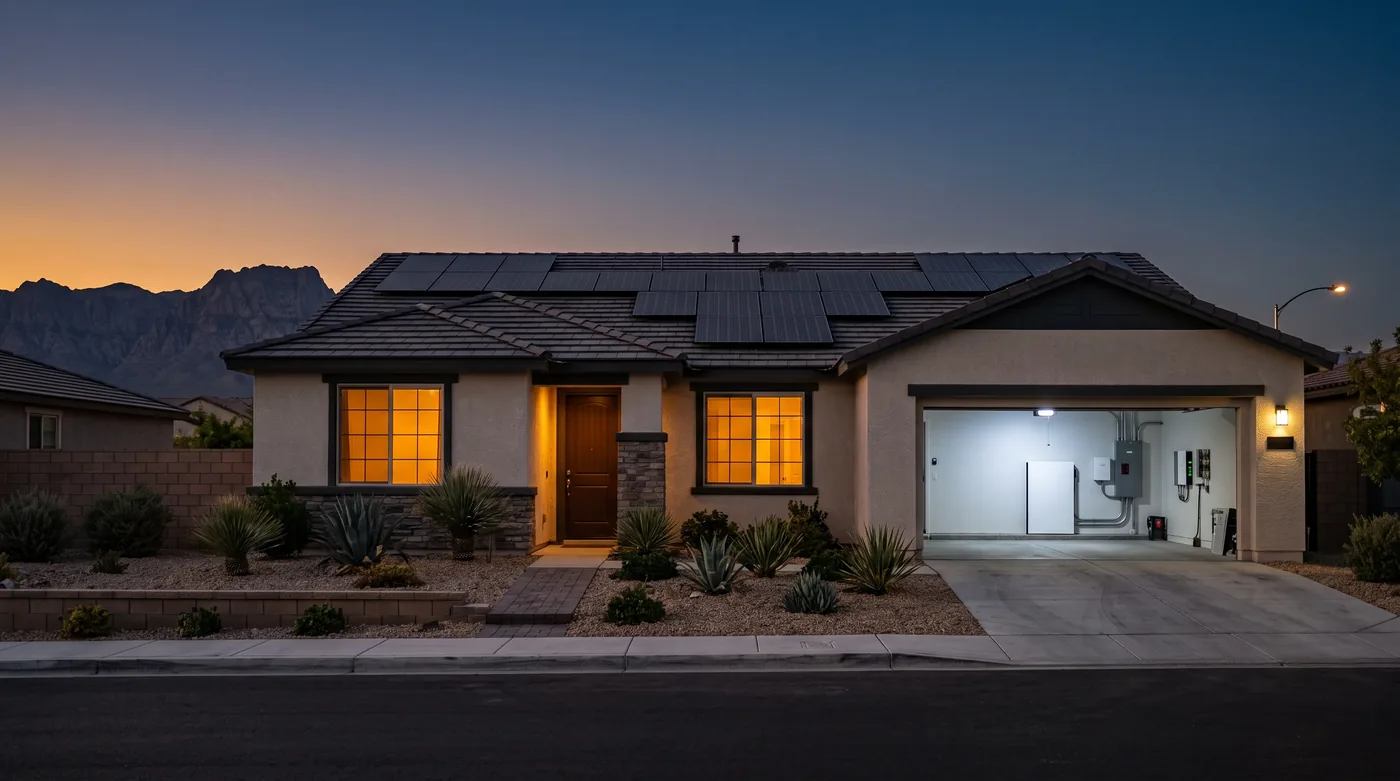
On NV Energy's time of use plan, summer evening power costs $0.47155 per kilowatt hour and everything else costs $0.07305. That is about 6.3 to 1, it runs 6:01 pm to 9:00 pm from June 1 to September 30, and the sun has usually already set inside it. A battery is the only thing that puts cheap daytime energy into those three hours.
The window is 6:01 to 9, and it is worth getting right
NV Energy's residential rate schedule, effective July 1 2026, defines the time of use periods in one line: "Summer on-peak: June 1 to Sept. 30, from 6:01 p.m. to 9 p.m. daily". Summer off peak is every other hour in those months. October through May is a single winter rate at all hours.
You will see 5 pm quoted around town. The tariff says 6:01. If you are planning your evening around a rate, plan it around the right rate.
Here is the whole of NV Energy's time of use schedule as the utility publishes it, so you can see exactly what changes when you opt in.
| On NV Energy's time of use plan (ORS-TOU) | Rate per kWh |
|---|---|
| Summer on peak, 6:01 pm to 9:00 pm, June 1 to September 30 | $0.47155 |
| Summer off peak, all other hours June to September | $0.07305 |
| Winter, all hours, October to May | $0.08658 |
| Basic service charge | $18.00 per month |
For comparison, the standard residential plan most Las Vegas homes are on is flat: $0.11622 per kilowatt hour, $0.11935 once the riders are added, and the same $18.00 basic service charge. There is no evening window on it at all.
The ratio, and why it is the honest argument for storage
Divide the two summer rates and you get about 6.3 to 1. On NV Energy's time of use plan, one kilowatt hour used at 7 pm in July costs what roughly six and a third kilowatt hours cost at 2 am.
That number is what makes a battery structural in this market rather than a luxury. A battery does not create energy. It moves it in time. When the price ratio between two times of day is 6.3 to 1, moving energy is worth something real. In a market where the price is flat, it is worth almost nothing, which is why battery advice written for a flat rate state does not transfer here.
Panels are finished before the window is
This is the fact that turns the ratio into an argument, and almost nobody prints it.
Sunset times for Las Vegas, from the United States Naval Observatory:
| Date | Sunset |
|---|---|
| June 1 | 7:53 pm |
| June 21, the longest day | 8:01 pm |
| July 15 | 7:58 pm |
| August 15 | 7:31 pm |
| September 30 | 6:25 pm |
On the longest day of the year, the sun is gone an hour before the on peak window closes. By mid August, an hour and a half of the window is after dark. On September 30, the last day of the summer season, the sun sets 24 minutes into the window and the rest of it is night.
And sunset is the generous reading. A panel at a very low sun angle produces a small fraction of what it produces at noon, so the array has effectively stopped contributing well before the sun touches the horizon. The most expensive three hours of the Las Vegas summer are precisely the hours your roof cannot reach.
Without storage, you buy those hours from NV Energy at $0.47155 per kilowatt hour on their time of use plan. With storage, you spend energy your own roof made at noon.
The arithmetic, with the assumptions written down
Take a house that draws about 3 kilowatts through the evening, so roughly 9 kilowatt hours across the 6:01 to 9:00 window. Nothing exotic: air conditioning still running down, dinner, laundry, televisions.
- Energy not bought in the window: 9 kWh at $0.47155 on NV Energy's time of use plan is $4.26.
- Energy it cost to put there: Tesla's Powerwall 3 datasheet lists solar to battery to home efficiency at 89 percent, so you need about 10.1 kWh of midday solar to deliver 9 kWh in the evening.
- What that midday solar would otherwise have earned: exported instead, it earns 75 percent of the retail rate under Nevada's Tier 4 net metering, confirmed by the Public Utilities Commission of Nevada. Assumption stated plainly: we are valuing midday summer export at 75 percent of the off peak rate, because midday in June is an off peak hour on that schedule. That is 10.1 kWh at about $0.056, or $0.57.
- Net swing for the day: about $3.69.
Across the 122 days from June 1 to September 30, that is roughly $450 in a summer.
Now the part a sales pitch leaves out. From October through May the rate is $0.08658 at all hours. There is no window, so there is no gap, so the battery earns essentially nothing on price movement for eight months of the year. The evening arbitrage case in Las Vegas is a four month a year case. Roughly $450 a season, on a house with a substantial evening load, is real money and it is not a payback on its own.
Which is why we never sell a battery on this number alone.
The three things a battery is actually worth here
Add them up honestly and the picture changes. Take any one of them alone and it does not.
1. The evening window. The $450 a summer above, on a house with a real evening load. Scale it to your own usage, not to ours.
2. Self consumption beats export, always. Nevada's open net metering tier credits exported energy at 75 percent of retail. A kilowatt hour you keep and use is worth the whole retail price; the same kilowatt hour sent to the grid is worth three quarters of it. That gap applies to every hour of every month, not just summer evenings, and it is the reason storage changes the sizing maths here more than it does in a one for one state. There is more on that in what 75 percent of retail actually costs you.
3. The daily demand charge, scheduled for January 1 2027 and under appeal. NV Energy's own figure is $0.14 per kilowatt of your highest 15 minute interval each day. A battery is the only thing in a house that can hold that peak down. It cannot remove the charge, and we set out exactly what it can and cannot do in can a battery get you out of the demand charge.
And a fourth thing that never shows up on a bill: what happens when the power goes out during monsoon season. Grid tied panels without storage shut down in an outage. That surprises people, and it should be said before the sale rather than after it.
What one battery can and cannot carry
Numbers from the Tesla Powerwall 3 datasheet, since it is the unit we install most: 13.5 kilowatt hours of nominal battery energy, up to 11.5 kilowatts of nominal AC output per unit, up to four units on a system, and a load start capability of 185 LRA, which is the specification that matters when an air conditioning compressor kicks in.
Read that against the worked example. Nine kilowatt hours through the evening window fits inside one unit with room to spare. Nine kilowatt hours through the evening plus holding a demand ceiling all afternoon plus keeping a reserve for an outage does not comfortably fit inside one unit, because the three jobs are competing for the same tank. That is the real sizing conversation, and it is why we ask for a year of your interval data before we quote.
Two rules that change the decision
Adding a battery does not move your net metering rate. From NV Energy's interconnection handbook, revision 10/16/2025: a system expansion that only adds an energy storage system, and adds no additional renewable capacity, does not result in a net metering rate change. Adding panels is the thing that moves you. If you are on an older, better tier, that distinction matters a great deal.
Battery backup needs NV Energy's approval before it goes in. The same handbook requires advance review and approval for a battery backup system on a grid connected system. That is our paperwork, not yours, but it is why a battery job takes longer than a panels only job.
Before you switch to the time of use plan
Everything above assumes you are on, or moving to, NV Energy's time of use plan. Two things to know before you opt in.
There is a guarantee on the first year. The tariff says that at the end of the first year of service on the time of use rates, NV Energy compares what you actually paid for consumption against what you would have paid on the standard residential schedule, and if the time of use total was higher, the utility credits the difference to your account. That is a genuine safety net, and it lasts one year.
And the arithmetic only works if the battery is set to discharge into the window. A system left on a default setting can sit through the expensive hours doing nothing. We set it, we show you the setting, and we write down what it is.
What we would tell you on the phone
If you are on the standard flat plan, your evening load is light and you do not care about outages, you may not need a battery and we will say so in writing. That answer costs us a sale and it keeps us licensed.
If your evenings are heavy, or you want the lights on through a monsoon outage, or your daily peak is high enough that the January 2027 charge is going to find you, then the 6.3 to 1 ratio on NV Energy's time of use plan is doing real work for you, and the case is worth building properly.
Either way, bring a year of NV Energy bills to the assessment. Your own interval data settles this in about twenty minutes, and the answer belongs to your roof, not to an average.
Questions people ask us
What are NV Energy's summer on peak hours?
On NV Energy's time of use plan, summer on peak runs from 6:01 pm to 9 pm daily, June 1 through September 30. Everything else in those months is off peak, and October through May is a single winter rate at all hours. The window is 6:01, not 5 or 6.
How much more does evening power cost in summer?
On NV Energy's time of use plan the summer on peak rate is $0.47155 per kilowatt hour against $0.07305 off peak, which is about 6.3 to 1. That ratio is what makes a battery structural here. On the standard flat residential plan there is no such window and no such gap.
Do I need a battery with solar panels in Las Vegas?
Not always. If you stay on the standard flat rate plan and your evening use is modest, panels alone may be the right answer and we will say so. A battery earns its place when your evening load is large, when you want backup during monsoon season, or when your daily peak is high.
Will panels cover the 6 to 9 pm window on their own?
No. On the longest day of the year the sun sets in Las Vegas just after 8 pm, and by the last day of September it sets at 6:25 pm, minutes into the window. Output at those low sun angles is a fraction of midday output, so the expensive hours are exactly the hours the roof cannot reach.
Is there still a battery rebate in Nevada?
No. NV Energy's residential storage incentive stopped accepting new applications in June 2023 and has not reopened. Nevada also does not exempt residential solar from sales tax or from property tax. Any battery quote you are given has to stand on its own arithmetic, which is why we print ours.
Does adding a battery change my net metering rate?
No. NV Energy's interconnection handbook says a system expansion that only adds energy storage, and adds no generating capacity, does not result in a net metering rate change. Adding panels does move you. The handbook also requires NV Energy's advance review and approval for battery backup on a grid connected system.
Where these numbers come from
- NV Energy, Nevada Power Company electric rate schedules for residential customers, effective 2026-07-01 checked 2026-09-22
- United States Naval Observatory, sun rise and set data for Las Vegas, 36.1699 N 115.1398 W checked 2026-09-19
- Public Utilities Commission of Nevada, net metering tiers and the 75 percent credit checked 2026-09-19
- NV Energy, Net Metering and Energy Storage Interconnection Handbook, revision 10/16/2025 checked 2026-09-19
- Tesla, Powerwall 3 datasheet, 2025 edition checked 2026-09-19
- EnergySage, Nevada solar rebates and incentives, updated 2026-01-06 checked 2026-09-19
- NV Energy, Southern Nevada Daily Demand, guide and frequently asked questions checked 2026-09-19
- KTNV, Nevada lawmakers decline taking on NV Energy's daily demand charge, 2026-08-19 checked 2026-09-19
Actual utility rates may go up or down and actual savings may vary. Every figure on this page is an estimate based on the sources listed below, not a promise about your home.
We recheck this page quarterly. Last checked 2026-09-19. If a number here has moved, tell us and we will fix it the same week.