
Battery backup
How big a home battery do you need in Las Vegas?
Size a Las Vegas home battery by its job, the 6 to 9 pm summer window, the demand charge or an outage, with the kWh and kW arithmetic worked through.
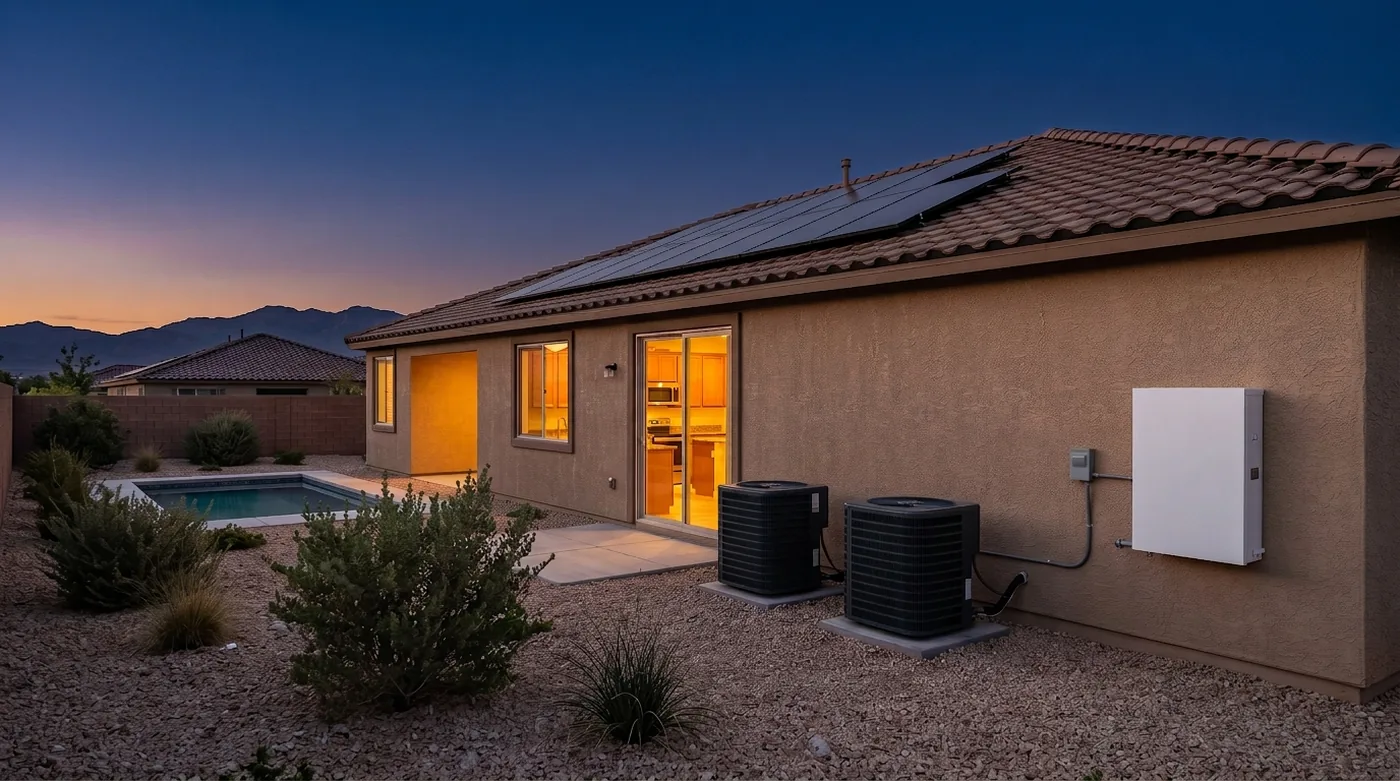
Size it by the job, not by the house. To cover the summer evening window on NV Energy's time of use plan, multiply your evening draw in kilowatts by three hours. To keep essentials running in an outage, add up what those circuits use in a day. To run the whole house through a Las Vegas July, one battery is rarely enough. Here is the arithmetic for each.
Two numbers on every battery, and which one runs out first
Every home battery has an energy rating and a power rating, and they answer different questions.
Energy, in kilowatt hours, is how much is in the tank. It decides how long the battery lasts.
Power, in kilowatts, is how much it can hand over at once. It decides what it can run at the same time, and whether a big motor will start.
Two datasheets, used here only for their published figures:
- Tesla Powerwall 3, 2025 datasheet: 13.5 kWh nominal battery energy, up to 11.5 kW of continuous AC output per unit, a load start capability of 185 LRA, and 89 percent solar to battery to home efficiency. A footnote says the energy figure is given at 25°C (77°F), at beginning of life.
- Enphase IQ Battery 5P, North America datasheet dated May 6 2025: 5.0 kWh usable capacity, 3.84 kVA continuous and 7.68 kVA peak output per unit, power start of up to 48 A LRA, and 90 percent AC round trip efficiency.
Neither figure is better than the other for being bigger. A small unit is simply a smaller step, and you stack steps until the job is covered. What matters is that you check both numbers against each job below, because a battery with enough energy and too little power fails just as surely as one with the reverse.
Job one: the summer evening window
On NV Energy's time of use plan, on the schedule effective October 1 2026, summer on peak energy costs $0.46912 per kilowatt hour from 6:01 pm to 9 pm, June 1 to September 30. Every other summer hour costs $0.07062. From October through May there is one winter rate, $0.08415, at all hours. The full case for storage on that plan is in why a battery pays for itself between 6 and 9 pm. This page is only about how much.
The window is three hours long, so the sizing is short:
Evening draw in kilowatts × 3 hours = kilowatt hours the battery must deliver.
Then decide how much you want held back for an outage. That reserve is a setting you choose, not a fixed number. We use 20 percent below as an assumption, stated plainly, so you can see what it does.
| Your average draw, 6:01 to 9 pm | Delivered in the window | Tank needed with 20% held back |
|---|---|---|
| 2 kW | 6 kWh | 7.5 kWh |
| 3 kW | 9 kWh | 11.25 kWh |
| 5 kW | 15 kWh | 18.75 kWh |
Put those against the datasheets. A single 13.5 kWh unit covers the 2 and 3 kilowatt houses with room to spare, and the 5 kilowatt house needs a second unit or an expansion. At 5.0 kWh per unit, the same three houses need two, three and four units. Check power too: the 5 kilowatt house on 3.84 kVA units needs at least two running together just to meet the draw, which four units do easily.
Why bigger is not better for this job
Every kilowatt hour the battery delivers between 6:01 and 9 pm replaces one that would have cost $0.46912 on NV Energy's time of use plan. A kilowatt hour stored beyond what your house uses in those three hours has no on peak hour left to replace. It waits until tomorrow. So a battery sized well past your evening need does not earn more on this job; it just costs more.
The reverse is also true. A battery that is too small runs flat at 8 pm and you buy the last hour at the on peak price.
Two corrections before you settle on a number
Losses. Energy goes in and comes out with some loss. At Tesla's listed 89 percent, delivering 9 kWh in the evening takes about 10.1 kWh stored at midday. At Enphase's listed 90 percent round trip, it takes 10 kWh. If you are sizing panels at the same time, that extra kilowatt hour a day belongs in the panel count.
Ageing. Capacity falls with years and cycles. Enphase's datasheet states its warranty as more than 60 percent of capacity, up to 15 years or 6,000 cycles. Tesla's datasheet lists a 10 year warranty; read the warranty document itself for its capacity terms. A battery sized to exactly today's evening will fall short of it later, so leave some headroom.
Where your evening number comes from
Not from a guess and not from your monthly bill total. NV Energy's MyAccount lets you download your use in 15 minute intervals. Take a hot July weekday, add up the kilowatt hours between 6 pm and 9 pm, and that is your evening need. How to download your NV Energy usage data walks through it.
Job two: the daily demand charge
NV Energy's daily demand charge is $0.14 per kilowatt of your highest 15 minute interval each day, reset daily and totalled across the bill. It is scheduled for January 1 2027, under appeal to the Nevada Supreme Court. NV Energy puts the typical southern Nevada household near 3.5 kilowatts, about $0.49 a day. NV Energy's daily demand charge, explained covers the rest.
For this job, size on power first. The battery has to deliver the gap between what the house wants and the ceiling you set, at the moment the house wants it.
Take a house that would hit 8 kilowatts on a summer afternoon, with a ceiling held at 4:
- Power needed: 8 minus 4, so 4 kW from the battery.
- One 11.5 kW unit covers that. One 3.84 kVA unit does not; two together (7.68 kVA) do.
- What it is worth: 4 kW × $0.14 = $0.56 a day.
Then energy. The ceiling has to hold every quarter hour the house sits above it, because you do not know in advance which one will be the day's worst. Say the house averages 2 kilowatts above the ceiling for four afternoon hours. That is 8 kWh gone before 6:01 pm, and the 3 kilowatt evening from the table above wants another 9.
| Job | kWh from the battery |
|---|---|
| Hold a 4 kW ceiling, 4 hours at an average 2 kW over | 8 |
| Cover the 6:01 to 9 pm window at 3 kW | 9 |
| Total before any outage reserve | 17 |
| With 20% held back | 21.25 |
That is where one battery quietly becomes two. It is also where a cheaper device deserves a look first: a load controller can stop the charger and the dryer stacking on the air conditioning for a fraction of the cost, and before you buy a battery, can a load controller do it cheaper? works that through. What a battery can and cannot do about the charge is in can a battery get you out of the demand charge?
Job three: an outage
Here the question is not the bill. It is what you want running when the street goes dark, and for how long.
Essentials
The usual arrangement moves a short list of circuits onto a backup panel: the refrigerator, some lights, the internet, a few outlets, maybe a fan. Read the nameplates on your own equipment for the real figures. As a round worked example, a list that averages 500 watts across the day uses 12 kWh in 24 hours. One 13.5 kWh unit carries that for about a day with nothing recharging it. Three 5.0 kWh units hold 15 kWh, a little more.
If the panels are wired to recharge the battery while the grid is down, the design question becomes the night rather than the whole outage. Ask for that in writing. What a battery does in an outage explains the backup panel and the recharge question.
The whole house, in July
This is where honest sizing gets uncomfortable. Pull your July interval data and look at a full day. A house that averages 2.5 kilowatts across 24 hours uses 60 kWh a day, most of it cooling. That is about four and a half times one 13.5 kWh unit, and twelve 5.0 kWh units.
There is also a ceiling on how much storage belongs in one place. Mayfield Renewables' summary of NFPA 855, the fire code standard for stationary storage, gives 20 kWh as the most any single residential unit may be rated and 80 kWh as the total in a garage or outdoors. Where a battery can go in the Las Vegas heat covers what the adopted code says about location.
So whole home summer backup is usually solved by recharge, not by stacking tanks: enough battery for the night, and panels that refill it by day.
Will it start the air conditioner?
A compressor pulls a short surge when it starts, far above what it draws running. The condenser's nameplate lists it as LRA, locked rotor amps. Compare that with the battery's load start rating: 185 LRA per unit on Tesla's Powerwall 3 datasheet, and up to 48 A LRA per unit on Enphase's IQ Battery 5P datasheet. If the condenser's number is higher than what the battery system can supply, the condenser does not start, however much energy is stored. Ask whoever quotes you to name the unit, its LRA, and how the design covers it.
Heat changes the numbers you size on
Tesla's datasheet gives the 13.5 kWh figure at 25°C and says performance may be de-rated above 40°C (104°F). Enphase publishes the temperatures at which its units charge and discharge at full power. A battery in a hot garage in August is not delivering its brochure rating, which is one more reason to leave headroom. Where a battery can go in the Las Vegas heat covers garage against outside wall.
A sizing worksheet you can fill in tonight
- Download your 15 minute data for last July from MyAccount.
- Evening need: add up the kilowatt hours between 6 pm and 9 pm on a hot weekday.
- Peak: find your highest 15 minutes, and decide the ceiling you would hold if the demand charge takes effect.
- Backup list: write down the circuits you want in an outage, and the LRA from each condenser nameplate you want on it.
- Reserve: choose how much you want held back.
- Add the energy, then check the power. Energy tells you how many units. Power tells you whether they can do it at once.
Bring that page to any quote, ours included. We size from your own interval data, put the energy and power arithmetic in the written quote, and tell you plainly when a battery is not the answer for what you want it to do.
Questions people ask us
How many kWh of battery do I need for the 6 to 9 pm window?
Take your average draw in kilowatts between 6:01 pm and 9 pm on a hot July weekday and multiply by three hours. A house drawing 3 kilowatts needs about 9 kilowatt hours delivered. Add the reserve you want to keep for outages. Energy stored beyond what the house uses in that window replaces nothing on NV Energy's time of use plan.
Is one Powerwall enough for a Las Vegas house?
For the evening window on a house drawing about 3 kilowatts, one unit rated at 13.5 kilowatt hours covers the 9 kilowatt hours with a reserve left over. For a house drawing 5 kilowatts through the evening, or for backing up central air conditioning through a summer outage, one is usually not enough. Your own interval data decides it.
Does battery size matter for the demand charge?
Power matters first. The daily demand charge, scheduled for January 1 2027 and under appeal, is priced on your highest 15 minutes in kilowatts, so the battery must be able to deliver the gap between your peak and the ceiling you set. Energy then decides how long it can hold that ceiling before the evening window also needs it.
Can a home battery run my air conditioner in an outage?
Sometimes. Check two numbers. The locked rotor amps (LRA) on the condenser nameplate must be within the battery's load start rating, and the stored energy must cover hours of running in July. Tesla's Powerwall 3 datasheet lists 185 LRA per unit. Enphase's IQ Battery 5P datasheet lists up to 48 A LRA per unit.
Should I size the battery for the whole house or just essentials?
Decide by what you want to happen in an outage. A refrigerator, lights, internet and a few outlets fit comfortably in one battery for a day. The whole house in a Las Vegas July, with cooling, uses several times that, and the realistic answer is panels that recharge the battery during the day rather than more batteries.
Where these numbers come from
- NV Energy, Nevada Power Company electric rate schedules for residential customers, effective October 1 2026 (optional residential time of use, Schedule ORS-TOU: winter $0.08415, summer on peak $0.46912, summer off peak $0.07062 per kWh; summer on peak June 1 to Sept. 30, 6:01 p.m. to 9 p.m.) checked 2026-09-29
- NV Energy, Southern Nevada Daily Demand, guide and frequently asked questions ($0.14 per kW, typical 3.5 kW, about $0.49 a day) checked 2026-09-29
- NV Energy, Daily Demand fact sheet (restructured bills beginning January 1, 2027; highest 15 minute interval, resets daily) checked 2026-09-29
- KTNV, Nevada lawmakers decline taking on NV Energy's daily demand charge (the case has been appealed to the Nevada Supreme Court) checked 2026-09-29
- Tesla, Powerwall 3 datasheet, 2025 edition (13.5 kWh nominal at 25°C, beginning of life; up to 11.5 kW AC per unit; 185 LRA; 89% solar to battery to home; 10 year warranty) checked 2026-09-29
- Enphase, IQ Battery 5P North America datasheet, DSH-00010-11.0, 2025-05-06 (5.0 kWh usable; 3.84 kVA continuous, 7.68 kVA peak; up to 48 A LRA; 90% AC round trip; warranty to more than 60% capacity, up to 15 years or 6,000 cycles) checked 2026-09-29
- Mayfield Renewables, Fire codes and NFPA 855 for energy storage systems, 2021-12-16 (residential limits: 20 kWh per unit, 80 kWh aggregate in garages and outdoors) checked 2026-09-29
Actual utility rates may go up or down and actual savings may vary. Every figure on this page is an estimate based on the sources listed below, not a promise about your home.
We recheck this page quarterly. Last checked 2026-09-29. If a number here has moved, tell us and we will fix it the same week.