
Battery backup
Home batteries in Las Vegas heat: garage or outside wall?
What battery datasheets say about Las Vegas heat, a garage against a shaded outside wall, and where adopted Las Vegas and Clark County code allows storage.
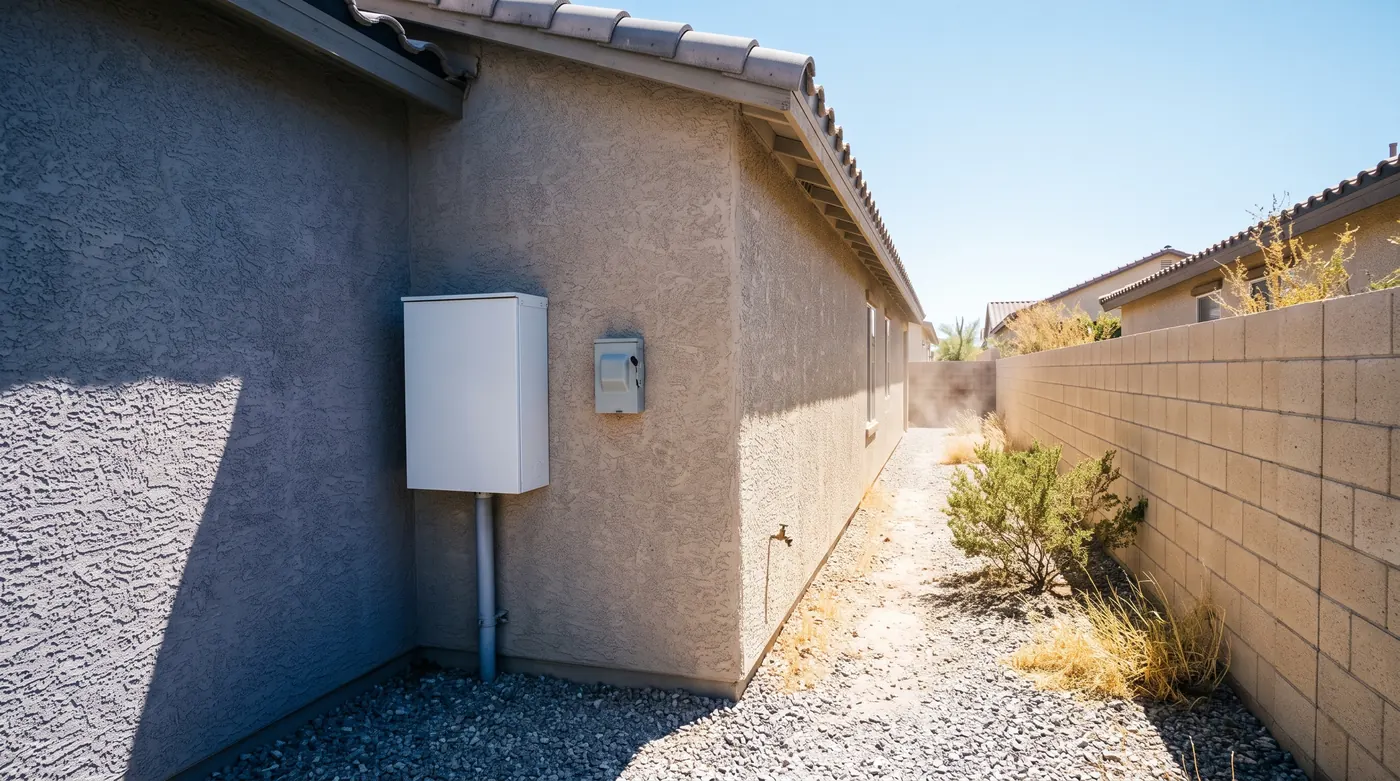
Either can work, and neither is automatically right. The battery datasheets we opened rate their units to operate up to 50°C (122°F) and say power drops as heat climbs past 40 to 45°C. A normal Las Vegas July afternoon is already at 40°C in the shade. So the question is which spot on your property stays coolest and out of the sun, and then which of those spots the code allows.
What the datasheets say about heat
Two makers, two ways of writing it. We are quoting them, not ranking them.
Tesla Powerwall 3. The 2025 datasheet gives an operating range of minus 20°C to 50°C (minus 4°F to 122°F), rates it for indoor and outdoor installation in a NEMA 3R enclosure, and adds a footnote: "Performance may be de-rated at operating temperatures above 40°C (104°F)." The same datasheet gives its 13.5 kWh energy figure at 25°C.
Tesla's installation manual is more direct about hot places. Where temperatures regularly exceed 40°C (104°F), "Tesla recommends installing Powerwall out of direct sunlight, as full sun exposure raises the temperature inside the enclosure above ambient levels." For hot climates it advises indoor installation or, outdoors, "a shaded area with good ventilation." Between 40°C and 50°C, the manual says charging and discharging power may be reduced.
Enphase IQ Battery 5P. The North America datasheet dated May 6 2025 gives an ambient operating range of minus 20°C to 50°C while charging and minus 20°C to 55°C while discharging.
Enphase's technical brief on installation temperatures, revised February 2026, sets out the full power band: charging at maximum power between 15°C and 45°C (59°F to 113°F), discharging at maximum power between 0°C and 50°C (32°F to 122°F). Outside those, the unit charges and discharges at reduced power, which the brief calls derated power. It also notes that the battery module inside the enclosure usually runs about 2°C warmer than the air outside it, and recommends keeping that 2°C as a design margin. The brief says exposure between minus 30°C and 60°C "does not represent a safety risk"; the cost of heat is performance, not safety.
The common thread: heat does not usually stop a listed battery, it slows it. On a hot afternoon a derated battery may deliver less power than its rating, which matters most for the jobs that need power at once: starting an air conditioner in an outage, or holding down a 15 minute peak. The everyday job, discharging through the 6 to 9 pm window, asks for steady power over three hours rather than a burst.
How hot a Las Vegas July actually is
The National Weather Service's 1991 to 2020 normals for Las Vegas put the normal July afternoon high at 104.5°F, which is 40.3°C, and the normal July overnight low at 82.0°F. The record is 120°F, set on July 7 2024.
Put those next to the datasheets:
| °F | °C | |
|---|---|---|
| Normal July high, in the shade | 104.5 | 40.3 |
| Where Tesla says performance may be de-rated | above 104 | above 40 |
| Where Enphase's full power charging band ends | 113 | 45 |
| Record Las Vegas high, July 7 2024 | 120 | 48.9 |
| Top of both published operating ranges | 122 | 50 |
Those are air temperatures, measured in shade. A cabinet in direct afternoon sun runs hotter than the air around it, which is exactly what Tesla's manual warns about. On a normal July afternoon, a battery in the open sun on a west wall is likely past the line where Tesla says performance may be de-rated, and closer to the top of Enphase's full power charging band than the air temperature suggests.
Garage or outside wall
There is no single right answer, because the two spots are hot in different ways.
A shaded outside wall. A north wall, or any wall that sits under a deep overhang through the afternoon, never takes direct sun. It sees the air temperature and not much more, and it cools off at night. This is often the coolest spot on a Las Vegas lot.
An outside wall in the sun. A west or south wall in full afternoon sun is usually the worst spot on the property. It adds solar heating to a 104°F afternoon, exactly the condition both manuals describe.
An attached garage. No direct sun on the cabinet, which helps. But a closed garage with a west facing door collects heat through the afternoon and releases it slowly overnight, so it may stay hotter than a shaded wall for longer. It also brings two practical rules that an outside wall does not: vehicles and separation from the house, both covered below.
We will not give you a number for your garage, because we do not have one and it varies by house. The honest way to decide is to measure it. Put a minimum and maximum thermometer in each candidate spot for a week in July, one in the garage where the battery would hang and one on the wall you are considering outside, and compare the afternoon highs. That week settles more than any rule of thumb.
What the code says about where it can go
Which code applies
Both local jurisdictions have moved to the 2024 International Residential Code. The City of Las Vegas council approved the 2024 codes, including the residential code, the fire code and the 2023 National Electrical Code, on July 16 2025, effective January 5 2026. Clark County lists the 2024 residential code and the 2023 electrical code as effective January 11 2026. We read the Southern Nevada amendments to the 2024 residential code, the Clark County amended version, and found no amendment to the energy storage provisions.
In the 2024 residential code, energy storage sits in Section R330. We could not open the code council's own text of that section; its site refused access. What follows comes from published summaries we did open, and your plan reviewer applies the adopted text, not a summary. If anything here differs from what the reviewer marks up, the reviewer is right.
The rules, as summarised
Not in the living space. The International Association of Electrical Inspectors' summary of the 2021 residential code lists the permitted places as detached garages and accessory structures, attached garages separated from the living space with gypsum wallboard, outside walls at least three feet from doors and windows that open directly into the home, and enclosed utility closets, basements and storage spaces with the required wall and ceiling finish. Sleeping rooms, and closets or spaces opening into them, are out. A 2026 column in the same magazine on the 2024 Section R330 says a unit is exempt from the section only if it is listed and labelled "for use in habitable spaces", and that the listing requires passing the cell level test in UL 9540A.
Tesla's installation manual says the same thing from the product side: "Powerwall is not intended for installation in habitable spaces and living spaces in dwelling units."
How much in one place. Mayfield Renewables' summary of NFPA 855, the fire code standard for stationary storage, gives these residential limits: 20 kWh as the most any single unit may be rated, 80 kWh in total in a garage, accessory structure or outdoors, and 40 kWh in a utility closet or storage space. Units sit at least three feet apart unless UL 9540A test data supports closer spacing.
Detection. The same summary lists fire detection, smoke and heat alarms, among the requirements. Tesla's manual adds that when Powerwall 3 is installed in a dwelling unit, fire detection and protection equipment should be installed in accordance with local building and fire codes.
Vehicles. Storage in a place a car can reach needs protection from impact under the same summary. Tesla's manual says to keep the unit out of the driving path in a garage and, if possible, to mount it on a side wall or above the height of vehicle bumpers.
Rules from the manual that matter here
A few lines from Tesla's site requirements are worth reading with a Las Vegas yard in mind:
- "Ensure that no water sources are above or near Powerwall, including downspouts, sprinklers, or faucets." Drip lines and hose bibs count.
- Keep the area around the unit clear. The manual's clearance page asks for at least 12 inches in front for airflow and more for electrical working space, and notes that "clearance may increase based on local code and/or site conditions."
The permit itself
The City of Las Vegas guidance effective February 15 2024 says solar installations with an energy storage system "will be required to submit for a full plan review and are not eligible for same day issuance." Placement is part of what that review looks at. Clark County, Henderson and North Las Vegas each run their own desk; solar permits in Las Vegas covers which one is yours.
Questions to ask about any proposed location
- Where exactly will it hang, and is that spot in direct sun at 3 pm in July? Ask for a photo of the wall.
- If it is in the garage: is it on a side wall or above bumper height, and is there a barrier where a car could reach it?
- If it is outside: how far is it from the nearest door or window that opens into the house?
- What is above and beside it? Sprinklers, drip lines, downspouts, a hose bib.
- How many kilowatt hours in that one location, and does the plan stay under the limit for that kind of space?
- How is fire detection handled for that room or area?
If you are still working out how much storage you need, how big a home battery do you need in Las Vegas does the sizing arithmetic, including why a battery in a hot spot needs headroom. If you are adding one to panels you already own, adding a battery to existing solar covers NV Energy's approval.
We pick the spot with you, on your property, before anything is drawn, and put the location, the clearances and the reasoning in the written quote.
Questions people ask us
Can a home battery handle Las Vegas summer heat?
Yes, within limits the makers publish. Tesla's Powerwall 3 datasheet rates it to operate up to 50°C (122°F) and says performance may be reduced above 40°C (104°F). The National Weather Service normal July high in Las Vegas is 104.5°F, right at that line in the shade. Placement decides how far past it the battery sits.
Is a garage or an outside wall better for a battery in Las Vegas?
Whichever spot stays coolest and out of direct sun, and that is a measurement, not a rule. Tesla's installation manual recommends keeping the battery out of direct sunlight where temperatures regularly exceed 40°C, because sun raises the enclosure above the air around it. That is why a shaded wall is a common choice. Measure a garage before assuming it is cooler.
Can a battery go inside the house?
Not in the living space, in general. The model residential rules, as summarised for the 2021 code, keep storage out of sleeping rooms and closets opening into them, and allow garages, detached structures, outside walls and suitably finished utility spaces. Tesla's installation manual says Powerwall is not intended for habitable spaces. A unit specifically listed for habitable spaces is an exception.
How far from a window does an outside battery have to be?
The model rules summarised by the International Association of Electrical Inspectors and by Mayfield Renewables put an outside battery at least three feet from doors and windows that open directly into the home. Your plan reviewer applies the adopted 2024 text, so treat three feet as the starting point and ask the reviewer if the wall is tight.
Do I need a permit and plan review for a battery in Las Vegas?
Yes. The City of Las Vegas guidance effective February 15 2024 says solar installations with an energy storage system must go through full plan review and are not eligible for same day permits. Clark County, Henderson and North Las Vegas run their own desks. NV Energy also has to approve battery backup on a grid connected system in advance.
Where these numbers come from
- Tesla, Powerwall 3 datasheet, 2025 edition (operating temperature minus 20°C to 50°C, minus 4°F to 122°F; performance may be de-rated above 40°C, 104°F; indoor and outdoor rated; NEMA 3R; floor or wall mount; energy values at 25°C) checked 2026-09-29
- Tesla, Powerwall 3 Installation Manual with Gateway 3, Powerwall 3 Operating Temperature Range checked 2026-09-29
- Tesla, Powerwall 3 Installation Manual with Gateway 3, Site Requirements and Pre-Installation Guidance checked 2026-09-29
- Tesla, Powerwall 3 Installation Manual with Gateway 3, Choose a Location that Meets Powerwall 3 Clearance Requirements checked 2026-09-29
- Enphase, IQ Battery 5P North America datasheet, DSH-00010-11.0, 2025-05-06 (ambient operating range charging minus 20°C to 50°C, discharging minus 20°C to 55°C) checked 2026-09-29
- Enphase, Temperature guidelines for IQ Battery installation, technical brief TEB-00300-3.0, February 2026 checked 2026-09-29
- National Weather Service Las Vegas, Temperature Overview (1991 to 2020 normals: July normal average maximum 104.5°F; record 120°F on 7/7/2024) checked 2026-09-29
- City of Las Vegas Building and Safety, Industry Advisory, Adoption of the 2024 Code (approved July 16 2025, effective January 5 2026) checked 2026-09-29
- Clark County Building and Fire Prevention, adopted codes (2024 IRC and 2023 NEC effective January 11 2026) checked 2026-09-29
- Southern Nevada Building Officials, Southern Nevada Amendments to the 2024 International Residential Code (Clark County amended) checked 2026-09-29
- UpCodes, Las Vegas Residential Code 2024 based on the Southern Nevada Residential Code 2024, chapter 3 contents (Section R330 Energy Storage Systems) checked 2026-09-29
- IAEI Magazine, UL Question Corner, Residential energy storage systems and 2024 IRC Section 330 compliance, 2026-04-19 checked 2026-09-29
- IAEI Magazine, Doug Smith, Energy storage systems (ESS) installed at dwellings, winter 2024 (2021 IRC R328.4 permitted locations) checked 2026-09-29
- Mayfield Renewables, Fire codes and NFPA 855 for energy storage systems, 2021-12-16 (residential limits under NFPA 855 chapter 15) checked 2026-09-29
- City of Las Vegas, Residential Photovoltaic (PV) Solar Permits, effective February 15 2024 checked 2026-09-29
We recheck this page quarterly. Last checked 2026-09-29. If a number here has moved, tell us and we will fix it the same week.