
Solar Rescue
Pigeons under your solar panels, and what to do about it in Las Vegas
Why the gap under a Las Vegas array fills with pigeons, what the droppings do to a tile roof and to production, what a critter guard is, and who should fit it.
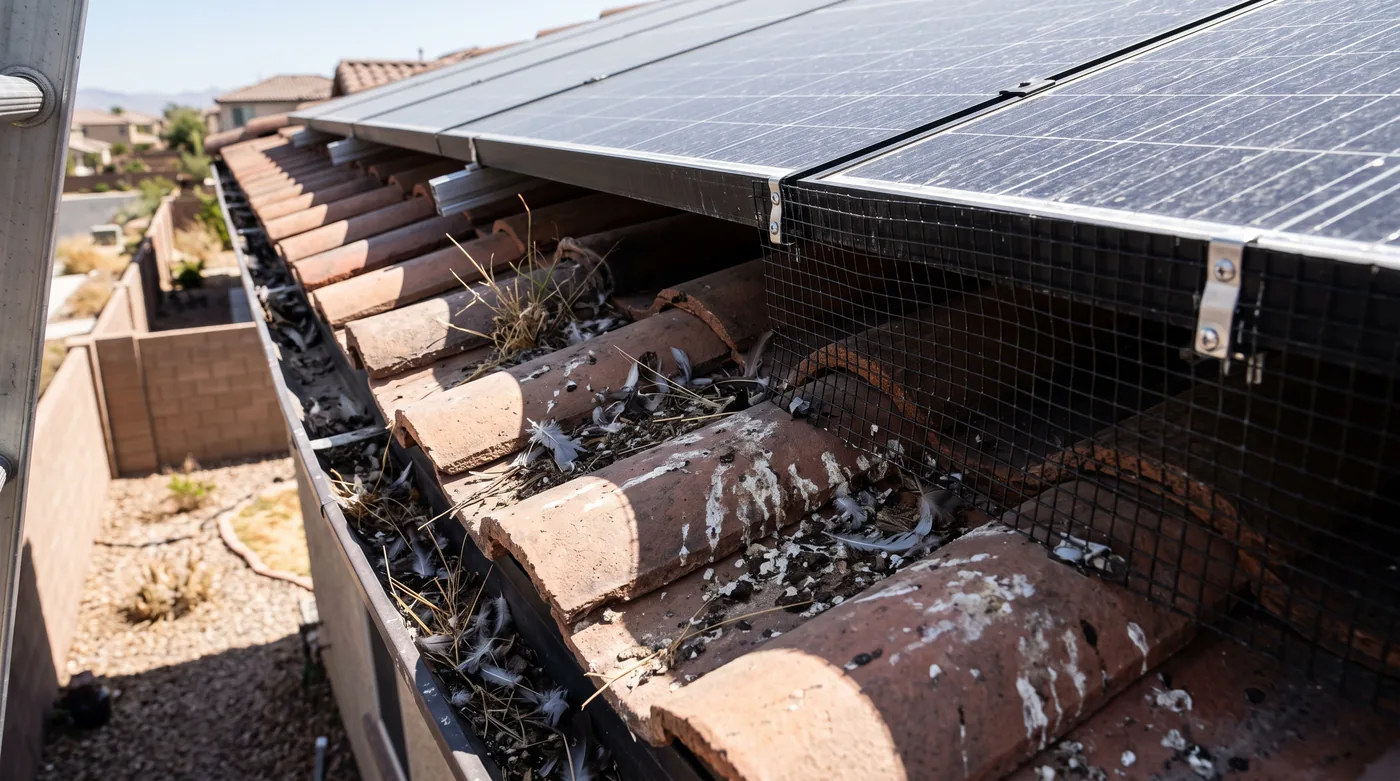
The gap between your panels and your roof is a shaded, sheltered ledge a few inches tall, and in this valley that makes it the best real estate on the building. Birds move in, droppings and nesting material build up under the array, and the fix is a mesh guard clipped around the perimeter after the space is cleaned out. It is roof work on a live electrical array, which is why it is not a weekend job.
Why the space under an array fills up here specifically
A rooftop array creates something that did not exist on your roof before: a long, flat, dry, roofed corridor, open along the sides, sitting a few inches above the tile.
In Las Vegas that corridor has three properties no bird can ignore. It is shaded all day on a surface that is otherwise punishing. It is closed above, so hawks and ravens cannot get at what is in it. And it stays dry, in a climate where dry is the default anyway.
Then the climate does the other half of the work. NOAA's published climate normals for Las Vegas McCarran International Airport put the annual normal precipitation at 4.19 inches. June's monthly normal is 0.07 inches. July and August, the wettest months of the year here, are 0.40 and 0.33.
That number matters more than it looks. In a rainy climate, what accumulates under an array gets flushed a few times a season. Here, nothing flushes. Whatever goes up there stays up there until somebody takes it down.
Know what is living up there before anybody touches it
This is the part that gets skipped, and it is the part with legal consequences.
The bird people usually mean is the feral city pigeon, Columba livia. We read the federal list of birds protected by the Migratory Bird Treaty Act, at 50 CFR 10.13, on this page's checked on date. Columba livia is not on it. Neither is the house sparrow, the European starling or the Eurasian collared dove. The Internet Center for Wildlife Damage Management states the same thing plainly: "Feral pigeons are not protected by federal law and most states do not afford them protection."
But the list is not empty of pigeons, and it is not empty of the other birds that get under arrays. From the same reading of 50 CFR 10.13:
| Under your array | On the federal protected list at 50 CFR 10.13 |
|---|---|
| Rock pigeon, Columba livia | No |
| House sparrow | No |
| European starling | No |
| Eurasian collared dove | No |
| House finch | Yes |
| Mourning dove | Yes |
| Barn swallow | Yes |
| Common raven | Yes |
| Band tailed pigeon, and four other Patagioenas pigeons | Yes |
House finches and mourning doves nest under Las Vegas arrays constantly, and neither one looks like a pigeon to a homeowner standing in the driveway with the sun in their eyes. An active nest belonging to a listed species is a different legal situation from a pigeon roost, and it is the sort of thing you want identified before a crew is on the roof with a pry bar, not after.
So the first step of this job is looking, not clearing.
What the droppings actually do to your roof
The Internet Center for Wildlife Damage Management is direct about it: "These droppings are acidic and can deface and accelerate deterioration of building materials." And separately, "Accumulated droppings can plug the gutters of roofs, causing water damage," and "Nests can obstruct exhaust vents and may cause fires."
Translate that onto a Clark County tile roof and you get a short, specific list of what we find.
- Droppings sitting on the tile and the underlayment, in a strip under the array, never rinsed, for as many years as the array has been up.
- Nesting material packed into the pan of the tile, which is the channel the roof uses to move water. A blocked channel on a roof that sees rain four or five times a year is invisible until the one storm that matters.
- Material in the valleys and at the scuppers, which is where a flat or low slope section actually drains.
- Feathers and nest debris against a vent, which is a different problem in a different trade and is worth saying out loud.
- Tile broken under foot traffic, from whoever went up to look at the birds without knowing how to walk a tile roof.
None of that is dramatic on the day. All of it is a roof repair later, and a roof repair under an existing array is an expensive job because the array has to come off and go back on.
What it does to the numbers on your production
Dust is a film. Droppings are not. They are opaque, they are thick, and they sit on one spot.
That distinction is the whole electrical story, and PVEducation, the reference maintained by Christiana Honsberg and Stuart Bowden, sets out why: "Hot-spot heating occurs when there is one low current solar cell in a string of at least several high short-circuit current solar cells." One shaded cell "reduces the current through the good cells, causing the good cells to produce higher voltages that can often reverse bias the bad cell." In the worst case, "the entire generating capacity of all the good cells is dissipated in the poor cell."
In plain terms: a few square inches of dropping in the wrong place does not cost you a few square inches of output. It drags down a string, and it turns the covered cell into a heater. Modules have bypass diodes to limit how bad that gets, which is exactly why you can have a real problem and a roof that looks fine from the street.
Nesting material has a second effect that gets ignored. A module runs cooler because air moves under it. Pack that gap with twigs and the module runs hotter, and a hotter module produces less.
We are not going to print a production loss percentage. The honest number depends on which cells are covered, which string they are on, and what your inverter does about it. Any figure that does not know your array is a figure somebody made up. What we do instead is read your per string numbers before the work and after it, and hand you both.
If your monitoring went dark because the company that installed the system closed, that is a solvable problem and a separate article: your installer is out of business.
What we will not tell you about your health
Pest control copy in this market leans hard on disease, so here is the careful version.
The illness usually named is histoplasmosis. The Centers for Disease Control and Prevention says Histoplasma "lives in the environment in parts of the United States and the world" and that "the fungus mainly lives in the central and eastern states." It also spreads in bird and bat droppings that mix in soil. Nevada is not the central or eastern states. We are not going to tell you that your Las Vegas roof is giving you histoplasmosis, and you should be wary of anybody who does.
What the wildlife damage literature does support is narrower and worth knowing. The same ICWDM pages say pigeons "may spread Newcastle disease and cryptococcosis," and that "Although rare, people in areas with active roosts can suffer bites from mites that are associated with the birds." Their own handling guidance is to "wear gloves and place nesting material and eggs in a plastic bag for disposal."
That is the accurate picture: a nuisance and a hygiene job that calls for gloves and sense, not an emergency.
What a critter guard actually is
Strip away the product names and it is one idea: close the gap so nothing can get under the array, after making sure nothing is under there already.
The physical form is a mesh, run around the perimeter of the array and held to the aluminium module frames with stainless clips. The specification matches what the wildlife damage handbook recommends for excluding pigeons from any structure: "Screen eaves, vents, windows, doors and other openings with 1/4-inch mesh hardware cloth," and block openings with "1/4-inch rust-proofed wire mesh, or plastic or nylon netting." Quarter inch mesh is small enough to stop a pigeon and a house finch both.
Four things separate a guard that lasts from one that does not, and none of them are about the mesh.
- It clips to the module frame, not to your roof. No new penetrations, no screws into tile, no adhesive stuck to the tile surface. A guard that puts holes in your roof has traded one leak for another.
- The clips are stainless. Everything up there sees full sun, extreme roof surface temperatures and unbroken ultraviolet for two decades. Plated steel clips rust, let go, and leave a flapping mesh edge.
- The space is emptied and cleaned first. Clipping mesh around an occupied array seals birds in. That is both a cruelty problem and, within a few weeks, a much worse smell problem.
- Perimeter is not the same as sealed. Gaps between rows, and the run along the ridge, are separate openings. A guard fitted around three sides because the fourth was awkward is a guard with a front door.
Exclusion is also the only approach that keeps working. The wildlife damage literature treats blocking access as the durable answer, and it is the only one that does not need to be repeated every season.
After a Las Vegas storm, look before you climb
July and August bring what little rain the valley gets, and they bring it sideways with dust in front of it. The morning after is when people go up on roofs and get hurt.
Do this from the ground and from your monitoring, in this order.
- Check production first. One string down, or a whole day at the wrong shape, tells you more than a look from the driveway will.
- Walk the perimeter of the house and look up at the array edge. A guard that has pulled loose shows as a dark gap or a bright line of mesh standing proud of the frame.
- Look at where water leaves the roof. Scuppers, valleys and downspout outlets. If material washed down out of the array, that is where it stops.
- Look for tile fragments on the ground. They come from somewhere.
- Look at the array from two sides for a module sitting at a different angle from its neighbours, which means a clamp or a rail has moved.
- Do not get on a wet or dusty tile roof to check any of this. Dust on glazed tile behaves like ball bearings.
If something has moved, the array is an electrical system that has moved, and the next call is to a licensed electrician rather than to a handyman with a ladder.
Why we will not tell you to do this yourself
Two hazards, both of them ordinary and both of them the reason this trade is licensed.
The array is live. A module makes voltage whenever light falls on it, and there is no switch on the roof that changes that. OSHA's own guidance on solar work says workers "are exposed to potential electrical hazards present in their work environment, which makes them more vulnerable to the danger of electrocution and arc flash hazards," and that "Fatal electrocution is the main hazard." Lifting a module to clean under it is not cleaning. It is work on an energised direct current system.
The roof is high and it is slick. OSHA's fall protection rule requires protection for residential construction work 6 feet or more above lower levels, at 29 CFR 1926.501(b)(13), and the same 6 foot trigger applies to steep roofs at (b)(11). That is the standard a licensed crew works to. It is not the standard a homeowner on a borrowed ladder is working to.
There is a third reason that is not about safety. If your system is still under a workmanship warranty, the party who lifts your modules matters. And if modules are coming off and going back on, the permit question belongs to whichever jurisdiction your parcel sits in, which we set out in solar permits in Las Vegas.
What we do, and the line we do not cross
We are an electrical contractor. Nevada law is specific about what that does and does not cover.
Under NRS 555.2667, pest control includes publicly holding yourself out as being in the business of "detecting, preventing, controlling or exterminating pests or otherwise engaging in, advertising or soliciting for" the use of "pesticides or mechanical devices for the extermination, control or prevention of infestations of pests." Under NRS 555.280, doing that for hire in Nevada requires a licence issued by the state.
We hold a Nevada C-2 electrical contractor licence, number 0032580A. We do not hold a pest control licence and we are not going to write copy that implies otherwise.
So the split is this. We do the array and the roof: lift the modules that need lifting, clean and clear the space underneath, inspect the tile and the underlayment while it is open, refit everything to torque, fit the guard to the module frames, and read your per string production before and after so you can see what changed. Where a job needs a licensed pest control operator, we coordinate one. We do not do their work and we do not bill for it as though we did.
You keep the report either way, whether or not you hire us for anything else.
What we would tell you if you called us today
If you can hear birds over your ceiling in the morning and you have panels, they are almost certainly under the array rather than in the attic, and that is the better of the two problems.
If your roof is 15 years old and your array is 10, get the roof looked at while the modules are off for the clean out, because that is the cheapest hour anyone will ever spend on that roof.
And if the numbers on your system dropped and nobody can tell you why, start there rather than with the birds. Reading your NV Energy bill with solar on it tells you whether the loss is real before anybody gets on a ladder. At the standard residential rate of $0.11935 per kilowatt hour on NV Energy's rate schedule effective July 1 2026, a string that has been down for a season is worth measuring properly rather than guessing at.
Questions people ask us
Why do pigeons nest under solar panels in Las Vegas?
The gap between a module and the roof is a shaded, sheltered, flat ledge a few inches tall, closed on top and open at the sides. In a valley where the roof surface bakes all summer, it is the coolest covered space on the building, and it is out of reach of most predators. Birds find it within a season.
Are pigeons protected, so that I cannot remove a nest?
The feral city pigeon, Columba livia, is not on the federal list of birds protected by the Migratory Bird Treaty Act at 50 CFR 10.13, which we read on this page's checked on date. Several other pigeons are on that list, and so are house finches, mourning doves and barn swallows, which also nest under arrays. Identify before you touch anything.
Do bird droppings reduce solar production?
Droppings are opaque, so they are hard shading rather than a thin film of dust. One shaded cell in a string pulls the current of the whole string down, and Las Vegas gets 4.19 inches of rain in a normal year, so nothing rinses them off. We will not print a percentage, because the honest figure depends on which cells are covered.
What is a critter guard?
A strip of mesh that closes the gap around the perimeter of the array. It clips to the aluminium module frames with stainless clips, so it adds no new holes to your roof. It is exclusion, not extermination. The space has to be emptied and cleaned before it is closed, or birds get sealed inside it.
Can I install bird mesh under my own panels?
We would not. The array makes voltage whenever light is on it, the work happens above 6 feet on a sloped tile roof, and lifting a module to clean under it is electrical work on a live system. OSHA treats both the electrical hazard and the fall hazard as serious. The mesh is the easy part of the job.
Does Simmons do pest control?
No. We hold a Nevada C-2 electrical contractor licence, number 0032580A, not a pest control licence. We do the roof and array work, the clean out, the guard and the production check. Where a job needs a licensed pest control operator, we bring one in rather than pretending the line does not exist.
Where these numbers come from
- United States Fish and Wildlife Service, List of Birds Protected by the Migratory Bird Treaty Act, 50 CFR 10.13 checked 2026-09-20
- Internet Center for Wildlife Damage Management, Pigeons, species page and legal status checked 2026-09-20
- Internet Center for Wildlife Damage Management, Pigeon damage identification checked 2026-09-20
- Internet Center for Wildlife Damage Management, Pigeon damage control and prevention methods checked 2026-09-20
- Centers for Disease Control and Prevention, About histoplasmosis checked 2026-09-20
- NOAA National Centers for Environmental Information, climate normals for Las Vegas McCarran International Airport, station USW00023169 checked 2026-09-20
- PVEducation, Hot spot heating, Honsberg and Bowden checked 2026-09-20
- Occupational Safety and Health Administration, Green Job Hazards, Solar Energy: Electrical checked 2026-09-20
- Occupational Safety and Health Administration, fall protection duty to have, 29 CFR 1926.501 checked 2026-09-20
- Nevada Revised Statutes 555.2667 and 555.280, definition of pest control and licence required checked 2026-09-20
- NV Energy, Nevada Power Company electric rate schedules for residential customers, effective 2026-07-01 checked 2026-09-22
Actual utility rates may go up or down and actual savings may vary. Every figure on this page is an estimate based on the sources listed below, not a promise about your home.
We recheck this page annually. Last checked 2026-09-20. If a number here has moved, tell us and we will fix it the same week.