
Battery backup
Adding a battery to the solar you already have in Las Vegas
You can add a battery to existing solar without losing your net metering rate, if you add storage only. AC or DC coupling, NV Energy review and permits.
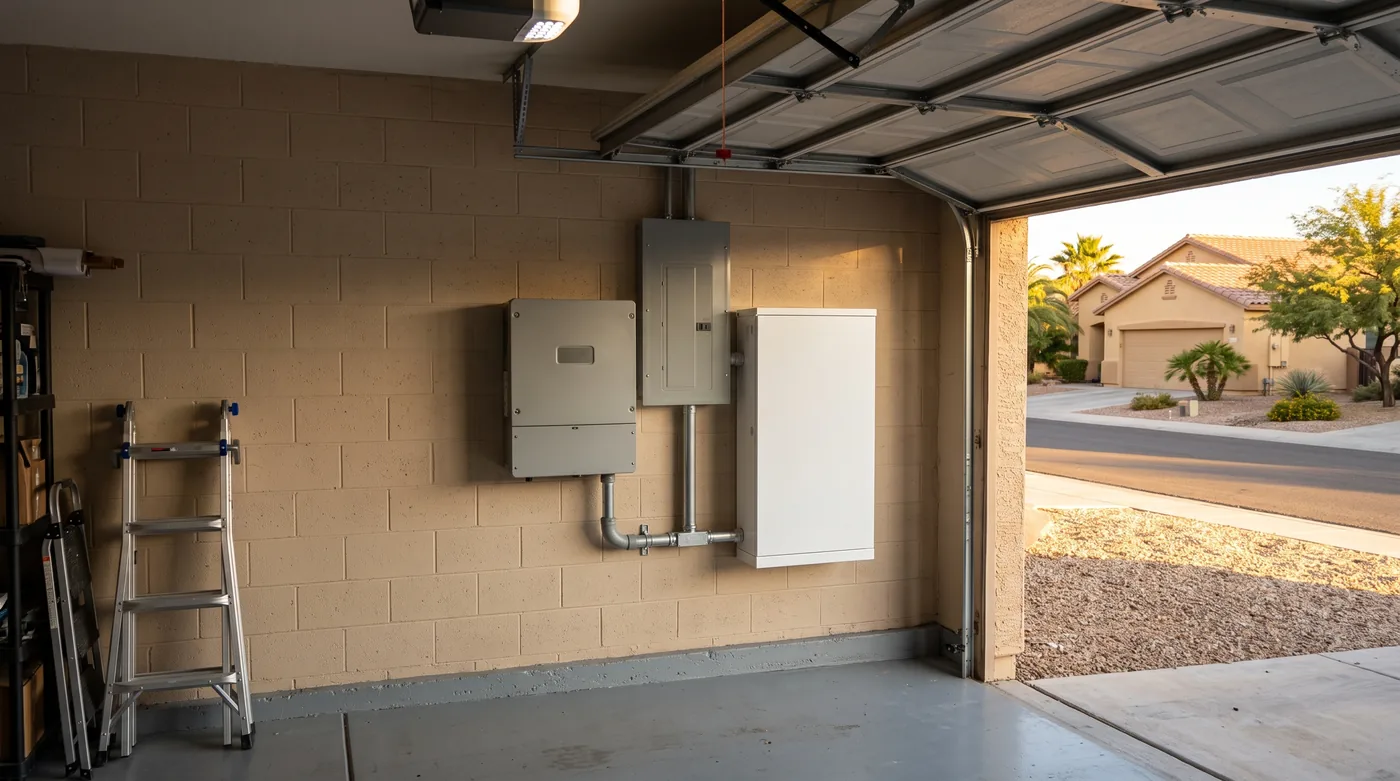
Yes, you can add a battery to the solar you already have, and if you add storage only, NV Energy's own handbook says your net metering rate does not change. The job needs NV Energy's advance approval and a building permit with a full plan review. The main design choice is whether the battery is AC coupled or DC coupled.
Here is what decides each of those, in the order it gets decided.
Your net metering rate is the first thing to protect
If your system was connected years ago, you may be on an older rate that NV Energy has closed to new customers. That rate is usually worth more to you than anything a battery adds, so protect it first.
NV Energy's Net Metering and Energy Storage Interconnection Handbook, in the revision dated 10/16/2025, sets out three cases.
| What you change | What the handbook says happens to your rate |
|---|---|
| Add a battery and nothing else | "A system expansion that only adds an energy storage system and does not add any additional renewable capacity will not result in a net metering rate change." |
| Add panels | An expansion that adds renewable capacity results in a net metering rate change if you are not already on the applicable rate. |
| Replace a failed system or part | A replacement may let you keep a closed rate (NMR G, NMR A, NMR-405 Tier 1, 2 or 3). Every replacement application goes through Engineering Review. |
The practical rule: do not add panels in the same job as the battery unless you have priced what the rate change costs you. If a proposal adds both, ask for the two parts to be quoted separately, and ask in writing which rate you will be on afterwards. What 75 percent of retail actually costs you shows how to put a number on the difference.
AC coupled or DC coupled
This is the one piece of jargon that matters on an existing system.
AC coupled. The battery comes with its own inverter and connects to your house wiring next to the solar inverter you already own. The panels and their inverter keep working as they do today. The battery charges from whatever the house is not using and gives it back later.
DC coupled. The battery and the panels share a single inverter. On a new build that is efficient. On an existing system it usually means taking your current inverter off the wall and replacing it.
Which is better depends on your house, but on an existing system three things usually point to AC coupling:
- Your inverter stays. Nothing that is currently producing has to come out.
- The paperwork stays simple. The change is clearly a storage addition. If a design replaces your inverter too, ask in writing whether NV Energy will treat the application as a storage only expansion or as a replacement, because the handbook sends every replacement through Engineering Review.
- The metering is simpler. The handbook notes that DC coupled storage using a backup load panel gets its own backup load panel meter, installed alongside an energy storage meter. That is not a problem, but it is another item on NV Energy's inspection.
DC coupling can still be the right call, for example when your existing inverter is old, out of warranty or already failing and has to be replaced anyway. If your inverter has already stopped, read what an inverter replacement involves first, because the two decisions should be made together.
What NV Energy has to approve
A battery is not something you can add quietly. The handbook is explicit on four points.
- Advance approval. The use of a battery backup system on a grid connected system requires advance review and approval by NV Energy, so that the system connects safely and everything it produces is recorded accurately on the meter.
- An application with an extra review. The application goes through NV Energy's online portal, PowerClerk. The handbook lists an initial review fee of $189 per application for Southern Nevada. Projects with batteries are routed into a Metering Technical Review, which runs inside the first ten business days of review.
- The battery's own paperwork. Storage applications need the battery's specification sheet showing its energy capacity and its maximum charge and discharge power, and all photovoltaic and storage equipment must carry a UL listing.
- No switching on early. The handbook says systems may not be energized before NV Energy's final verification.
The installer normally files all of this. You should still see the application number and the approval, and keep a copy.
What the city or county has to approve
The building permit is separate from NV Energy's approval, and for a battery it is the slower of the two.
The City of Las Vegas guidance for residential solar permits, effective February 15 2024, says installations with an energy storage system "will be required to submit for a full plan review and are not eligible for same day issuance." A panels only permit can be issued the same day. A battery cannot.
Henderson, North Las Vegas and unincorporated Clark County each run their own permit desks. Solar permits in Las Vegas covers which one your address falls under.
The handbook also points to NFPA 855, the fire code standard for installing stationary energy storage, which is why where the battery goes on your wall or in your garage is decided by code, not by where it looks tidiest.
What a battery actually does for an existing solar house
Your panels already cover most of the daytime. What a battery adds is the evening and the outage.
The evening price window. On NV Energy's time of use plan, the schedule effective October 1 2026 charges $0.46912 per kilowatt hour for summer on peak energy, from 6:01 pm to 9 pm between June 1 and September 30, against $0.07062 off peak. Energy your roof made at noon and the battery holds until 7 pm avoids that evening price. Battery peak hours in Las Vegas runs the arithmetic. That window only exists if you are on the time of use plan; on the standard residential plan the price is the same at every hour.
The demand charge. NV Energy's daily demand charge, $0.14 per kilowatt of your highest 15 minute interval each day, is scheduled for January 1 2027, under appeal to the Nevada Supreme Court. A battery is the one piece of equipment that can hold that peak down. Can a battery get you out of the demand charge? shows how far it can and cannot go.
The outage. Panels alone shut down when the grid goes down. A battery set up for backup keeps selected circuits, or the whole house, running. What a battery does in an outage covers what to back up.
Before you ask anyone for a quote
Gather four things. They make every quote you get comparable.
- Your current net metering rate. It is printed on your NV Energy bill. Write it down.
- Your inverter's make and model, from the label on the unit, and whether it is still producing. How to find out if your system still works walks through the check.
- Twelve months of your usage, ideally with the 15 minute interval data from MyAccount.
- A photo of your main electrical panel with the door open, so the space and the main breaker size are visible.
Then ask each installer three questions in writing: is this AC or DC coupled, will my net metering rate change, and which permit desk and plan review does this go through. We answer all three in the written quote, and if a battery does not make sense for your house we will say so.
If you have no panels at all and are wondering whether a battery alone is worth it, that is a different calculation. See a battery without solar in Las Vegas.
Questions people ask us
Can I add a battery to my existing solar system?
Yes. Most existing systems in the valley can take a battery. The two questions that decide how are whether the battery connects on the AC side with its own inverter, or shares an inverter with your panels on the DC side, and whether your electrical panel has room. Both are answered on a site visit, before anyone quotes you a number.
Will adding a battery change my NV Energy net metering rate?
Not if you add storage only. NV Energy's Net Metering and Energy Storage Interconnection Handbook, revision dated 10/16/2025, says an expansion that only adds an energy storage system, with no additional renewable capacity, does not result in a net metering rate change. Adding panels at the same time is what can move you to the current rate.
Does NV Energy have to approve a battery added to existing solar?
Yes. The same handbook says a battery backup system on a grid connected system needs NV Energy's advance review and approval, and that projects with batteries are routed into a metering technical review. The application goes in through NV Energy's portal, PowerClerk, and the system is not energized on the new configuration until NV Energy's verification is complete.
Do I need a building permit to add a battery in Las Vegas?
Yes. The City of Las Vegas residential solar permit guidance, effective February 15 2024, says installations with an energy storage system must go through a full plan review and are not eligible for same day permit issuance. Clark County and the other cities run their own permit desks, so the jurisdiction your address sits in decides the exact path.
What is the difference between AC coupled and DC coupled?
An AC coupled battery has its own inverter and connects to your house wiring alongside the solar inverter you already own, which normally stays in place. A DC coupled battery shares one inverter with the panels, which usually means replacing the inverter you have. On an existing system, AC coupling is usually the simpler path, and it keeps the change clearly a storage addition.
Where these numbers come from
- NV Energy, Net Metering and Energy Storage Interconnection Handbook, revision dated 10/16/2025 (storage only expansions, system replacements and closed rates, battery backup approval, metering technical review for projects with batteries, the $189 Southern Nevada application fee, DC coupled backup load panel metering, energizing only after final verification) checked 2026-09-28
- City of Las Vegas Building and Safety, Residential Photovoltaic (Solar) Permits, effective February 15 2024, updated 05/29/2024 (installations with an energy storage system require full plan review) checked 2026-09-28
- NV Energy, Nevada Power Company electric rate schedules for residential customers, effective October 1 2026 (optional residential time of use: summer on peak $0.46912 and summer off peak $0.07062 per kWh, summer on peak 6:01 pm to 9 pm June 1 to September 30) checked 2026-09-28
- NV Energy, Southern Nevada Daily Demand, guide and frequently asked questions ($0.14 per kW daily, starting January 2027; read through the site's own content endpoint) checked 2026-09-28
- KTNV, Nevada lawmakers decline taking on NV Energy's daily demand charge, 2026-08-19 (the challenge has been appealed to the Nevada Supreme Court) checked 2026-09-28
Actual utility rates may go up or down and actual savings may vary. Every figure on this page is an estimate based on the sources listed below, not a promise about your home.
We recheck this page quarterly. Last checked 2026-09-28. If a number here has moved, tell us and we will fix it the same week.