
Your NV Energy bill
Your pool pump is probably setting your demand charge
A 1.5 horsepower pool pump pulls about 1,600 watts, and NV Energy's daily demand charge is priced on your worst 15 minutes. Here is the arithmetic.
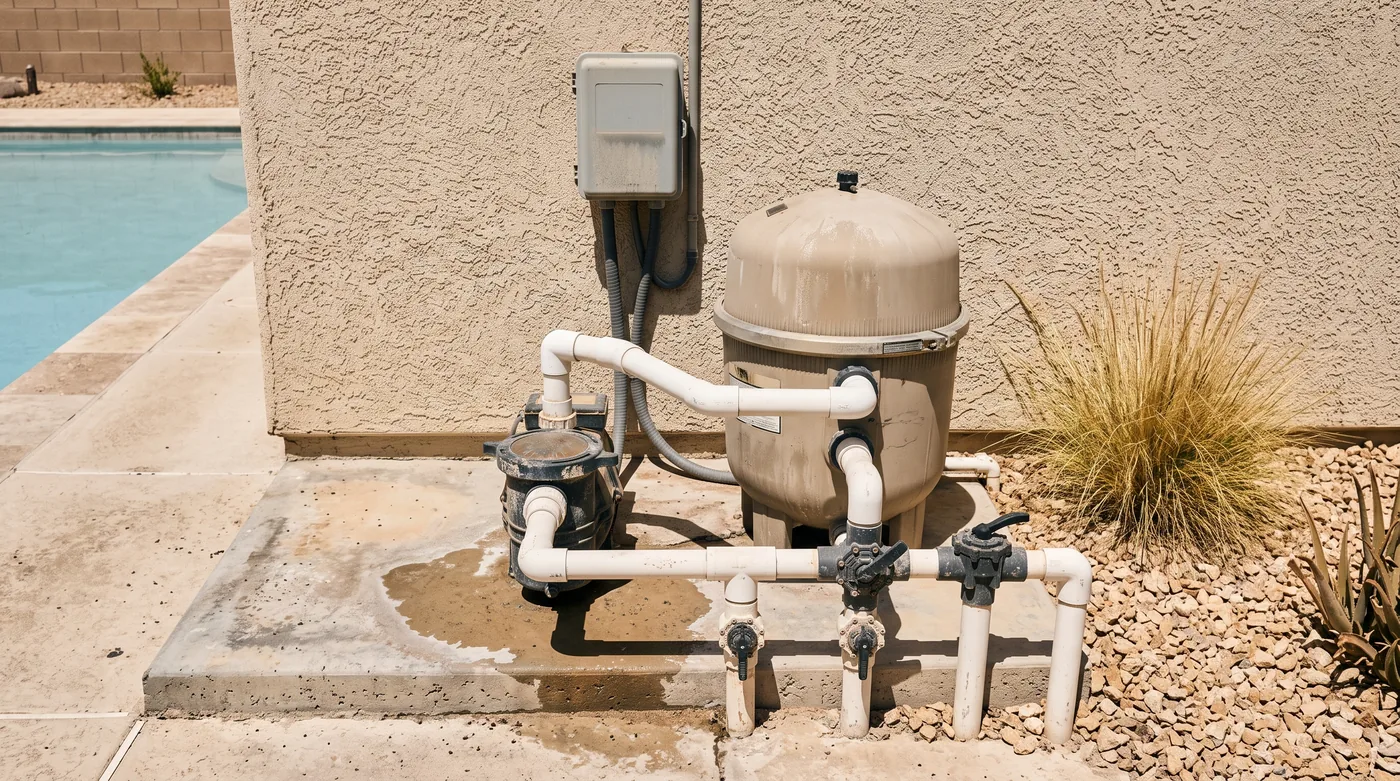
Probably, and you can check it this week. NV Energy's own appliance guide puts a 1.5 horsepower pool pump at 1,600 watts. The daily demand charge is $0.14 for every kilowatt in your single highest 15 minute stretch of the day, scheduled for January 1 2027 and under appeal. If your pump is running inside that quarter hour, it is adding about $0.22 a day to that line, and moving it costs you nothing.
The two numbers, side by side
Almost every confusing thing about this charge goes away once you hold these two facts at the same time.
Your pump is a multi kilowatt instantaneous load. NV Energy publishes a household appliance guide with watts and annual kilowatt hours for common equipment. Two lines from it:
| From NV Energy's household appliance guide | Watts | Annual kWh |
|---|---|---|
| Pool Pump 1.5 hp | 1,600 | 4,608 |
| Pool Pump 2.0 hp | 2,200 | 6,262 |
| Air conditioner, three and one half ton | 6,500 | 10,530 |
| Clothes dryer | 2,790 | 900 |
The demand charge measures instantaneous load. NV Energy's fact sheet, dated June 2026, says daily demand "is calculated based on each customer's highest 15-minute interval of electricity use and this resets every day of the month. These daily peaks are totaled over the billing period."
So one of the largest steady loads on your property is being measured by a charge that prices nothing but size. That is the whole article. The rest is arithmetic.
Two cautions before we use those numbers. The appliance guide carries a 2011 print code and its own footnote: the figures "are average figures based on industry statistics. They do not apply to a particular manufacturer's product and vary depending on individual operation." And 4,608 kilowatt hours a year at 1,600 watts works out to 2,880 hours, or 7.9 hours a day, which is a filtration schedule, not a law of nature. Your pump and your schedule are yours. We will show you how to read both.
What the pump costs on the energy line
This part you are already paying, today, with no new tariff involved.
NV Energy's residential rate schedule effective July 1 2026 puts the standard single family plan at $0.11622 per kilowatt hour for consumption, $0.11935 once the riders are added, with an $18.00 monthly basic service charge.
- 1.5 hp pump, 4,608 kWh a year at $0.11935: about $557 a year.
- 2.0 hp pump, 6,262 kWh a year at $0.11935: about $757 a year.
ENERGY STAR puts it more bluntly than we would: "Your pool pump could be your home's second largest energy user, costing you as much as $310 in energy every year." Their figure is a national average across climates where a pool runs four months. Ours runs most of the year.
What the pump will cost on the demand line
Now add the charge that is scheduled for January 1 2027 and under appeal.
The rate is $0.14 per kilowatt of your daily 15 minute peak. We are going to be precise about where that comes from, because the unit is the thing people get wrong.
The sentence we can quote is The Nevada Independent's, from its May 7 2026 explainer: customers "will be charged 14 cents per kilowatt of power that they use during their highest 15 minutes of usage on a single day." NV Energy's own daily demand landing page states the rate too, but that page does not render its text to anything except a browser, so we are citing the source we could actually open.
It cross checks against NV Energy's own fact sheet, which says "A typical household will see a daily demand total of approximately $0.49 per day." Our arithmetic, not theirs: $0.49 divided by $0.14 is 3.5 kilowatts, which is a plausible typical household peak for this valley. The two figures agree, which is the most we can say without reading the tariff sheet, and the tariff sheet is not out.
Note the unit. Per kilowatt, not per kilowatt hour. If somebody quotes you the cents per kilowatt hour version, the arithmetic that follows will not describe your bill.
Here is the pump, worked all the way through.
| Step | Figure |
|---|---|
| 1.5 hp pump, running | 1.6 kW |
| Rate | $0.14 per kW of the daily 15 minute peak |
| If the pump is inside that quarter hour | 1.6 x $0.14 = $0.22 a day |
| Across a 31 day month | about $6.94 |
| Same for a 2.0 hp pump | 2.2 x $0.14 = $0.31 a day, about $9.55 a month |
And here it is stacked on a July afternoon, which is the case people actually live in.
| July afternoon | Peak kW | Daily demand | 31 days |
|---|---|---|---|
| Three and a half ton condenser alone | 6.5 | $0.91 | $28.21 |
| Condenser plus the pump, overlapping | 8.1 | $1.13 | $35.15 |
| Difference | 1.6 | $0.22 | $6.94 |
Notice that the difference is the same $6.94 in both tables. That is not a coincidence, it is the shape of the charge. Demand is a flat price times a number of kilowatts, so a load that sits inside your peak quarter hour costs the same whether it sits there alone or on top of a condenser.
Which produces the one sentence that matters most on this page.
The pump costs you nothing on that line unless it is inside your worst quarter hour
A charge that only looks at the single largest 15 minutes of the day ignores everything that happens outside it.
If your condenser hits 6.5 kilowatts at 4:30 pm and your pump runs at 11 pm with nothing else on, your daily maximum is still 6.5 kilowatts. The pump contributed nothing to that line. It still cost you on the energy line, every hour it ran, but the demand charge never saw it.
If your pump runs from 10 am to 6 pm because that is what the timer at the equipment pad was set to in 2009, it is inside the worst quarter hour of a Las Vegas summer day almost every day, and you are paying the $6.94 a month for a scheduling accident.
That is why this is the cheapest demonstration of the whole charge. You do not need equipment to fix it. You need to know when the pump runs and when your house peaks.
Summer and winter are two different problems
The valley's two seasons behave differently here and most advice ignores it.
June through September. Your air conditioning is the floor under your peak, and the pump is a passenger on top of it. Moving the pump out of the compressor's worst window removes 1.6 kilowatts from the number the meter records. It does not get you anywhere near the 3.5 kilowatt typical household implied by NV Energy's own $0.49 a day figure, because the condenser alone is roughly twice that.
October through May. The compressor is mostly quiet, and now the pump is a serious candidate for the largest thing your house does all day. At 1.6 kilowatts it is competing with the dryer at 2,790 watts and losing to almost nothing else that runs for a continuous quarter hour. In those eight months, a pool pump genuinely can be the thing that sets your daily demand charge on its own.
Nobody writes the winter half of this, because winter bills are small and nobody is selling anything in February. But the demand charge does not take the winter off.
The clock does not matter, only the overlap does
This is where good intentions go wrong, so we will quote NV Energy directly. Their fact sheet lists what daily demand is not, and the list includes: "A time of use rate."
So "run the pool pump at night to beat the demand charge" is not right as stated. Running it at night helps only because nothing else is running at night, which makes the overlap small. If you charge an electric vehicle at 1 am and the pump joins it, you have simply built a new peak at 1 am and the price is identical.
The rule is not about hours. It is about simultaneity. Put your big loads in single file.
A separate and real evening argument does exist, but it belongs to a different rate: on NV Energy's time of use plan, summer on peak energy runs 6:01 pm to 9 pm at $0.47155 per kilowatt hour against $0.07305 off peak, and there, the clock is the whole story. We set that out in why a battery pays for itself between 6 and 9 pm. Do not mix the two charges up. Most people do.
What half speed actually does, and why it is not a trick
Water is heavy and pumps obey the cube law, which produces a result that sounds made up until you see it measured.
ENERGY STAR states it in one line: "reducing pump speed by one-half allows the pump to use just one-eighth as much energy."
Run the pool turnover at half speed and you need roughly twice the hours, so the energy goes to about a quarter, not an eighth:
- 8 hours at 1.6 kilowatts is 12.8 kilowatt hours.
- 16 hours at 0.2 kilowatts is 3.2 kilowatt hours.
For the demand charge, though, only the first number in each line matters. The peak contribution falls from 1.6 kilowatts to 0.2, which takes the pump's share of daily demand from $0.22 a day to under three cents.
Now the measured version, so you are not taking the cube law on faith. We pulled the ENERGY STAR certified pool pump list on 2026-09-20. It carries 423 models with measured power at defined test points. For the Pentair IntelliFlo VSF, model 011056:
| Pentair IntelliFlo VSF, model 011056 | Speed | Measured input power |
|---|---|---|
| Low speed test point | 1,110 rpm | 114.79 W |
| High speed test point | 2,759.5 rpm | 1,295.05 W |
| Full speed curve point | not stated in the listing | 2,502.49 W |
Same pump. Same pool. About 115 watts or about 2,500 watts, depending entirely on a setting.
Across the 320 in-ground variable speed models on that list, low speed power runs from 71.30 to 164.10 watts, with a median of 117.31. Across the 127 of them that report the full speed curve point, power runs from 766.10 to 2,524.70 watts, median 1,533.00. Those are our counts from that file on that date, and you can pull the same file.
A variable speed pump set to run fast is worse than the pump it replaced
This is the part the equipment sales pitch leaves out, and it is the reason we will not simply tell you to buy a new pump.
That Pentair at its full speed curve point draws 2,502 watts. NV Energy's old single speed 1.5 horsepower figure is 1,600 watts. If a variable speed pump gets installed and then set to run at or near full speed, because that is what made the cleaner work or because nobody went back to tune it, the new pump is a larger contributor to your daily peak than the one it replaced.
The hardware does not do anything on its own. The speed setting does everything. If you already have a variable speed pump, the free move available to you today is to find out what speed it is actually running at.
Why the old pump is still legal and still on your pad
Federal standards changed, and they changed forward only.
Under 10 CFR 431.465(f), each dedicated purpose pool pump that is not a submersible pump and is manufactured starting on July 19 2021 has to meet a minimum weighted energy factor. For the self priming pool filter pump class at 0.711 hydraulic horsepower and above, the floor is a weighted energy factor equal to 6.59 minus 2.30 times the natural log of the rated hydraulic horsepower. ENERGY STAR sets the same floor for that class in its own criteria.
That rule reaches manufacture. It does not reach the pump already bolted to your equipment pad, and it does not require you to replace anything. So the honest situation in a valley full of houses built between 1995 and 2010 is this: a lot of equipment pads still carry a single speed motor that runs at one speed, full speed, every hour it runs, and will keep doing so until it fails.
What to do this week, in order, and none of it costs money
- Go read the pump. The motor nameplate gives you horsepower, volts and amps. Volts times amps divided by 1,000 gives you kilowatts. A 230 volt motor drawing 7 amps is about 1.6 kilowatts. That number is yours, not an average.
- Find out when it runs. The timer or the controller at the pad will tell you. Write down the start and stop times.
- Pull your 15 minute data. NV Energy meters read in 15 minute intervals and that is the same data the charge will bill on. We set out how to get a year of it in how to pull your last 12 months of NV Energy usage.
- Find your worst quarter hour in July and in January, and see whether the pump's run window sits inside it. That single comparison answers the question in the title for your house specifically.
- Move the pump out of the overlap if it is inside. Sequencing is free. The dryer, the oven, the vehicle charger and the pump are all loads you can put in single file. The compressor is the one you mostly cannot.
- If you have a variable speed pump, check the speed, then work down until the pool still turns over and the cleaner still works. ENERGY STAR notes separately that "Running your pool filter only 6 hours a day versus 24 hours, will reduce your energy use by 75%," which is the same lever pointed at the energy line instead of the peak.
What we would tell you if you called us today
We are a licensed Las Vegas electrical contractor, so the pool pump is a load calculation to us before it is a sales opportunity.
If your pump is a single speed unit running in the middle of a summer afternoon, you have a scheduling problem worth about $7 a month on the demand line and several hundred dollars a year on the energy line, and both of those are fixable at the pad, by you, this weekend.
If you have already moved it and your peak is still high, the thing setting it is almost certainly a condenser, or two condensers overlapping, and that is a different conversation. We go through what storage can and cannot do about a peak in can a battery get you out of the demand charge, including the cases where it does not pay for itself.
And if somebody offers to sell you a pool pump to beat the demand charge, ask them what speed they intend to run it at, and what they think your peak quarter hour is today. If they cannot answer the second question, they have not looked at your data.
Questions people ask us
How much electricity does a pool pump use in Las Vegas?
NV Energy's own household appliance guide lists a 1.5 horsepower pool pump at 1,600 watts and 4,608 kilowatt hours a year, and a 2.0 horsepower pump at 2,200 watts and 6,262 kilowatt hours. At the standard residential rate of $0.11935 per kilowatt hour that is about $557 and $757 a year on the energy line alone.
Can a pool pump really set my daily demand charge?
It can, and in the eight months a year your air conditioning is mostly off it very often does. A 1.6 kilowatt pump running through a full quarter hour is a strong candidate for the largest thing your house did that day. In summer it usually stacks on top of the compressor instead.
How much does the pool pump add to the daily demand charge?
The rate is $0.14 per kilowatt of your highest 15 minute average each day. A 1.6 kilowatt pump inside that quarter hour adds $0.22 a day, about $6.94 across a 31 day month. If the pump runs at a time that is not your daily maximum, it adds nothing to that line at all.
Does running the pool pump at night avoid the demand charge?
Only if the night is not when your peak happens. NV Energy's fact sheet lists what daily demand is not, and a time of use rate is on that list, so the hour on the clock carries no price of its own. What matters is whether the pump is inside the one quarter hour that turned out to be your largest that day.
Is a variable speed pool pump worth it for the demand charge?
It depends entirely on the speed you run it at. The same certified pump measures about 115 watts at 1,110 revolutions per minute and about 1,295 watts at 2,760. Run at low speed it nearly disappears from your peak. Run at full speed it is a bigger load than the single speed pump it replaced.
When does the daily demand charge start?
It is scheduled for January 1 2027 in Southern Nevada and it is under appeal to the Nevada Supreme Court. It is not on the residential rate schedule that took effect July 1 2026, which we read on this page's checked on date and which contains no demand line at all.
Where these numbers come from
- NV Energy, Daily Demand fact sheet PDF, dated 2026-06 checked 2026-09-20
- NV Energy, Household Appliance Guide, watts and annual kWh by appliance checked 2026-09-20
- NV Energy, Nevada Power Company electric rate schedules for residential customers, effective 2026-07-01 checked 2026-09-22
- The Nevada Independent, What is NV Energy's daily demand charge and how will it affect customers, 2026-05-07 checked 2026-09-20
- ENERGY STAR, Certified Pool Pumps product list, measured power at each test point checked 2026-09-20
- ENERGY STAR, Pool Pumps product page, run time and speed guidance checked 2026-09-20
- ENERGY STAR, Pool Pumps key product criteria, weighted energy factor requirements checked 2026-09-20
- United States Department of Energy, energy conservation standards for dedicated-purpose pool pumps, 10 CFR 431.465(f) checked 2026-09-20
Actual utility rates may go up or down and actual savings may vary. Every figure on this page is an estimate based on the sources listed below, not a promise about your home.
We recheck this page quarterly. Last checked 2026-09-20. If a number here has moved, tell us and we will fix it the same week.