
Net metering and the daily demand charge
Can a battery get you out of the demand charge?
A home battery is the only thing that shaves a 15 minute peak, but it will not remove the charge. The honest arithmetic, with NV Energy's own figures.
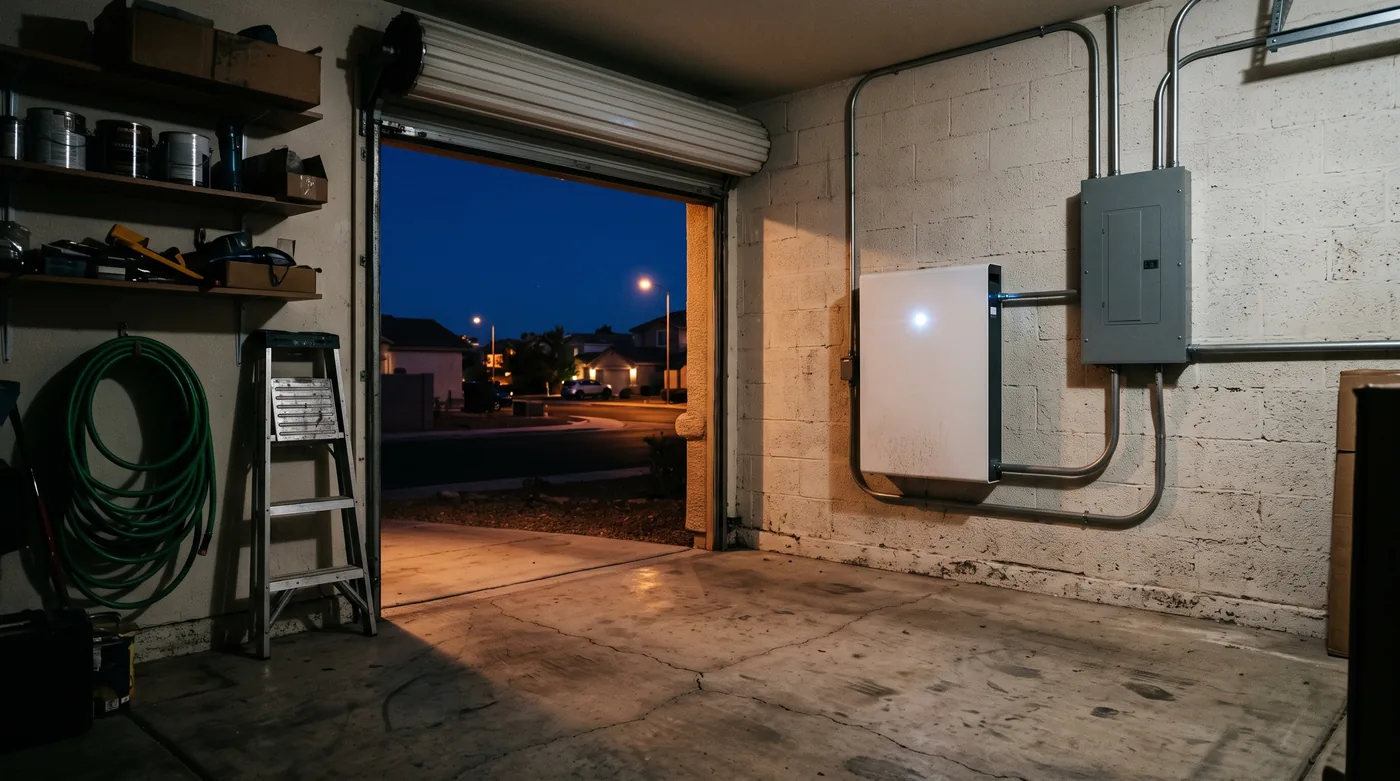
A battery is the only thing in a house that can hold down a 15 minute peak without you changing how you live. It will not remove NV Energy's daily demand charge. It lowers the number the charge is measured on, up to the battery's own power rating, and only while it has charge left. Here is the arithmetic.
Start with what the charge is measuring
NV Energy's daily demand charge, explained in full here, is $0.14 per kilowatt of your highest 15 minute interval, every day, totalled across the billing period. It is scheduled for January 1 2027 and it is under appeal to the Nevada Supreme Court.
Two properties of that definition decide everything a battery can do about it.
It is priced on power, not energy. Cutting your monthly kilowatt hours does not touch it. Only the height of your worst quarter hour does.
It is flat across the clock. NV Energy's own frequently asked questions say this is not a time of use rate, that the cost is the same every hour of every day, and that it makes no difference whether your maximum use happens at 2 in the morning or at a quarter to seven in the evening.
That second point is the one that trips up battery advice written for other states. A battery configured only to cover an evening price window will sit still through a midday peak, and a midday peak costs exactly the same as an evening one.
Why a battery is the only tool that touches it
Everything else you can do about a peak involves not doing something. A battery is different because it can supply the house from storage at the moment the house asks, so the meter never sees the draw.
Think of it as a ceiling. You pick a grid draw you do not want to exceed, say 4 kilowatts. Every time the house wants more than that, the battery makes up the difference and the meter keeps reading 4. Your demand charge for that day is 4 kilowatts times $0.14, which is 56 cents, no matter what the house was actually doing.
That is genuinely the whole mechanism, and nothing else in a home does it.
The arithmetic, on a house that is not average
NV Energy puts the typical Southern Nevada home near 3.5 kilowatts and expects an average bill impact between $15 and $20 a month. If your peak really is 3.5 kilowatts, a battery is not the answer to this charge and we would tell you so.
The houses where this matters are the ones with two condensers, or a vehicle charger, or a pool pump that overlaps with the air conditioning. Take a house that hits 8 kilowatts for a full quarter hour on a summer afternoon.
| Peak | Per day | 31 day month | |
|---|---|---|---|
| No battery | 8.0 kW | $1.12 | $34.72 |
| Ceiling held at 4 kW | 4.0 kW | $0.56 | $17.36 |
| Difference | 4.0 kW | $0.56 | $17.36 |
Four summer months of that is roughly $69. Winter peaks are lower, so the rest of the year contributes less. Call the whole year somewhere in the low hundreds of dollars against this one charge, on a house with a genuinely high peak.
Say the quiet part out loud: that number alone does not pay for a battery. It is one line in the case, not the case. The evening price argument on NV Energy's time of use plan, where summer on peak energy runs $0.47155 per kilowatt hour against $0.07305 off peak, is a much larger number, and backup during an outage is a value that does not appear on a bill at all. Any honest battery quote adds those up rather than resting on one of them.
The two limits that decide how deep you can shave
Power rating. A battery can only fill a gap as wide as its output. Tesla's Powerwall 3 datasheet lists a nominal AC output of up to 11.5 kilowatts per unit and supports up to four units. If your house pulls 9 kilowatts and the battery can deliver 5, the grid supplies the other 4 and the meter records it.
Stored energy, and what else is competing for it. Holding a 4 kilowatt gap for one 15 minute block costs only 1 kilowatt hour, so a single peak is trivial. The problem is that you do not know in advance which quarter hour will be the worst one, so the battery has to hold the ceiling all afternoon. Five hours of averaging 2 kilowatts of support is 10 kilowatt hours, and a Powerwall 3 is listed at 13.5 kilowatt hours nominal. Now ask that same stored energy to also carry the 6:01 pm to 9 pm price window and to keep a reserve for outages, and you can see how the three jobs compete for one tank.
This is why battery sizing here is a real calculation against your own interval data, not a number off a price list. Two houses on the same street with the same annual usage can need different systems, because one of them runs its big loads together and the other does not.
There is a second reason the energy budget matters. A battery that has been discharging to hold a ceiling all afternoon has to recharge before it can do it again, and in summer the only cheap window to recharge from the grid is overnight. On a house with panels it recharges from the roof during the day, which is free but which also competes with the energy you would otherwise have exported. None of that is a reason to avoid storage. It is a reason to want the sizing done against your own numbers rather than against a brochure.
What we cannot tell you yet, and will not pretend to
No home battery sold today is configured against a charge that does not exist yet. The control settings available now are built around time of use pricing and backup reserve, not around a flat daily demand charge measured on a 15 minute window.
So when you are shopping, ask the question in writing: what exactly will this system do on January 1 2027, and who changes the setting? If the answer is a shrug or a promise, that is your answer. We put ours in the written quote and we will update your settings when the tariff is live, at no charge, because we expect to still be here.
The free things you should do anyway
Sequencing costs nothing and works, because the charge is priced on things happening at the same time.
- Put the dryer, the oven and the dishwasher on different parts of the day rather than the same hour.
- Set the vehicle charger to start after the house has quietened down. A Level 2 charger is a large steady load and it will set your peak if it overlaps with a condenser.
- Run the pool pump outside the hottest part of the afternoon, when the air conditioning is already at full tilt.
- Leave the air conditioning alone. It is the load you cannot sequence, and it is usually the floor under your peak rather than the thing sitting on top of it.
A load controller can enforce some of this for you. It is cheaper than storage and it deserves to be on the table. What it cannot do is help with the load you refuse to interrupt, which in August in Las Vegas is the air conditioning, which is exactly why a battery is the only thing that reaches the rest of the way.
Two rules from NV Energy's own handbook
Both of these come from the Net Metering and Energy Storage Interconnection Handbook, revision 10/16/2025, and both change decisions.
Adding storage on its own does not move your net metering rate. The handbook: "A system expansion that only adds an energy storage system and does not add any additional renewable capacity will not result in a net metering rate change." Adding panels is the thing that moves you. If you are sitting on an older tier, that distinction is worth real money.
Battery backup needs approval before it goes in. The handbook says the use of a battery backup system on a grid connected system requires advance review and approval by NV Energy. That is part of the permitting and interconnection work we handle, and it is a reason a battery job takes longer than a panels-only job.
One more thing worth knowing before anyone quotes you: NV Energy's residential storage incentive stopped accepting new applications in June 2023 and has not reopened, and Nevada does not exempt residential solar from sales tax or from property tax. A battery here stands on its own arithmetic.
So, can a battery get you out of it?
No. It can get you under it.
If your peak is near the 3.5 kilowatts NV Energy quotes, do nothing about this charge. If your peak is 8 or 10 kilowatts because two condensers and a charger overlap, a battery is the only thing that reaches it, and it is worth pricing against the evening window and backup at the same time rather than on its own.
Pull your own 15 minute usage out of MyAccount, find your worst quarter hour in July, and multiply by $0.14. That is the only number that describes your house. We will do it with you, free, and tell you if the answer is that you do not need us.
Questions people ask us
Will a battery eliminate NV Energy's daily demand charge?
No. A battery can lower the peak the charge is measured on, which lowers the number, but the line stays on your bill. Anyone promising the charge disappears is overselling. What a battery does is hold your grid draw under a ceiling, and only up to its own power rating and only while it has charge left.
How much can a battery realistically take off the demand charge?
It depends entirely on how far it can hold your peak down. Every kilowatt you shave is worth 14 cents a day, so a 4 kilowatt reduction held every day of a 31 day month is about $17 for that month. Summer months are worth more than winter ones because the peaks are bigger.
Does a load controller work instead of a battery?
A controller can stop two big loads from running at the same time, and that genuinely helps because the charge is priced on simultaneity. It cannot help with the load you cannot interrupt, which in Las Vegas is usually air conditioning. Sequencing is free and worth doing whether or not you add storage.
Does adding a battery change my net metering rate?
No. NV Energy's interconnection handbook is explicit: a system expansion that only adds energy storage, without adding generating capacity, does not result in a net metering rate change. Adding panels is the thing that moves you. The handbook also says battery backup on a grid connected system needs NV Energy's advance review and approval.
Is there still a rebate for a home battery in Nevada?
No. NV Energy ran a residential storage incentive, and it stopped accepting new applications in June 2023. It has not reopened. Nevada also does not exempt residential solar from sales tax or from property tax, so any battery quote you are given has to stand on its own arithmetic.
Where these numbers come from
- NV Energy, Southern Nevada Daily Demand, guide and frequently asked questions checked 2026-09-19
- NV Energy, Daily Demand fact sheet PDF, dated 2026-06 checked 2026-09-19
- NV Energy, Nevada Power Company electric rate schedules for residential customers, effective 2026-07-01 checked 2026-09-22
- NV Energy, Net Metering and Energy Storage Interconnection Handbook, revision 10/16/2025 checked 2026-09-19
- Tesla, Powerwall 3 datasheet, 2025 edition checked 2026-09-19
- EnergySage, Nevada solar rebates and incentives, updated 2026-01-06 checked 2026-09-19
- The Nevada Independent, What is NV Energy's daily demand charge and how will it affect customers, 2026-05-07 checked 2026-09-19
- KTNV, Nevada lawmakers decline taking on NV Energy's daily demand charge, 2026-08-19 checked 2026-09-19
Actual utility rates may go up or down and actual savings may vary. Every figure on this page is an estimate based on the sources listed below, not a promise about your home.
We recheck this page monthly. Last checked 2026-09-19. If a number here has moved, tell us and we will fix it the same week.