
Battery backup
A home battery without solar panels in Las Vegas
A battery with no panels can keep your lights on in an outage and shift summer evening use on NV Energy's time of use plan. What it can and cannot save you.
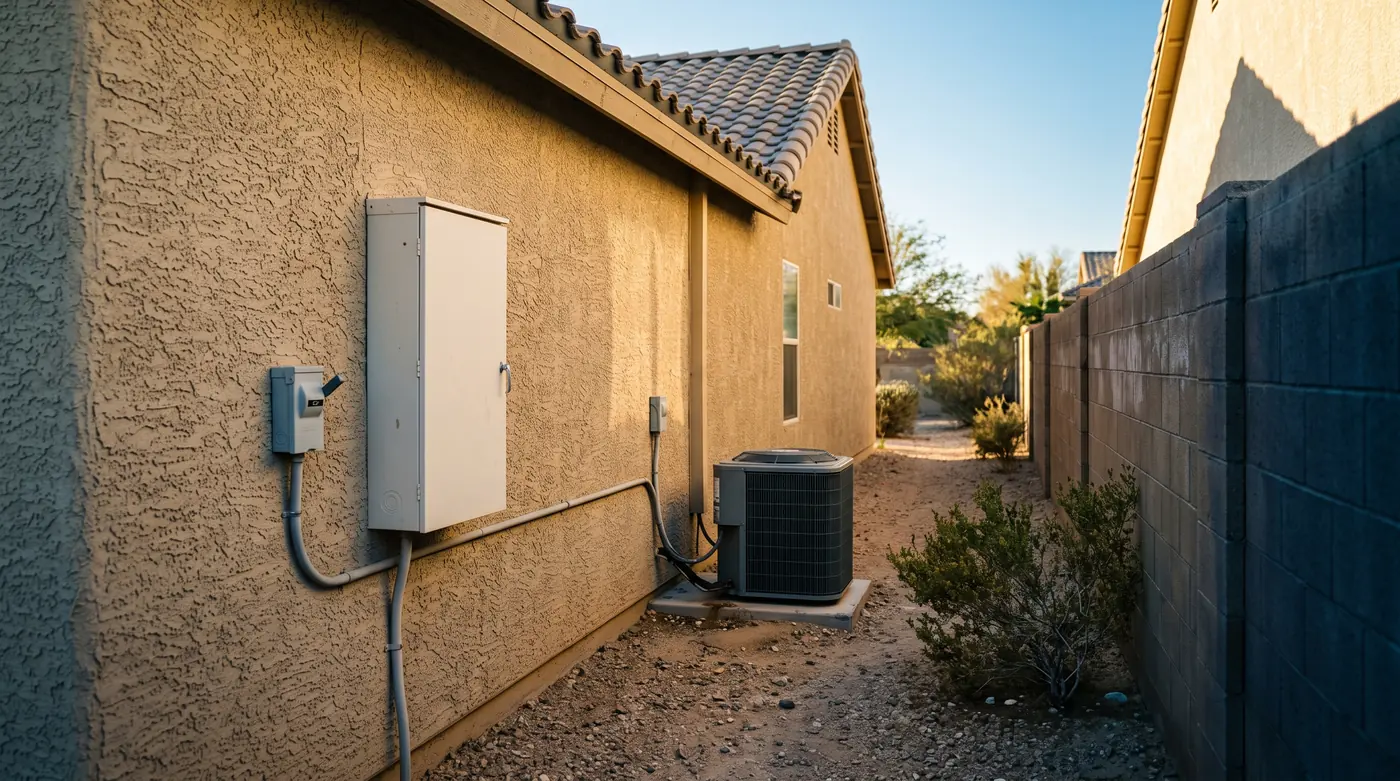
Yes, you can put in a home battery with no solar panels. In Las Vegas it does two useful things: it keeps chosen circuits running in an outage, and on NV Energy's time of use plan it can move summer evening use to cheaper hours. It cannot make energy, so it never lowers the total you buy. Whether it pays depends on which of those you need.
What a battery with no panels is
It is the same battery you would pair with solar, charging from the grid instead of from a roof. It sits on a wall in the garage or outside, connects to your electrical panel, and follows whatever schedule it is set to: charge when power is cheap, give it back when power is expensive, and keep a reserve for when the grid is down.
Everything it gives back it first bought from NV Energy, plus a little extra, because every battery loses some energy going in and coming out. The maker's datasheet states how much. So the only ways it saves money are by buying at a cheaper hour than it sells to your house, or by holding down a peak you are charged for.
Job one: backup
This is where a battery without solar earns its place most clearly.
When the grid goes down, a battery set up for backup isolates your house from the grid and keeps running the circuits it was wired to cover. Refrigerator, internet, lights, a medical device, a garage door. Without panels it cannot refill itself until the grid returns, so the size of the battery against the size of those circuits decides how long it lasts.
That makes circuit choice the whole design. A battery covering a refrigerator and a few lights lasts a long time. A battery asked to run central air conditioning in August does not. What a battery does in an outage walks through which circuits to back up and why air conditioning changes everything.
Job two: the summer evening price
On NV Energy's time of use plan, the schedule effective October 1 2026 prices summer energy in two blocks, and winter in one:
| Period | Hours | Price per kWh |
|---|---|---|
| Summer on peak | 6:01 pm to 9 pm daily, June 1 to September 30 | $0.46912 |
| Summer off peak | All other summer hours | $0.07062 |
| Winter | All hours, October to May | $0.08415 |
A battery charged overnight at the off peak price and emptied into the house between 6:01 pm and 9 pm avoids the on peak price for whatever it covers. On that plan the gap is roughly 40 cents on every kilowatt hour it shifts.
Now the limits, because they are the part most battery pitches leave out.
- It only works four months a year. From October to May the time of use plan charges the same price at every hour, so there is nothing to shift.
- It only works on the time of use plan. On NV Energy's standard residential plan the price is the same at every hour, all year.
- The numbers move. NV Energy resets these rates several times a year, and the October 1 2026 figures above replaced the July ones. The shape stays; the exact figures do not, so check the schedule in force before you run your own arithmetic.
The October 2026 rate sheet also carries a Time-of-Use Guarantee. At the end of your first year on the time of use plan, NV Energy compares what you paid for energy with what you would have paid on the standard plan, and credits the difference if the time of use plan cost you more. That lowers the risk of trying it.
Battery peak hours in Las Vegas runs this arithmetic in detail for a house with panels. Without panels the evening saving is the same per kilowatt hour shifted, but the battery has to buy all of its charge from the grid.
Job three: the daily demand charge
NV Energy's daily demand charge is $0.14 per kilowatt of your highest 15 minute interval each day, totalled across the bill. It is scheduled for January 1 2027, under appeal to the Nevada Supreme Court.
NV Energy's own frequently asked questions say it is not a time of use rate: the price is the same whether your peak lands at 2 am or at 6:45 pm. NV Energy puts the average Southern Nevada peak near 3.5 kilowatts, about $0.49 a day.
A battery can cover the top of a peak so the meter sees less of it, and that works the same with or without panels. The difference is the recharge. A battery with no roof refills from the grid, and if it refills fast at the wrong moment it can set a new peak of its own. The charging schedule has to be set with that in mind.
Before spending money on storage for this charge, look at the free and cheaper options. A load controller before a battery explains when separating two big loads does most of the work, and can a battery get you out of the demand charge? shows what storage adds on top.
The approvals are the same as with solar
A battery with no panels is still interconnected with the grid, so NV Energy treats it seriously.
NV Energy's Net Metering and Energy Storage Interconnection Handbook, in the revision dated 10/16/2025, lists an Energy Storage Only application next to the solar ones, and defines an energy storage device as a generator for the purposes of the handbook. It says the use of a battery backup system on a grid connected system requires advance review and approval by NV Energy, routes projects with batteries into a metering technical review, and requires a UL listing on storage equipment.
The building permit is separate. The City of Las Vegas guidance, effective February 15 2024, says installations with an energy storage system must go through a full plan review and are not eligible for same day issuance. Other cities and the county run their own desks; solar permits in Las Vegas covers which one is yours.
So, is it worth it without panels?
Put the three jobs side by side.
| Job | Worth it without panels? |
|---|---|
| Backup in an outage | Often yes. It is the quiet, no fuel way to keep essentials running. |
| Summer evening price | Only on the time of use plan, only June to September, and only on what it shifts. |
| Daily demand charge | Possibly, on a house with a high peak, once the cheaper fixes are done. |
If backup is what you want, a battery without panels is a reasonable purchase on its own terms. If saving money is the only goal, the case is thin, because four summer months of evening shifting has to carry the whole cost.
If you are likely to add panels later, say so on day one, so the battery you buy now can take them. Adding a battery to solar you already have covers the reverse case.
We will pull your 15 minute usage from MyAccount with you, price it on both NV Energy plans, and tell you plainly which of the three jobs your house actually needs. Any quote we give you is in writing, after that.
Questions people ask us
Can you have a home battery without solar panels?
Yes. A battery charges from the grid instead of from a roof. It still does two useful things in Las Vegas, keeping chosen circuits running when the power goes out and shifting summer evening use to cheaper hours on NV Energy's time of use plan. What it cannot do is make energy, so it never lowers the total you buy.
Does NV Energy have to approve a battery with no solar?
Yes. NV Energy's Net Metering and Energy Storage Interconnection Handbook, revision dated 10/16/2025, lists an Energy Storage Only application alongside the solar ones, and says battery backup on a grid connected system needs advance review and approval. It also treats a storage device as a generator for the purposes of the handbook, so it is interconnected, inspected and metered.
Can a battery without solar save money on NV Energy's time of use plan?
Only in summer. On NV Energy's time of use plan, the schedule effective October 1 2026 charges $0.46912 per kWh on peak from 6:01 pm to 9 pm, June 1 to September 30, and $0.07062 off peak. From October to May every hour costs the same, $0.08415, so there is nothing to shift. The battery also loses some energy in each round trip.
Will a battery help with NV Energy's daily demand charge?
It can lower it. The charge is $0.14 per kilowatt of your highest 15 minute interval each day, scheduled for January 1 2027, under appeal to the Nevada Supreme Court. A battery can cover the top of a peak so the meter sees less. It works the same with or without panels, but a battery with no roof has to recharge from the grid.
Is a battery without solar worth it?
For backup, often yes, because there is no other quiet way to keep a refrigerator and medical equipment running through an outage. For money alone, usually not, because the evening saving exists only four months a year. The honest test is your own interval usage priced against your own plan, which we will do with you.
Where these numbers come from
- NV Energy, Nevada Power Company electric rate schedules for residential customers, effective October 1 2026 (optional residential time of use: winter $0.08415, summer on peak $0.46912, summer off peak $0.07062 per kWh, summer on peak June 1 to Sept. 30, 6:01 p.m. to 9 p.m.; and the Time-of-Use Guarantee) checked 2026-09-28
- NV Energy, Net Metering and Energy Storage Interconnection Handbook, revision dated 10/16/2025 (Energy Storage Only application, storage device treated as a generator, battery backup approval, metering technical review, UL listing, NFPA 855) checked 2026-09-28
- NV Energy, Southern Nevada Daily Demand, guide and frequently asked questions ($0.14 per kW daily, the 3.5 kW typical peak and about $0.49 a day, not a time of use rate, starting January 2027; read through the site's own content endpoint) checked 2026-09-28
- NV Energy, Daily Demand fact sheet PDF (highest 15 minute interval, daily reset, effective January 1 2027) checked 2026-09-28
- KTNV, Nevada lawmakers decline taking on NV Energy's daily demand charge, 2026-08-19 (the challenge has been appealed to the Nevada Supreme Court) checked 2026-09-28
- City of Las Vegas Building and Safety, Residential Photovoltaic (Solar) Permits, effective February 15 2024, updated 05/29/2024 (installations with an energy storage system require full plan review) checked 2026-09-28
Actual utility rates may go up or down and actual savings may vary. Every figure on this page is an estimate based on the sources listed below, not a promise about your home.
We recheck this page quarterly. Last checked 2026-09-28. If a number here has moved, tell us and we will fix it the same week.