
Around the valley
Solar panels in Summerlin, NV
In Summerlin the design review office sees your solar plans before any permit desk does, and your village decides whether that desk is the city or the county.
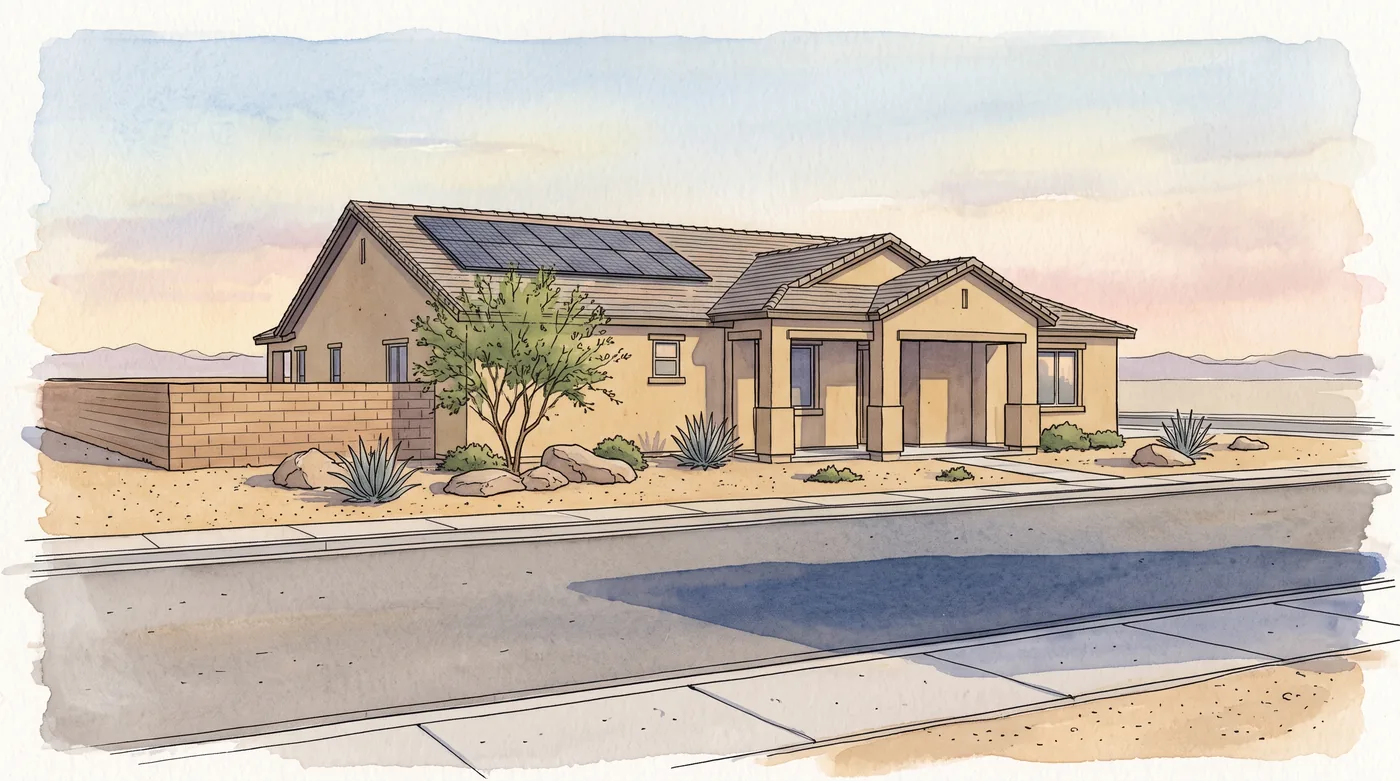
In Summerlin, solar has three approvals, not two, and the first one is not a government office. Your community association's Design Review Committee reviews the plans, then either the City of Las Vegas or Clark County issues the permit depending on which part of Summerlin you live in, then NV Energy interconnects. We are Simmons Solar Electric, a licensed Nevada electrical contractor under licence 0032580A, and we prepare the design review submission as well as the permit.
Which Summerlin you live in decides your permit desk
Summerlin is not one association and not one jurisdiction. The design guidelines for Summerlin North, Summerlin South and Summerlin West are posted separately, and each one says out loud which government you will be dealing with.
The Summerlin North guidelines, effective January 1, 2025, have a section titled "Approval of Design Review Committee vs. City", and they say materials left in the street are subject to City of Las Vegas ordinances. Summerlin West's guidelines, updated October 2022, also point to City permits. The Summerlin South guidelines, updated February 2019, have the same section titled "vs. County" instead, and point to Clark County ordinances. The Census Bureau treats Summerlin South as a census designated place, which is the label it uses for a community that is not an incorporated city.
That split matters because the two desks work differently:
- City of Las Vegas. Under the city's Residential Photovoltaic (Solar) Permits sheet, effective February 15, 2024, a licensed electrical contractor can get a residential array with no battery and no ballasted racking issued the same day online, by uploading electrical plans and a load calculation. Add a battery and the job goes to full plan review.
- Clark County. The county permits under policy BD-PP-206, revised April 30, 2026. Its thresholds are different: no electrical plan review for a system that does not exceed 5 kW, and engineer designed plans at 25 kW DC and above.
The Summerlin guidelines are explicit about the overlap: committee approval does not waive the permit, and a permit does not waive committee approval. Every step in both processes is in our permit guide.
What Summerlin North actually requires for solar
All three associations use the same opening sentence: rooftop solar equipment, for the home or for a pool or spa, is permitted but must be submitted for approval and kept in like new condition. Summerlin South and Summerlin West stop close to there, adding that piping below the roofline must be painted to match the home.
Summerlin North's 2025 guidelines go further, and they read like a design brief:
- Flush mounted only. All modules must be flush mounted on the roof. Tilt up kits and brackets that angle panels against the roof pitch are not allowed.
- Conduit on the side or rear. All conduit must be attached to the side or rear of the home, and all wires, conduit and fasteners painted to match the adjacent wall.
- Inverters out of sight. Inverters and control boxes go in an inconspicuous location, with every effort made to keep them out of view of the street and common areas.
- The roof goes back the way it was. Roofing must be returned to its original state, and asphalt composition roofing is prohibited, so a broken concrete tile is replaced with tile.
- Birds. Bird deterrents are strongly recommended to prevent roosting under the array.
We design to that list from the start. Flush mounting on a pitched tile roof is what we would do anyway; running conduit through the attic and out the side wall instead of across the front elevation is a decision that has to be made before the plan set is drawn, because it changes the conduit route on the electrical plan the permit desk reviews.
Each set of Summerlin guidelines opens with a version of the line "Custom Lot and Sub-Association Design Criteria may be more rigid", and Summerlin North's say the committee may require your village sub-association to approve the plans first. If your neighbourhood has its own association, its rules are the ones we need in hand.
The clock, and what state law lets the association ask for
The Summerlin guidelines say that under the CC&Rs the committee has a maximum of 30 days from a complete application to decide, and that a typical submittal takes 10 to 15 working days. Summerlin North adds that approved work must be completed within 180 days, and that starting before approval can bring a stop work order.
State law now sits on top of that. NRS 116.333, added in 2025, says an association that has adopted solar rules under NRS 116.334 must approve or deny within 35 days, with reasons, or the request is deemed approved; an association without adopted solar rules must approve within 15 days and may not impose conditions. All three Summerlin guidelines we read predate that section, so the first question for your design review office is whether the association has adopted solar rules under NRS 116.334. The full statute walk through is in our HOA guide.
NRS 116.334 also lists what those rules may ask of you: panels that do not face a street, as long as that does not cut production by more than 10 percent as determined with NREL's PVWatts Calculator; conduit painted to match the house; batteries stored in a garage; and inverters out of the street and reasonably out of view. Summerlin North's conduit and inverter rules sit inside that list.
Underneath all of it are two older statutes that apply whether or not you are in an association. NRS 111.239 says a covenant, restriction or condition in a deed or contract that "prohibits or unreasonably restricts or has the effect of prohibiting or unreasonably restricting the owner of the property from using a system for obtaining solar energy on his or her property is void and unenforceable." NRS 278.0208 says the same of local government ordinances and of those covenants. Both deem unreasonable any restriction that cuts a system's efficiency or performance by more than 10 percent of what was originally specified, as determined by the Director of the Office of Energy, where no comparable alternative is allowed, and both protect components painted with black solar glazing.
What a Summerlin kilowatt returns, and why the street rule is arithmetic
Summerlin sits high on the valley's western slope. Queried against the USGS elevation service, the ground is about 2,630 feet near Sun City Summerlin, about 2,990 feet at The Ridges, about 3,020 feet near Downtown Summerlin and about 3,390 feet at the western edge.
We ran the same model at each point in the European Commission's PVGIS tool on September 29, 2026: one kilowatt, 20 degree tilt, building mounted, 14 percent losses.
| Point in Summerlin | South facing | West facing |
|---|---|---|
| Near Sun City Summerlin | 1,777 kWh | 1,479 kWh |
| The Ridges | 1,774 kWh | 1,479 kWh |
| Near Downtown Summerlin | 1,774 kWh | 1,479 kWh |
| Western edge | 1,774 kWh | 1,476 kWh |
These are the highest south facing results of any place we have modelled in the valley, a little over one percent above North Las Vegas under identical settings. They are a model of a clear, unshaded plane, not a quote.
The second column is the one to bring to design review. Moving an array from a south plane to a west plane costs about 17 percent on this model. The statute's test uses PVWatts rather than PVGIS, so we run your actual roof through PVWatts too, but if your street side is the south side, a rule that pushes the panels to a west facing rear plane may be exactly the kind of restriction NRS 116.334 does not let the association impose.
Newer houses, and what that changes
In the Census Bureau's 2020 to 2024 estimates, the median housing unit in Summerlin South was built in 2006, about 86 percent were built in 2000 or later, and the survey counts none built before 1960. On houses that young the conversation is less about replacing an old service panel and more about making room in a modern one, and about lifting and resetting concrete tile carefully enough that the roof really does go back the way it was.
Other places we cover
Henderson prices solar permits from a published schedule. North Las Vegas builds its fee from your contract value. Enterprise and Spring Valley are Clark County, like Summerlin South.
Talk to us about your Summerlin roof
Tell us your village and your association. We will pull the guidelines that apply, lay the array out to them, model the street facing question before you submit, and give you a fixed written price. If design review says no, we read the reasons against the statute with you.
Questions people ask us
Does the Summerlin HOA have to approve solar panels?
It has to review them. The design guidelines for Summerlin North, Summerlin South and Summerlin West all say rooftop solar is permitted but must be submitted for approval. Nevada law then limits what the association can demand: NRS 116.333 gives an association with adopted solar rules 35 days to approve or deny, and treats silence as approval.
Is Summerlin in the City of Las Vegas?
Mostly, not entirely. The Summerlin North and Summerlin West design guidelines tell owners to get City permits and cite City of Las Vegas ordinances. The Summerlin South guidelines tell owners to get County permits and cite Clark County ordinances, and the Census Bureau counts Summerlin South as a census designated place rather than part of a city.
What are Summerlin North's rules for solar?
The January 1, 2025 guidelines require panels flush mounted on the roof with no tilt up kits, conduit run on the side or rear of the home, wires and fasteners painted to match the wall, inverters kept out of view, and the roof returned to its original state. Bird deterrents are strongly recommended. Sub-association rules may be stricter.
Can Summerlin make me put panels on the back of the house?
Under NRS 116.334 an association's adopted rules may require panels not to face a street, but only if that does not cut production by more than 10 percent, measured with NREL's PVWatts Calculator. On our own model, moving a Summerlin array from a south plane to a west plane cost about 17 percent, so the answer depends on which way your house faces.
Do panels produce more in Summerlin than elsewhere in the valley?
A little. Under identical settings one south facing kilowatt returned 1,774 to 1,777 kWh a year at four Summerlin points, against 1,750 to 1,753 kWh at three North Las Vegas points. That is just over one percent. Summerlin also sits high, from about 2,630 feet near Sun City Summerlin to about 3,390 feet at the western edge.
Where these numbers come from
- Summerlin North Community Association, Design Guidelines and Standards, effective January 1, 2025: section V.J Solar and Wind Energy Equipment; section III.D City permits; section IV.A 30 day decision period and 10 to 15 working day typical processing; 180 day completion; stop work orders checked 2026-09-29
- Summerlin South Community Association, Design Guidelines and Standards, prepared August 31, 1994, updated February 2019: section J Solar and Wind Energy Equipment; Approval of Design Review Committee vs. County checked 2026-09-29
- Summerlin West Community Association, Design Guidelines and Standards, prepared December 1, 2001, updated October 2022: section J Solar and Wind Energy Equipment; City permits checked 2026-09-29
- NRS 116.333 and NRS 116.334, distributed generation systems in common-interest communities, Nevada Revised Statutes as posted by the Nevada Legislature checked 2026-09-29
- NRS 111.239, prohibition or restriction on use of system for obtaining solar energy on property checked 2026-09-29
- NRS 278.0208, prohibition against prohibiting or unreasonably restricting use of system for obtaining solar energy checked 2026-09-29
- City of Las Vegas Building and Safety, Residential Photovoltaic (Solar) Permits, effective February 15, 2024 checked 2026-09-29
- Clark County Building Department, Solar Photovoltaic Requirements, policy BD-PP-206, effective 09/15/2014, revised 04/30/2026 checked 2026-09-29
- U.S. Census Bureau, American Community Survey 2020 to 2024 5-year estimates, tables B25034 and B25035, Summerlin South CDP, retrieved through the Census Reporter data service checked 2026-09-29
- USGS 3DEP Elevation Point Query Service, queried 2026-09-29 near Sun City Summerlin 36.2050 -115.3000, The Ridges 36.1690 -115.3280, Downtown Summerlin 36.1520 -115.3300 and the western edge 36.1750 -115.3600 checked 2026-09-29
- European Commission Joint Research Centre PVGIS 5.3 PVcalc, run 2026-09-29 for each coordinate above and for North Las Vegas comparison points: 1 kWp, building mounted, 20 degree tilt, azimuth south and azimuth west, 14 percent system losses, PVGIS-ERA5 radiation data checked 2026-09-29
We recheck this page quarterly. Last checked 2026-09-29. If a number here has moved, tell us and we will fix it the same week.