
Around the valley
Solar panels in Enterprise and Spring Valley, NV
Enterprise and Spring Valley are Clark County towns, not cities. One permit desk, two very different housing stocks, and what each means for a solar roof.
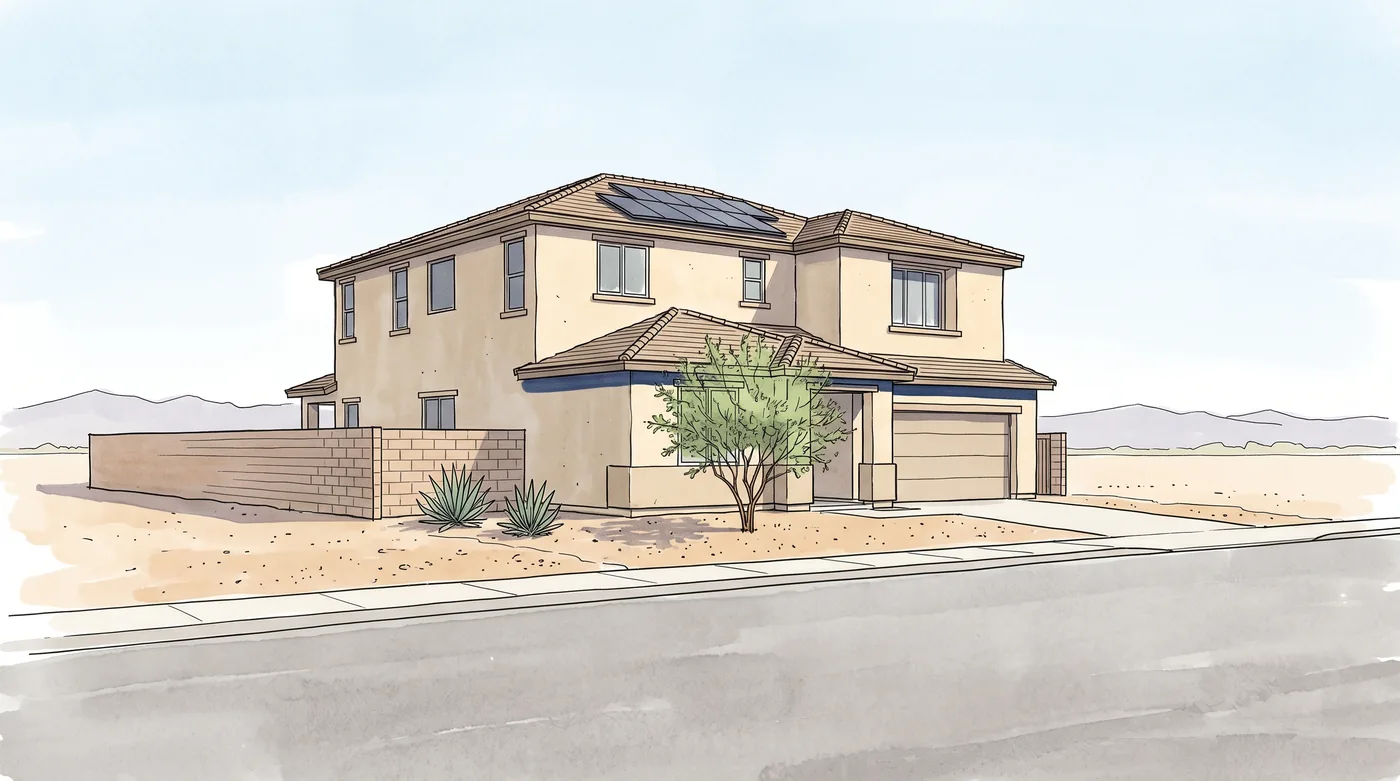
Enterprise and Spring Valley are not cities. They are unincorporated towns of Clark County, so your rooftop solar permit comes from the Clark County Building Department under its policy BD-PP-206, whatever your mailing address says. The two towns share that permit desk and sit side by side in the southwest valley, but their houses were built a generation apart, and that changes what we look for first. We are Simmons Solar Electric, a licensed Nevada electrical contractor under licence 0032580A, and we pull the county permit ourselves.
Two towns the size of cities, with no city hall
Clark County lists Enterprise and Spring Valley among its urban towns, each with a Town Advisory Board. The county describes those boards as advisory: residents who meet in public and pass concerns and recommendations to the County Commission. They do not issue building permits, and neither town has a building department of its own.
They are large. The Census Bureau's 2020 to 2024 estimates put Enterprise at about 240,000 residents and Spring Valley at about 219,000, which would make each one of the biggest cities in Nevada if it were a city. Many addresses in both towns read Las Vegas. That is the trap: a homeowner reads that the City of Las Vegas issues residential solar permits the same day online, and assumes it applies to them. It does not. The City's same day path, effective February 15, 2024, is for parcels inside the City of Las Vegas. In Enterprise and Spring Valley the rules are the county's, and we confirm the parcel's jurisdiction before we quote.
The county rules, in the parts that shape your array
The Clark County Building Department, at 4701 West Russell Road, reviews solar under BD-PP-206, Solar Photovoltaic Requirements, effective September 15, 2014 and revised April 30, 2026, written against the 2024 IFC, IBC and IRC, ASCE 7-22 and the 2023 NFPA 70.
The paper you need depends on size. No electrical plan review is required for a system that does not exceed 5 kW. Engineer designed plans are required for a new system of 25 kW DC or greater, and for an addition that brings the total to 25 kW DC.
Structural paperwork can be waived, on conditions. The Building Official may waive the detailed submittal package and the engineering for a residential install if every one of these holds: roof mounted and no higher than the existing building, no more than 4 pounds per square foot, panels parallel to the roof plane, within 24 inches of the roof, attachment points no more than 48 inches on center, and on wood framing, anchored to solid rafters or blocking with at least one 5/16 inch lag embedded at least two and a half inches.
Ridges are where the panel count gets decided. An array covering 33 percent or less of the plan view roof area needs an 18 inch setback on both sides of a horizontal ridge; above that it is 36 inches. The county adds a line many layouts miss: if the array sits on both sides of a ridge, at least one side must keep the full 36 inch clearance regardless of coverage. On a simple gable with panels wanted on both slopes, that single rule can cost a row. Two 36 inch pathways from eave to ridge are required as well, one on the street or driveway side, and nothing may go below an emergency escape window.
One label the inspector will look for. The rapid shutdown label has to sit within three feet of the service disconnecting means and show where every rapid shutdown switch is.
Enterprise: mostly this century
In the Census Bureau's estimates, the median Enterprise housing unit was built in 2007. About 84 percent of all units were built in 2000 or later, and about a third were built in 2010 or later. About 6 percent predate 1990.
On those houses the usual questions are about fitting a solar breaker into a modern panel, and about which roof planes are big enough to carry a useful array once the pathways are taken out. Enterprise also climbs: the USGS elevation service puts Southern Highlands near 2,370 feet and Mountain's Edge near 2,750 feet.
Spring Valley: a generation older
Spring Valley's median housing unit was built in 1999, fewer than half were built since 2000, and roughly a quarter were built in the 1970s and 1980s. That is the stock where we open the service panel before we talk about panel counts. An older panel may have no room for a solar breaker, may need its main breaker de-rated, or may need replacing, and any of those changes the design, the paperwork and the price. It is also where a roof may be nearing the end of its own life, which is a conversation to have before an array goes on it rather than after.
We are describing what the survey says about these towns, not what we have found on our own jobs. When we have completed installs here, this section will say what we actually found.
What a kilowatt returns across both towns
We ran the same model at four points in the European Commission's PVGIS tool on September 29, 2026: one kilowatt, 20 degree tilt, building mounted, 14 percent losses.
| Point | Town | Elevation | South facing | West facing |
|---|---|---|---|---|
| Mountain's Edge | Enterprise | about 2,750 ft | 1,770 kWh | 1,484 kWh |
| Southern Highlands | Enterprise | about 2,370 ft | 1,765 kWh | 1,474 kWh |
| Durango and Desert Inn | Spring Valley | about 2,620 ft | 1,761 kWh | 1,473 kWh |
| Rainbow and Flamingo | Spring Valley | about 2,360 ft | 1,753 kWh | 1,466 kWh |
The spread between the best and worst south facing point is about one percent. Swapping south for west costs about 16 percent at every point. This is a model of a clear, unshaded plane, not a quote, and it points at the same conclusion in both towns: the ridge rule above and the direction of your roof planes matter far more than the town you live in.
Then NV Energy
Both towns are NV Energy territory. After the county passes your final inspection, interconnection goes through NV Energy's PowerClerk process, and the utility's handbook dated October 16, 2025 sets the Southern Nevada application fee at 189 dollars. The whole sequence, and how the county compares with the city desks, is in our permit guide.
Other places we cover
Henderson and North Las Vegas are cities with their own permit desks. Part of Summerlin is Clark County too, with its own design review on top.
Talk to us about your roof
Tell us the address. We will confirm the jurisdiction, open the service panel, lay the array out to the county's ridge and pathway rules, and give you a fixed written price. If the roof itself needs work first, you will hear that from us before anything else.
Questions people ask us
Who issues solar permits in Enterprise and Spring Valley?
Clark County. Enterprise and Spring Valley are unincorporated towns, listed by the county among its urban towns with a Town Advisory Board. The town boards advise the County Commission and do not issue permits. The Clark County Building Department, at 4701 West Russell Road, permits rooftop solar under its policy BD-PP-206, revised April 30, 2026.
My address says Las Vegas. Which rules apply to me?
The parcel decides, not the mailing address. Many Enterprise and Spring Valley homes have a Las Vegas mailing address while sitting outside the City of Las Vegas, so the City's same day online solar permit does not apply there. We look the parcel up before quoting, because the jurisdiction changes the code document, the portal and the review path.
Does a small system need a plan review in Clark County?
Not an electrical one. BD-PP-206 says no electrical plan review is required for systems that do not exceed 5 kW, and it requires engineer designed plans for new systems of 25 kW DC or more. Most home systems fall between those lines. Structural review can also be waived if the installation meets every one of the county's listed conditions.
Are Enterprise homes newer than Spring Valley homes?
On the Census Bureau's 2020 to 2024 estimates, yes, by a wide margin. The median Enterprise housing unit was built in 2007 and about 84 percent were built in 2000 or later. In Spring Valley the median is 1999, fewer than half were built since 2000, and about a quarter date from the 1970s and 1980s.
Do panels produce differently in Enterprise and Spring Valley?
Very little. With identical settings, a south facing kilowatt returned 1,770 kWh a year at Mountain's Edge and 1,765 at Southern Highlands in Enterprise, and 1,761 near Durango and Desert Inn and 1,753 near Rainbow and Flamingo in Spring Valley. The whole spread is about one percent; a west facing plane loses about 16 percent.
Where these numbers come from
- Clark County Town and Liaison Services, Town Advisory Boards and Citizens Advisory Councils: advisory role to the County Commission for unincorporated areas; Enterprise and Spring Valley listed among urban towns checked 2026-09-29
- Clark County Building Department, Solar Photovoltaic Requirements, policy BD-PP-206, effective 09/15/2014, revised 04/30/2026: codes, ridge setbacks including the both-sides-of-ridge rule, electrical plan review thresholds, structural waiver criteria, rapid shutdown label checked 2026-09-29
- City of Las Vegas Building and Safety, Residential Photovoltaic (Solar) Permits, effective February 15, 2024 checked 2026-09-29
- U.S. Census Bureau, American Community Survey 2020 to 2024 5-year estimates, tables B01003 Total Population, B25034 Year Structure Built and B25035 Median Year Structure Built, Enterprise CDP and Spring Valley CDP, retrieved through the Census Reporter data service checked 2026-09-29
- USGS 3DEP Elevation Point Query Service, queried 2026-09-29 at Mountain's Edge 36.0100 -115.2800, Southern Highlands 35.9900 -115.2000, Durango Drive and Desert Inn Road 36.1290 -115.2800, and Rainbow Boulevard and Flamingo Road 36.1150 -115.2430 checked 2026-09-29
- European Commission Joint Research Centre PVGIS 5.3 PVcalc, run 2026-09-29 for each coordinate above: 1 kWp, building mounted, 20 degree tilt, azimuth south and azimuth west, 14 percent system losses, PVGIS-ERA5 radiation data checked 2026-09-29
- NV Energy, Net Metering and Energy Storage Interconnection Handbook, version 7 dated 10/16/2025: Southern Nevada application fee 189 dollars checked 2026-09-29
We recheck this page quarterly. Last checked 2026-09-29. If a number here has moved, tell us and we will fix it the same week.