
Solar Rescue
Solar panel cleaning in Las Vegas: does it pay, and how to do it safely
What Las Vegas dust really costs a rooftop array, what NREL measured, why hard tap water spots glass, how to clean it safely and when to hire.
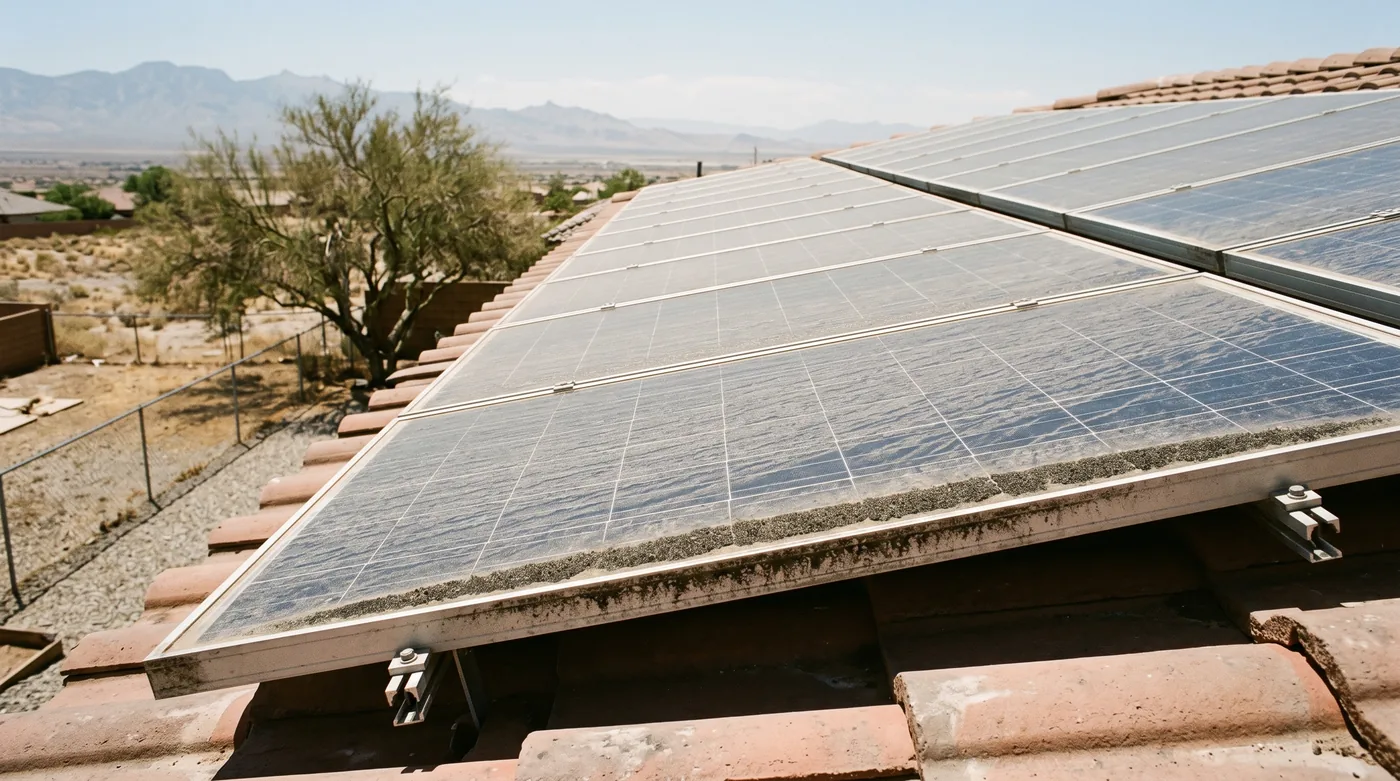
Sometimes, and you can find out for your own roof in a week without guessing. Record a few clear days of production, clean the panels safely or have them cleaned, and record a few clear days after. The difference is what cleaning is worth to you. NREL's data says the typical yearly loss from dirt is a few percent, but some sites lose much more, and droppings behave very differently from dust.
What the studies actually measured
Solar marketing is full of cleaning numbers. Here is what the published data from the National Renewable Energy Laboratory says, and what it does not.
Across monitored US systems. NREL's 2024 fleet study extracted soiling losses for 255 systems that showed measurable soiling, meaning more than 1 percent. Among those, annual soiling losses typically ranged from 0 to 15 percent, and the median was 2 to 3 percent.
In the Southwest specifically. A 2023 NREL paper picked 16 Southwest sites from the same soiling map, chosen because they had soiling losses above 1 percent, and modeled 20 years of rain and dust. Average losses at those sites ranged from 4.3 to 15.5 percent a year. Those are large ground-mounted plants chosen for being dusty, so they are a ceiling for a dusty site rather than a forecast for your house.
In NREL's own estimator. PVWatts, NREL's free public calculator, assumes a default 2 percent for soiling.
Two honest conclusions follow. For many roofs, the loss is a few percent a year, which may not cover a paid cleaning. For some roofs, especially near construction, unpaved lots or open desert, it is much more. The only way to know which roof you have is to measure it.
One more detail from the 2023 paper: when a system has more panel capacity than inverter capacity, the inverter caps output on the best hours anyway, so some of the dust loss disappears into that cap. A system that clips on clear spring afternoons may gain less from cleaning than you would expect.
Why rain does not do it here
In most of the country, rain cleans panels for free. NOAA's climate normals for the Las Vegas airport put annual rain at 4.19 inches. The standard soiling model the 2023 NREL paper used treats a day with more than 2.5 millimetres of rain as a cleaning event and lets dust build up steadily between them. Here, the gaps between those days are long.
A light summer shower can make things worse, not better, turning a film of dust into mud streaks that dry in the sun.
Dust versus droppings
These are different problems.
Dust is an even film. It dims every cell a little. The loss grows slowly and cleaning restores most of it.
Droppings are opaque. One covered cell can drag down a whole string, and a covered cell can heat up. Nobody can give you a percentage for droppings without knowing which cells are covered. If you see spots, cleaning is only half the answer, because the spots come from birds, and birds in Las Vegas usually mean something living under the array. Pigeons under your solar panels covers the clean out and the critter guard that stops it coming back.
The water problem
Las Vegas tap water is hard. The Las Vegas Valley Water District puts it at 280 parts per million, or 16 grains per gallon, which it classes as very hard. The minerals are calcium and magnesium.
That does not hurt you, but it matters on glass. Water that dries on a hot panel leaves its minerals behind as white spots, the same way it does on a shower door. A panel that has been washed badly with hard water many times can look worse than a dusty one.
Panel makers know this. One major manufacturer's installation manual asks for water with low mineral content and near neutral pH. Practical ways to get there:
- Wash in the early morning, when the glass is cool and the water does not flash dry.
- Finish with a rinse of filtered or deionised water if you have it.
- Do not let the panels air dry in full sun.
How to clean without voiding the warranty
Read your panel maker's manual before anyone touches the glass, because the same manual that sets the rules also says what voids the warranty. The manual we opened for this page, CSI Solar's installation manual for standard modules, is typical. It says damage from inappropriate cleaning voids the warranty, and it asks for:
- No dry scraping or rubbing. It causes micro scratches in the glass.
- No abrasive cleaners, degreasers or unapproved chemicals. Only substances the manufacturer approves.
- Soft, non-abrasive tools. A soft cloth, sponge or soft bristle brush, made of non-conductive material.
- A pressure limit. That manual sets a maximum water pressure of 4 MPa. A pressure washer can exceed a limit like that, and a garden hose does the job without the risk.
- Avoid the hottest hours. Cold water on hot glass is thermal stress.
It also says what every licensed electrician will tell you: the voltage and current in an array during daylight are enough to cause a lethal shock, and cracked or damaged modules are a shock hazard, worse when wet. Look for cracked glass before you spray anything. If you see any, stop and call someone.
Stay on the ground
Cleaning from the ground with a hose and a soft brush on a pole is fine if you can reach safely. Climbing is not.
Tile breaks under foot, and dust on glazed tile makes it slippery. OSHA's fall protection rule requires protection for residential construction work 6 feet or more above a lower level. A homeowner on a ladder with a hose is not working to that standard, and a broken tile under an array is the start of a roof leak under your solar panels.
When to hire someone
Hire when your own before and after numbers say the gain is worth the fee, or when the job is one you cannot do from the ground. Ask anyone you hire:
- What water they use, and how they avoid spotting.
- What tools touch the glass.
- Whether they walk on the roof, and how they protect the tile.
- Whether they will look under the array for birds and nesting material while they are up there.
We do not publish a cleaning price, and we will tell you if your numbers say it is not worth doing.
Measure first, clean second
- Pick three to five clear days in a row and write down daily production from your inverter or app.
- Clean, or have the panels cleaned.
- Write down the next three to five clear days.
- Compare the averages.
If production barely moves, dust was not your problem. If your system is well short of what the contract promised, the cause may be something else entirely, and solar producing less than promised walks through the other suspects. If you do not know where to find the production numbers, your app and NV Energy's figure explains which one to use.
Questions people ask us
How much production do dirty solar panels lose in Las Vegas?
It depends on the site, and anyone quoting one number for every roof is guessing. NREL's analysis of monitored US systems found annual soiling losses typically between 0 and 15 percent, with a median around 2 to 3 percent, among the sites that showed measurable soiling. NREL's own estimator assumes 2 percent. Your own before and after numbers are the only figure that fits your roof.
Does rain clean solar panels in Las Vegas?
Not often. NOAA's climate normals for the airport put annual rain at 4.19 inches. The standard soiling model NREL uses treats a day of more than 2.5 millimetres of rain as a cleaning event, and dust builds up in between. A light shower can also turn dust into mud streaks rather than washing it off.
Can I use tap water to clean my solar panels in Las Vegas?
It works, but it leaves marks. The Las Vegas Valley Water District rates its tap water at 280 parts per million, or 16 grains per gallon, which it calls very hard. Water that dries on hot glass leaves those minerals behind. Panel makers generally ask for water with low mineral content, so rinse early in the morning and dry it, or use filtered water.
Can I pressure wash solar panels?
Check your panel maker's manual first, because improper cleaning can void the module warranty. One major manufacturer's manual sets a maximum water pressure, bans abrasive cleaners and dry scraping, and asks that cleaning avoid the hottest hours of the day. Most homeowners are better off with a hose, a soft brush on a pole and patience.
Is it worth paying someone to clean my panels?
Only if your numbers say so. Record a few clear days of production, clean or have them cleaned, and record a few clear days after. If the gain is small, the money is better spent elsewhere. If the gain is large or the dirt is droppings, it may pay, and droppings often mean birds under the array, which is a bigger job.
Should I clean the panels myself on a tile roof?
We would not climb. Tile breaks under foot, dusty glazed tile is slippery, and OSHA requires fall protection for residential construction work 6 feet or more above a lower level. The array is also live whenever light is on it. Cleaning from the ground with a pole and hose is a different matter, if you can reach safely.
Where these numbers come from
- Deline and others, Availability and Performance Loss Factors for U.S. PV Fleet Systems, National Renewable Energy Laboratory, NREL/TP-5K00-88769, February 2024 (soiling values for 255 systems with loss above 1 percent; annualized soiling losses typically 0 to 15 percent with a median of 2 to 3 percent) checked 2026-09-28
- Muller and Rashed, Considering the Variability of Soiling in Long-Term PV Performance Forecasting, National Renewable Energy Laboratory preprint, 50th IEEE Photovoltaic Specialists Conference, 2023 (16 Southwest US sites chosen for soiling above 1 percent, average modeled soiling losses 4.3 to 15.5 percent; Kimber model cleaning on rain days above 2.5 mm; clipping can mitigate soiling losses) checked 2026-09-28
- Dobos, PVWatts Version 5 Manual, National Renewable Energy Laboratory, NREL/TP-6A20-62641 (default soiling loss 2 percent) checked 2026-09-28
- NOAA National Centers for Environmental Information, climate normals for Las Vegas McCarran International Airport, station USW00023169 (annual normal precipitation 4.19 inches) checked 2026-09-28
- Las Vegas Valley Water District, water quality FAQs (hardness 280 parts per million or 16 grains per gallon, very hard; calcium and magnesium) checked 2026-09-28
- CSI Solar (Canadian Solar), Installation Manual of Standard Solar Modules, revision 3.3, December 2022, sections 7 and 8 (maintenance and module cleaning guidelines: improper cleaning voids warranty; water with low mineral content and near neutral pH; maximum 4 MPa; avoid the hottest hours; no dry scraping; lethal voltage in daylight) checked 2026-09-28
- Occupational Safety and Health Administration, fall protection duty to have, 29 CFR 1926.501 checked 2026-09-28
Actual utility rates may go up or down and actual savings may vary. Every figure on this page is an estimate based on the sources listed below, not a promise about your home.
We recheck this page annually. Last checked 2026-09-28. If a number here has moved, tell us and we will fix it the same week.