
Solar Rescue
Solar producing less than promised in Las Vegas: how to check it yourself
Your system makes less than the contract said. How to compare the first year estimate with what it really made, what is normal in Las Vegas and what is a fault.
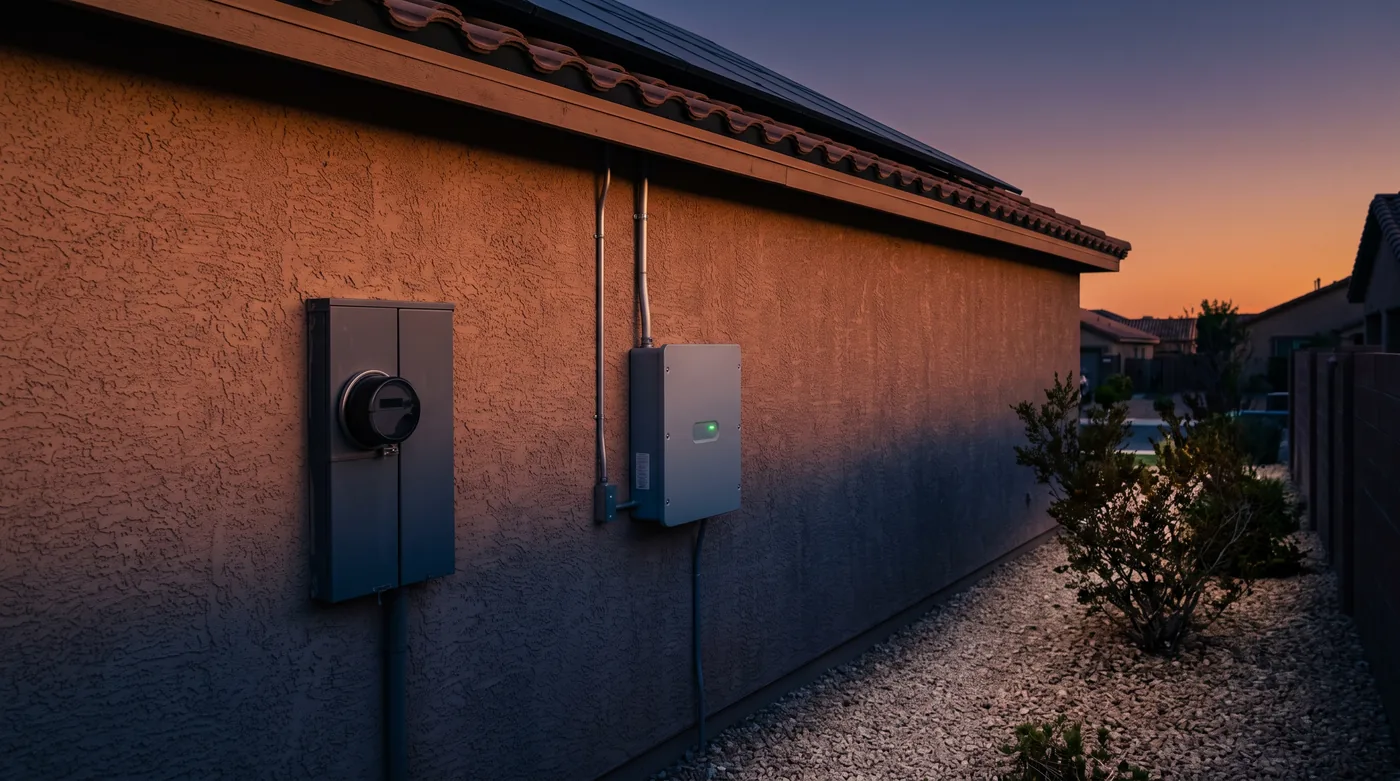
Pull out your contract and find one number: the estimated production in the first year of operation, in kWh. Compare it with twelve months of what your system actually made, counted from the day NV Energy let you switch on. If you are within a few percent, that is weather. If you are far short, or short every year by more than the degradation written into the same contract, something is wrong, and Nevada law gave your contract a clause about it.
This page walks through that comparison, what is normal for a Las Vegas roof, and what is a fault.
First, make sure you are comparing the right numbers
Most "my system is underperforming" worries start with a unit mix up. Two units, two different things.
- kW is size. It is the most the system can deliver at one instant under test conditions. A "10 kW system" is a size, like the engine size of a car.
- kWh is energy. It is what the system actually makes over time. Your contract's production estimate is in kWh. Your NV Energy bill is in kWh. Your shortfall is in kWh.
A 10 kW system does not make 10 kWh every hour of daylight. It makes its full rating, at most, for a few hours around noon on a cool, clear day, and much less the rest of the time. If someone showed you an hourly figure in kW and you are comparing it with a yearly figure in kWh, the "gap" may be nothing but arithmetic.
The second trap is the meter. NV Energy's meter only sees what you exported and what you imported. Everything your house used the moment the panels made it never crosses the meter, so your bill always shows less than your roof produced. Your app says one number and NV Energy says another explains which is which. For this check, use your inverter's own yearly or lifetime total wherever you can.
What your contract has to say
If you bought your system, Nevada is specific. Under NRS 598.9813 the cover page of a purchase agreement shows the estimated production in the first year of operation. Under NRS 598.9814 the agreement itself has to give the size of the system, that first year estimate, and the estimated annual degradation. It has to describe any guarantee of performance. And it has to set out the installer's duties if the system fails to meet the first year estimate.
Those duties, as the current statute reads, run from the date the utility gave permission to connect. If the system has not met the estimate one year after that date, the installer must either take whatever action is needed to make it meet the estimate the following year, including adding equipment or repairing what is there, or send you written notice that it missed, and then take that action if it misses again a year after the notice.
Leases carry the same duty under NRS 598.9811. A power purchase agreement must describe any performance guarantee under NRS 598.9817. Older agreements may predate some of this, so read what yours actually says. Your rights in a Nevada solar contract goes through the rest of the paperwork.
Why a Las Vegas roof makes less than the brochure
A healthy system in this valley still misses its nameplate every single day. The question is whether it misses by the amount the estimate already allowed for. Five things account for most of it.
Heat
Panels are rated at a cell temperature of 25 C. They lose output as they get hotter. NREL's PVWatts model, the free public estimator from the National Renewable Energy Laboratory, uses a loss of 0.47 percent per degree Celsius for a standard module and 0.35 percent for a premium one. For every 10 C a panel runs above its test temperature, that is roughly 3.5 to 4.7 percent less output.
A dark panel on a Las Vegas roof in July is far hotter than 25 C. That is why a clear July day can produce less than a clear May day. It is not a fault, and a competent estimate already priced it in. Your panel's own coefficient is on its datasheet, under temperature characteristics.
Degradation
Panels lose a little output each year. NREL's review of published field measurements found a median of 0.5 percent a year, with 78 percent of reported rates below 1 percent. A later NREL study of a large US fleet put median system decline at roughly 0.5 to 0.75 percent a year.
What binds your installer is the degradation figure in your own agreement, not a national median. Year five should be compared with the first year estimate less five years of that stated rate.
Dust and droppings
Dust is a film. Droppings are opaque patches that pull down a whole string. PVWatts assumes 2 percent a year for soiling as a default, and in a place where NOAA's climate normals put annual rain at 4.19 inches, much of it never rinses off on its own. Does cleaning your panels in Las Vegas pay? covers what the studies actually measured. Birds under the array are a separate problem, set out in pigeons under your solar panels.
Shade that was not there on day one
A tree that grew, a neighbour's second storey, a new satellite dish. PVWatts assumes about 3 percent shading loss even for systems described as unshaded. New shade on one panel can pull down others wired with it. Walk around the house at 9 in the morning and 3 in the afternoon and look at the array.
Clipping
Most systems are built with more panel capacity than inverter capacity. PVWatts uses a default DC to AC ratio of 1.1. On the best hours of the best days, the panels could make more than the inverter can pass, so the inverter caps it. In your monitoring this shows as a flat top on the daily curve on clear spring afternoons.
Clipping is a design choice, and a sensible estimate models it. It becomes your problem only if the estimate ignored it.
What a fault looks like instead
Everything above is gradual. Faults are not. Look for these patterns in a year of data.
| What you see | What it usually means |
|---|---|
| A few percent short of the estimate in one year | Weather, heat and dust. Watch the next year |
| Short by about the stated degradation, every year | Working as described |
| A sudden step down to about half or two thirds | One string, one inverter or a group of microinverters stopped |
| A day, a week or a month of zero | Inverter off, a breaker tripped, or a shutdown device failed |
| Short from the very first month, by a lot | Undersized design, wrong orientation, or the estimate was optimistic |
| The contract year counted from the install date, not permission to operate | A counting error. NV Energy gives no credit until its meter is set |
A step down is the one that hides longest, because the system still looks alive from the street. How to find out if your solar system still works walks through reading the inverter, and solar inverter replacement cost covers the most common failed part. NREL's fleet study found inverter availability of 0.99 at the median system, which is a reminder that downtime is normal in small amounts and a problem in large ones.
How to run the check
- Find the estimate. First year production in kWh, and the annual degradation, from your agreement.
- Get twelve months of real production. Use the inverter's yearly total. If monitoring is gone, download your NV Energy usage and use exports as a floor, knowing they understate what the roof made.
- Count from the right day. Year one starts at permission to operate, not at installation.
- Adjust for age. Year three is the estimate less three years of the stated degradation.
- Look at the shape. Summer dip, slow slide, sudden step, flat tops. The table above tells you which.
- Rule out the cheap causes. Dust, droppings, new shade, a light on the inverter.
If you land within a few percent in a normal year, stop worrying and check again next year.
When the numbers really are short
Write it down before you call anyone: the estimate, the actual, the dates you used, and any pattern you saw. Then send the installer a dated letter asking what they will do under the production clause of your agreement, and keep a copy. A phone call leaves no record. A letter starts the clock the statute describes.
If the installer does not answer, the Nevada State Contractors Board takes complaints against licensed contractors. Its investigator decides whether a jobsite visit is needed and can send the contractor a Notice to Correct, which the Board says usually allows 20 to 30 days to comply.
If the company that installed the system has closed, the production duty may have gone with it, but the manufacturer warranties on panels and inverters usually have not. Your solar company went out of business covers what survives.
And if production turns out to be fine but the bill still went up, the cause is somewhere else: your bill went up after solar.
We inspect systems whoever installed them. If you would like someone to read the numbers with you, we will tell you what we find whether or not there is work in it for us.
Questions people ask us
My contract promised more kWh than my system makes. Is that normal?
Some shortfall in a single year can be normal, because the estimate is built on typical weather and your year was not typical. A shortfall that repeats year after year, or one far larger than the degradation rate written into your agreement, is not normal. Compare a full twelve months against the first year estimate, then compare later years against that estimate less the stated degradation.
What is the difference between kW and kWh on my solar contract?
kW is the size of the system, the most it can deliver at one instant under test conditions. kWh is energy, what it actually makes over time, and it is the number the contract estimate and your NV Energy bill both use. A 10 kW system does not make 10 kWh an hour all day. Check your shortfall in kWh over a year, never in kW.
Why does my system make less in July than in May when July is sunnier?
Heat. Panels are rated at a cell temperature of 25 C, and they lose output as they get hotter. NREL's PVWatts model uses a loss of 0.35 to 0.47 percent per degree Celsius for crystalline panels, depending on the module. A roof in a Las Vegas July runs far above that test temperature, so the extra sunshine is partly cancelled by the heat.
How much should solar panels degrade each year?
The figure that binds your installer is the one in your own agreement, because Nevada requires a purchase or lease agreement to state the estimated annual degradation. For context, NREL's review of published field measurements found a median of 0.5 percent a year, with 78 percent of reported rates below 1 percent a year.
Does Nevada law make the installer fix a system that underproduces?
For a purchase agreement, NRS 598.9814 requires the contract to set out the installer's duties if the system misses its first year production estimate, including repairing or adding equipment, or giving written notice and then fixing it if the next year also falls short. Leases carry a similar clause. Read your own agreement for the exact wording and dates.
What if the company that installed my system is gone?
The first year estimate and the manufacturer warranties are still on paper, but the company that owed the production duty may not be there to perform it. Start by measuring the shortfall properly, then read our page on what survives when an installer closes. Manufacturer warranties on panels and inverters usually survive the installer.
Where these numbers come from
- NRS 598.9813 and 598.9814, agreement for purchase of a distributed generation system: cover page must show the estimated production in the first year of operation (598.9813(2)(h)); the agreement must state the estimated first year production and the estimated annual degradation (598.9814(3)), describe any performance guarantee (598.9814(11)), and set out the installer's duties if the system fails to meet the first year estimate (598.9814(22)); NRS 598.9811 sets the same duty for leases and NRS 598.9817(18) requires a PPA to describe any performance guarantee. Nevada Revised Statutes chapter 598 as posted by the Nevada Legislature checked 2026-09-28
- Dobos, PVWatts Version 5 Manual, National Renewable Energy Laboratory, NREL/TP-6A20-62641 (temperature coefficients of -0.47 percent per degree C for standard and -0.35 percent for premium modules against a 25 C reference; default DC to AC ratio 1.1 and clipping at peak sun; default system losses 14 percent including soiling 2 percent and shading 3 percent) checked 2026-09-28
- Jordan and Kurtz, Photovoltaic Degradation Rates: An Analytical Review, National Renewable Energy Laboratory, NREL/JA-5200-51664, June 2012 (median 0.5 percent per year, 78 percent of reported rates below 1 percent per year) checked 2026-09-28
- Deline and others, Availability and Performance Loss Factors for U.S. PV Fleet Systems, National Renewable Energy Laboratory, NREL/TP-5K00-88769, February 2024 (median system degradation about 0.5 to 0.75 percent per year; inverter availability 0.99 at P50) checked 2026-09-28
- NOAA National Centers for Environmental Information, climate normals for Las Vegas McCarran International Airport, station USW00023169 (annual normal precipitation 4.19 inches) checked 2026-09-28
- NV Energy, Net Metering and Energy Storage Interconnection Handbook, on no kWh credit before the NV Energy meter is set checked 2026-09-28
- Nevada State Contractors Board, licensed contractor complaints: investigation, jobsite visit and Notice to Correct checked 2026-09-28
Actual utility rates may go up or down and actual savings may vary. Every figure on this page is an estimate based on the sources listed below, not a promise about your home.
Simmons Solar Electric is not affiliated with, authorised by, or acting for any company named on this page, or for its trustee or estate. We do not honour another company's workmanship warranty. Everything stated here about a company is public record, with its source listed below.
We recheck this page quarterly. Last checked 2026-09-28. If a number here has moved, tell us and we will fix it the same week.