
Solar Rescue
Roof leak under your solar panels in Las Vegas: who fixes it
A ceiling stain under your solar array. Where tile and shingle roofs leak at panel mounts, who is responsible under Nevada law, and what to record.
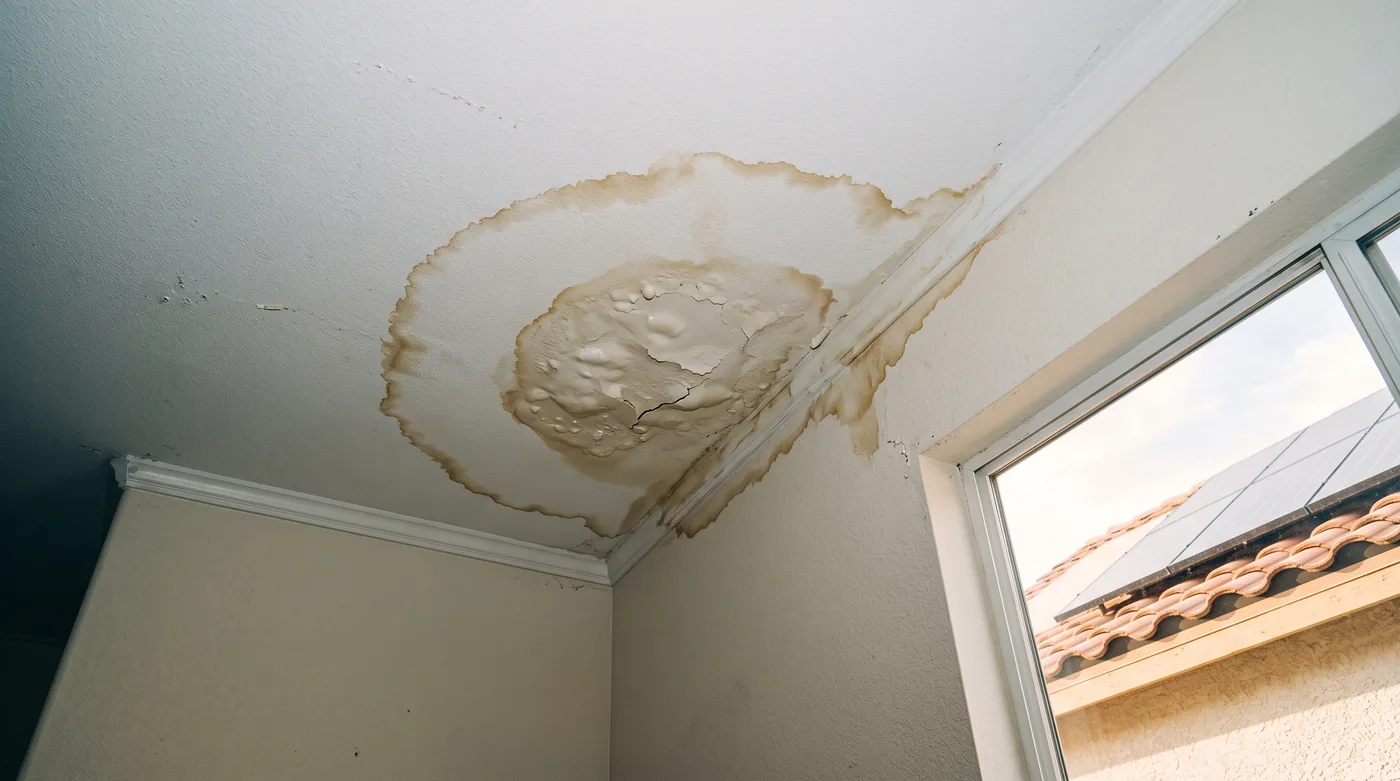
A stain on the ceiling under your array usually means water is getting in at, or uphill of, one of the places the solar mounts go through your roof. If it is at a mount, Nevada law put a warranty on it: every solar purchase, lease or power purchase agreement must carry a written warranty on the installation and the roof penetrations for at least 10 years, under NRS 598.9821. Your first job is not the repair. It is finding exactly where the water enters, on the record, before anyone covers it up.
Why solar roofs leak where they do
Every rooftop array is held on by mounts that go through the roof into the rafters. Each one is a hole, and each hole is sealed by flashing and sealant. That is where most solar leaks start.
On a concrete or clay tile roof
Most Las Vegas houses have tile. On tile, the tile itself sheds most of the water, and the real waterproofing is the underlayment below it. A solar mount on tile usually means lifting or cutting a tile, fastening through the underlayment into a rafter, and flashing the fastener so water running down the underlayment goes around it.
The common failures:
- Underlayment punctured and not properly flashed. Water running under the tile finds the hole.
- A tile cracked during the install, or later by someone walking the roof, letting water straight onto the underlayment at that spot.
- A tile reset out of line so its channel no longer carries water down the slope.
- Old underlayment. Tile outlasts what is under it. A solar install on a roof with tired underlayment can leak at the mounts and between them.
- Debris damming the tile channels. Nesting material and droppings under an array block the pans water drains through. Pigeons under your solar panels covers what we find.
On an asphalt shingle roof
Fewer houses here, but the logic is the same. The mount goes through the shingle and deck, and a flashing plate should slide under the course above it. Leaks come from a flashing that sits on top of the shingle instead of under it, sealant used in place of flashing, or a fastener that missed the rafter and was left in the deck.
The stain is rarely where the hole is
Water that gets under tile runs down the underlayment, and water that gets through the deck runs along rafters and insulation before it drips. The stain on your ceiling is where the water finally found a way down, which is often lower on the slope than where it got in. A stain under the array does not prove the array caused it. A stain away from the array does not clear it.
Why it shows up years later
Las Vegas does not test a roof often. NOAA's climate normals for the airport put annual rain at 4.19 inches, with 0.80 inches across June, July and August, which is when the storms arrive hard and sideways. A mount that was never properly flashed can sit dry through a year and leak in the first real storm.
That timing matters for the warranty. A leak that first appears in year six is still inside a 10 year penetration warranty.
Who is responsible
Three parties can own a leak, and they will each suggest it is one of the others.
| Where the water enters | Usually whose problem |
|---|---|
| At a solar mount, its flashing or a tile disturbed by the install | The company that installed the solar, under its installation and roof penetration warranty |
| At a mount added or reset later by another contractor | That contractor, under whatever warranty it gave you |
| In roofing the array never touched, or failed underlayment from age | The roof, and your roofer's warranty if it is still running |
| Storm or sudden damage | Often a homeowner's insurance question |
NRS 598.9821 requires the installation and penetration warranty to be express, in writing, and to expire no earlier than 10 years after installation. The separate disclosure pages that come with a lease, a purchase and a power purchase agreement must also describe any warranty for repairing damage to your roof from installing or removing the system, under NRS 598.9812, 598.9815 and 598.9818. Find the warranty page in your agreement and read its conditions, especially anything about notifying them and about who may work on the system.
If your array was removed and reinstalled for a reroof, the holes in your new roof are the reinstalling contractor's work, not the original installer's. Removing and reinstalling solar panels for a new roof explains why you should have that warranty in writing.
If you are on a lease or power purchase agreement, the system belongs to the company. Call them first; your agreement may say who is allowed to touch it. Your rights in a Nevada solar contract goes through what the documents had to contain.
Why the panels may have to come off
The mount is under the panel. On tile, the flashing is under the tile. A repair made by squeezing sealant around whatever can be reached from the edge of the array almost never reaches the actual hole, and it tends to hide the evidence of what failed.
A proper repair usually means switching the system off, lifting the modules over the leak, lifting the tile, and repairing the flashing and underlayment at the mount. If the underlayment is failing across the whole plane, the fix becomes a reroof of that section, and the array comes off and goes back on. That is the detach and reset job described in removing and reinstalling solar panels, and it usually needs permits: the City of Las Vegas homeowner guide lists new roofing where the old is removed, altering permanent wiring, and photovoltaic systems among work that needs one. Solar permits in Las Vegas shows which building department you are in.
Lifting modules is electrical work on a live system. The Nevada State Contractors Board says a licensed contractor is required to repair, maintain, restore or alter solar systems on single-family homes. A roofer who offers to "just unbolt a couple of panels" is offering to do that work.
What to document, in this order
- Photograph the stain wide and close, with the date. Lightly pencil its edge so you can see if it grows after the next rain.
- Locate it. Measure from the outside wall and note which roof plane sits above it.
- Attic, if it is safe. Photograph wet decking or insulation without moving anything. Do not walk the joists if you are not sure of your footing.
- Paperwork. The solar agreement, the warranty page, the date NV Energy gave permission to operate, and anything on the roof's age.
- Notify in writing. Email the installer with the photos and ask for an inspection under the roof penetration warranty. A phone call leaves nothing behind.
- Get the cause on paper. Ask whoever inspects to photograph the entry point with the tile or panel lifted, and to write down what failed, before any repair covers it.
Do not go up on the roof yourself. Tile breaks under foot, dusty tile is slick, and the array is live whenever the sun is on it.
When nobody will take responsibility
If the installer will not come, the Nevada State Contractors Board takes complaints against licensed contractors. Its investigator decides whether a jobsite visit is needed. If corrective work is required the Board sends a Notice to Correct, which it says is usually sent within five working days of the visit, and the contractor is generally allowed 20 to 30 days to comply.
If the installer has closed, the penetration warranty may have closed with it. The leak still needs a diagnosis and a repair, and your homeowner's policy may have something to say about the damage inside. Your solar company went out of business covers what survives, and solar panels and your home insurance covers the policy side.
We are a licensed Nevada electrical contractor, not a roofer. On a leak under an array we do the part that is ours: shut the system down, lift the modules, find and photograph the entry point with your roofer, repair the mounts and flashing we are responsible for, put the array back, and check production against what it made before. You keep the photos either way.
Questions people ask us
Who is responsible for a roof leak under solar panels?
If the water is coming in at a panel mount, it is usually the installer's work. Nevada requires every solar purchase, lease or power purchase agreement to carry a written warranty on the installation and on the penetrations into the roof, lasting at least 10 years from installation, under NRS 598.9821. If the leak is in roofing the array never touched, it is a roof problem.
My roofer says it is the solar and the solar company says it is the roof. What now?
Ask both for their answer in writing, with photos of where they think the water enters. The leak usually shows up on the ceiling lower down the slope than where it gets in, so a stain below the array does not prove the array caused it. Someone has to lift tile or panels and look. Get that inspection documented before any repair covers it up.
Do the panels have to come off to fix a leak?
Often, yes. A mount sits under the panel, and on a tile roof the flashing sits under the tile. A repair made from the edge of the array without lifting anything rarely reaches the actual hole. Taking modules off is electrical work on a live system, and it is the same detach and reset process used for a full reroof.
What should I record before calling anyone?
Photograph the stain with a date, and again after the next rain to show whether it grew. Note which room and roughly how far from the outside wall. Find your solar agreement and the warranty page, the installation date, and your roof's age. If you can safely see into the attic, photograph wet decking or insulation without disturbing it.
What if the company that installed my solar is out of business?
The 10 year penetration warranty came from that company, so it may not be there to honour it. Your roof, your homeowner's policy and the manufacturer warranties are separate. A licensed contractor can still diagnose the leak and repair the mounts. Our page on what survives when an installer closes covers the order to work in.
Does rain ever reach a leak in Las Vegas?
It does, just rarely. NOAA's climate normals for the airport put annual rain at 4.19 inches, with 0.80 inches across June, July and August when storms arrive fast. A small leak can sit unnoticed through a dry year and show up after one storm, which is why a stain often appears years after the install.
Where these numbers come from
- NRS 598.9821, express warranties required in an agreement for a distributed generation system: installation and roof penetration warranty in writing, expiring not earlier than 10 years after installation; and NRS 598.9812(3)(o), 598.9815 and 598.9818, the separate disclosure for a lease, a purchase and a power purchase agreement must describe any warranty for repairing roof damage caused by installing or removing the system. Nevada Revised Statutes chapter 598 as posted by the Nevada Legislature checked 2026-09-28
- NOAA National Centers for Environmental Information, climate normals for Las Vegas McCarran International Airport, station USW00023169 (annual normal precipitation 4.19 inches; June to August 0.80 inches) checked 2026-09-28
- Nevada State Contractors Board, licensed contractor complaints: investigator decides on a jobsite visit, Notice to Correct usually sent within five working days of the visit, contractor generally allowed 20 to 30 days to comply checked 2026-09-28
- Nevada State Contractors Board, Residential Solar: a licensed contractor is required to construct, repair, maintain, restore, alter or improve solar systems on single-family residences checked 2026-09-28
- City of Las Vegas Building Department, When Do I Need a Permit? A Homeowner's Guide (permits for new roofing where all old roofing is removed, for altering permanent wiring and for photovoltaic systems) checked 2026-09-28
Simmons Solar Electric is not affiliated with, authorised by, or acting for any company named on this page, or for its trustee or estate. We do not honour another company's workmanship warranty. Everything stated here about a company is public record, with its source listed below.
We recheck this page annually. Last checked 2026-09-28. If a number here has moved, tell us and we will fix it the same week.