
Your NV Energy bill
Charging an EV on NV Energy without setting your demand charge
NV Energy's EV rate rewards charging after midnight, but the daily demand charge counts how hard you pull. How to charge a car in Las Vegas and keep both low.
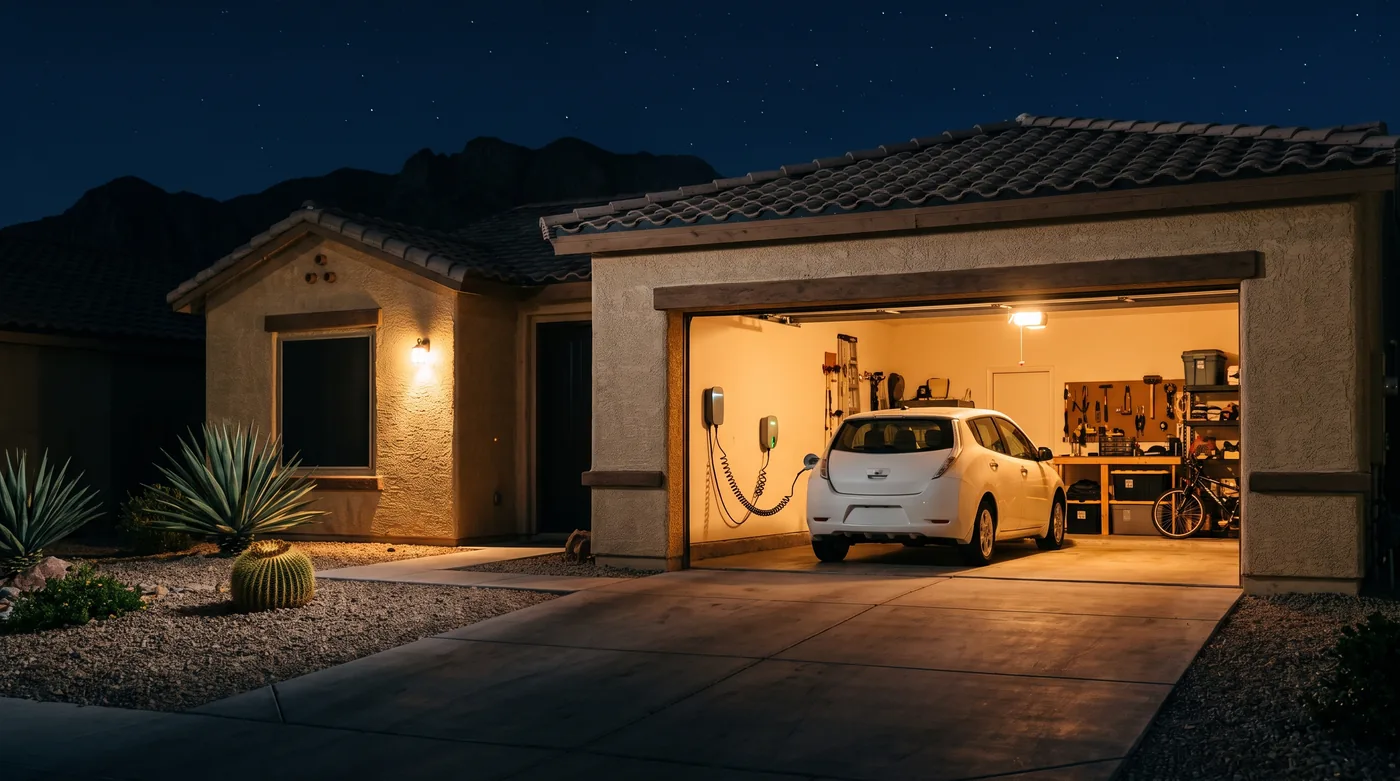
Charge after midnight and charge gently. On NV Energy's optional time of use plan, the EV rate makes every kWh your home uses between 12:01 am and 8 am cheaper. The daily demand charge, scheduled for January 1 2027, under appeal, does not care what time it is. It bills the hardest 15 minutes of your day. A car charging at full power at 2 am can set that peak on its own.
So there are two separate levers, and people mix them up. The clock lowers your energy rate. The amperage lowers your demand. You want both.
The EV rate, in NV Energy's own words
NV Energy offers what it calls Electric Vehicle Time-of-Use rates. On its rate schedule this is the Electric Vehicle Recharge Rider on Schedule ORS-TOU, the optional time of use plan for a single family home. The recharge period runs 12:01 am to 8 am every day.
Three things on NV Energy's EV page are worth knowing before you sign up.
- The discount is for the whole house, not the car. NV Energy says the lower rate applies to all the energy used at the home during that period, not just the electricity used to charge the vehicle. Your dishwasher at 1 am gets the same rate.
- The first year is guaranteed. NV Energy compares the EV rate with the regular flat rate over your first 12 months, credits the difference if the EV rate cost more, and offers to move you back.
- You have to qualify. The page says participation is not guaranteed, you must be pre-qualified, and NV Energy needs access to your meter. Its time of use page adds a 12 month minimum.
What the EV rate costs from October 1 2026
These are energy rates per kWh from NV Energy's October 1 2026 residential insert, before the small riders the insert lists separately. For comparison, the standard plan, Schedule RS, is $0.11379 for the same line.
| On NV Energy's time of use plan (ORS-TOU) | Hours | Per kWh |
|---|---|---|
| Winter, EV recharge period | October to May, 12:01 am to 8 am | $0.07564 |
| Winter, all other hours | October to May | $0.08415 |
| Summer, EV recharge period | June 1 to September 30, 12:01 am to 8 am | $0.06346 |
| Summer, off-peak | June 1 to September 30, other hours outside on-peak | $0.07062 |
| Summer, on-peak | June 1 to September 30, 6:01 pm to 9:00 pm | $0.46912 |
The last row is the catch. On NV Energy's time of use plan, energy between 6:01 pm and 9 pm in summer costs about four times the standard rate. The EV rate pays off in a house that can keep those three summer evening hours light: pool pump off, laundry moved, air conditioning pre-cooled. If you cannot, the first year guarantee tells you so without costing you the difference.
The demand charge counts the pull, not the hour
NV Energy's own page is plain about it: the daily demand charge "is not a time-of-use (TOU) rate," and "whether your maximum energy use is at 2 a.m. or 6:45 p.m., the rates are the same." It is priced at $0.14 per kilowatt of your highest 15 minute interval, every day, totalled over the bill.
A charger's pull is its amps times its volts. Your charger's setting is on its label or in its app.
| Charger setting at 240 volts | Draw | Most it can add to one day | Energy it can deliver from 12:01 am to 8 am |
|---|---|---|---|
| 48 amps | about 11.5 kW | about $1.61 | about 92 kWh |
| 32 amps | about 7.7 kW | about $1.08 | about 61 kWh |
| 16 amps | about 3.8 kW | about $0.54 | about 31 kWh |
That table is arithmetic on NV Energy's $0.14 figure and the eight hour window, not a quote. "Most it can add" assumes the charger lands on top of the rest of your load in the same 15 minutes. If the rest of the house is quiet at 2 am, the car may simply become your peak for that day, and the charge is whatever the car draws plus whatever else was running.
Now compare the right-hand column with what your car actually uses. Most cars report daily kWh in their app. If you use 15 or 20 kWh on a normal day, a 16 amp setting refills it with hours to spare, and the 48 amp setting buys you speed you are paying for in demand.
How to charge without setting a new peak
- Charge inside the window. Set the car or the charger to start at 12:01 am. That gets the recharge rate on NV Energy's time of use plan, and it keeps the car away from the evening, when the air conditioner, oven and dryer stack up.
- Turn the amperage down to what you need. Use the table above. Most chargers and most cars let you cap the current. A slower overnight charge is the cheapest demand control there is.
- Keep other big loads out of the window, or out of each other's way. A pool pump, a second air conditioner or an electric water heater that runs at 2 am adds to the same 15 minutes as the car. Stagger them. Our pool pump page works through the most common one.
- Look at your own 15 minute data. MyAccount already shows residential usage in 15 minute increments. Pull a week, find your highest interval, and see what was running.
- If two EVs share one garage, split the night. Two cars at full power at the same time double the pull. One after the other, at a lower setting, does not.
If you want the house to manage this for you, a load controller can pause the charger when the air conditioning starts, and a battery can carry part of the evening. The trade-offs are on load controller or battery.
What we do not know yet
How the demand charge sits on a time of use bill. NV Energy's page describes the charge as applying to residential customers in Southern Nevada and does not carve out time of use customers. We have not seen the published tariff text for the demand charge on Schedule ORS-TOU, and we will print it here when we can open it.
Whether it starts on January 1 2027. The charge is scheduled for that date and under appeal. Two district courts ruled against the challengers in late May 2026, as Nevada Current reported, and both sets of challengers said they would appeal to the Nevada Supreme Court. The record is on our appeal status page.
The advice above does not depend on either answer. Charging gently after midnight costs less on the EV rate today and keeps your peak down if the demand charge arrives.
If your garage needs a circuit first
A Level 2 charger is a 240 volt appliance on its own circuit, and it is a large new load for an older main panel. If you are adding one, ask the electrician to size the circuit for the setting you will actually use, and to tell you whether your panel has room. We are a licensed electrical contractor and do this work; the same visit can look at whether solar, a battery or neither makes sense against your bill at the October 2026 rates.
Questions people ask us
Does NV Energy have an EV rate?
Yes. On NV Energy's optional time of use plan, Schedule ORS-TOU, an Electric Vehicle Recharge Rider applies a lower rate from 12:01 am to 8 am every day. NV Energy's page says the discount covers all the energy your home uses in that window, not only the car. You have to be pre-qualified and on a time of use meter.
Will charging my EV at night avoid the daily demand charge?
No. The daily demand charge, scheduled for January 1 2027 and under appeal, is priced on your highest 15 minute interval each day at any hour. NV Energy says it makes no difference whether that peak happens at 2 am or 6:45 pm. Night charging lowers the energy rate on the EV plan; only a smaller pull lowers the demand.
How much can an EV charger add to the daily demand charge?
At most its own draw times $0.14, the per kilowatt figure on NV Energy's daily demand page. A charger pulling 32 amps at 240 volts draws about 7.7 kilowatts, so it can add up to about $1.08 to one day if it lands on top of your other load. At 16 amps it is about 3.8 kilowatts and $0.54.
Should I turn my EV charger down to a lower amperage?
If your car sits in the garage all night, often yes. The 12:01 am to 8 am window on NV Energy's EV rate is eight hours long. At about 3.8 kilowatts the car can take roughly 30 kWh in that window, which covers many daily commutes. Check your own daily kWh in the car's app before you choose a setting.
Does the NV Energy EV rate cost more in summer?
It can. On NV Energy's time of use plan the summer on-peak rate, June 1 to September 30 from 6:01 pm to 9:00 pm, is $0.46912 per kWh from October 1 2026. NV Energy guarantees the first 12 months: if the EV rate cost more than the standard rate, it credits the difference.
Can solar panels charge my EV at night?
Not directly. Panels produce in daylight, and a car charging after midnight runs on grid power. What your panels exported during the day earns net metering credit that offsets energy charges. Whether those credits can offset the daily demand charge is something NV Energy and solar advocates describe differently, covered on our demand charge page.
Where these numbers come from
- NV Energy, Electric Vehicle Rate page (EV time of use rates; discount applies to all energy used at the home in the EV charging period; first 12 month comparison with the flat rate; pre-qualification and meter access required) checked 2026-09-28
- NV Energy, Time-of-Use Rate page (TOU plus Electric Vehicle; 12 month minimum; usage visible in 15 minute increments in MyAccount) checked 2026-09-28
- NV Energy, Nevada Power Company electric rate schedules for residential customers, effective October 1 2026: Schedule ORS-TOU winter $0.08415, winter REVRR $0.07564, summer on-peak $0.46912, summer off-peak $0.07062, summer REVRR $0.06346 per kWh; EVRR period 12:01 a.m. to 8 a.m. daily; summer on-peak June 1 to Sept. 30, 6:01 p.m. to 9:00 p.m.; Schedule RS consumption $0.11379 checked 2026-09-28
- NV Energy, Southern Nevada Daily Demand, guide and frequently asked questions ($0.14 per kW; highest 15 minute interval; 'not a time-of-use (TOU) rate'; the 2 a.m. or 6:45 p.m. example) checked 2026-09-28
- NV Energy, Daily Demand fact sheet PDF, dated 2026-06 (takes effect January 1 2027; highest 15 minute interval, resets every day) checked 2026-09-28
- Nevada Current, Demand charge opponents lose second round in two days, vow to appeal, 2026-05-28 checked 2026-09-28
Actual utility rates may go up or down and actual savings may vary. Every figure on this page is an estimate based on the sources listed below, not a promise about your home.
We recheck this page quarterly. Last checked 2026-09-28. If a number here has moved, tell us and we will fix it the same week.