
Your NV Energy bill
What a Las Vegas home actually pays per kilowatt hour
The standard residential rate, what the riders add, the time of use plan and its 6 to 9 pm summer price, and what changes on October 1 2026.
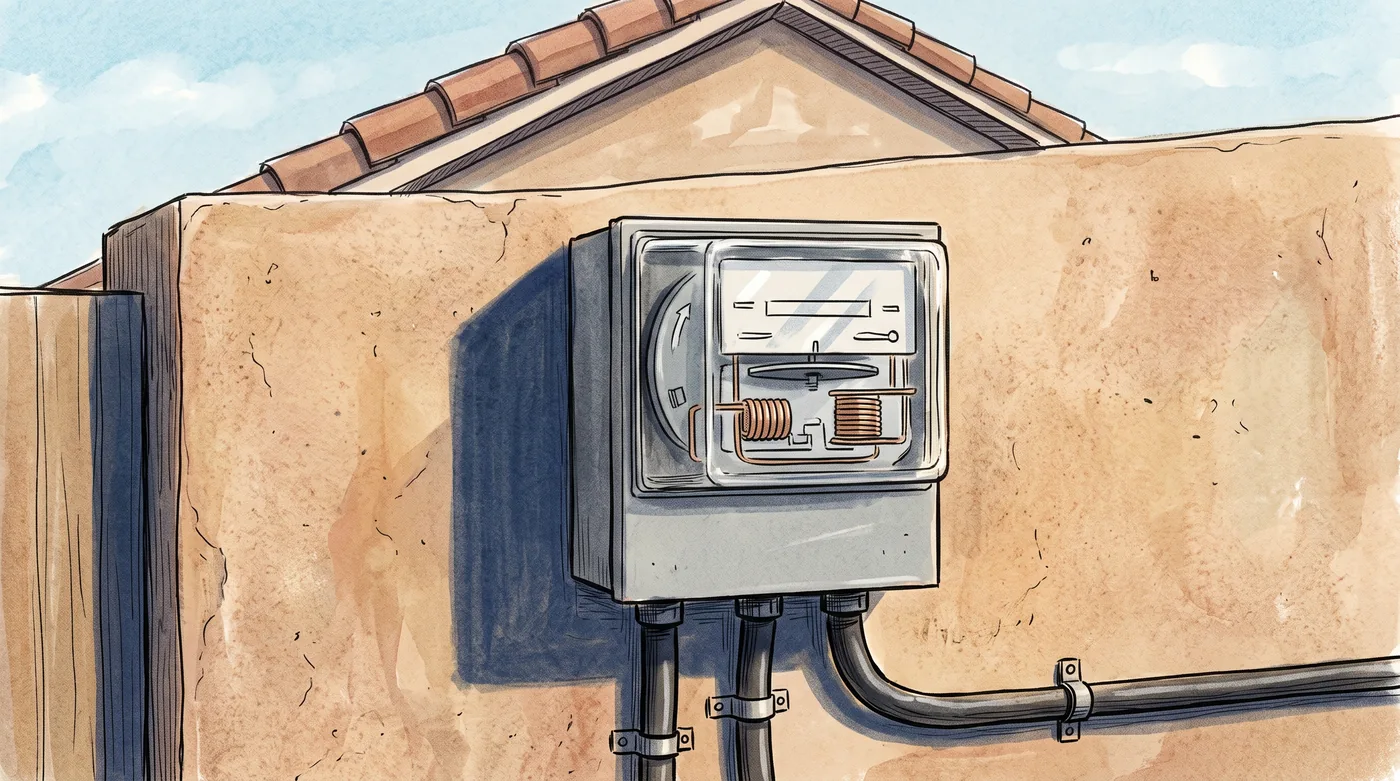
On the standard residential plan, a Las Vegas home pays $0.11622 per kilowatt hour for energy and $0.11935 all in once the riders are counted, on the schedule effective July 1 2026. On top of that sits a $18.00 monthly basic service charge that arrives whether you use anything or not.
That is the whole answer for most houses. The rest of this page is where each part comes from, why the number people quote each other is usually wrong, and what happens on October 1.
The standard plan, line by line
Schedule RS is the standard single family residential rate. Schedule RM is the multi family equivalent, and it is cheaper on both counts, which matters if you live in a condo or an apartment and have been comparing notes with someone in a house.
| Effective July 1 2026 | Schedule RS, single family | Schedule RM, multi family |
|---|---|---|
| Basic service charge, per month | $18.00 | $8.20 |
| Energy, per kilowatt hour | $0.11622 | $0.10732 |
| Total effective rate, per kilowatt hour | $0.11935 | $0.11001 |
Two more things land on the bill and neither is in the table above. A 5 percent Clark County local government fee applies, and a Universal Energy Charge of $0.00039 per kilowatt hour goes to the State of Nevada's energy assistance fund.
This is why the rate someone tells you at a barbecue is almost always lower than the rate you actually pay. They are quoting the consumption charge. Your bill divided by your kilowatt hours is the real number, and it is higher.
If your bill is higher than you expected for reasons that are not the rate, why is my NV Energy bill so high this summer works through the cooling arithmetic instead.
The time of use plan, and the 6 to 9 pm problem
The optional residential time of use plan is a genuinely different product, not a discount. It prices the same kilowatt hour differently depending on when you use it.
| Optional time of use, effective July 1 2026 | Per kilowatt hour |
|---|---|
| Winter, all hours | $0.08658 |
| Summer, off peak | $0.07305 |
| Summer, on peak, 6:01 pm to 9 pm | $0.47155 |
Read the last two rows together. Summer on peak is about 6.5 times summer off peak, on the same plan, on the same day, three hours apart. Winter and summer off peak are both well below the standard rate.
So the plan rewards a household that can move load out of those three hours and punishes one that cannot. The three hour window is also, inconveniently, exactly when a Las Vegas house is hottest inside and the sun is going down, which is why it matters so much to solar owners specifically. Why a battery pays for itself between 6 and 9 pm works that case through.
Nobody should switch plans on a table of rates. Switch on your own hours, which you can download: how to pull your last 12 months of NV Energy usage includes the 15 minute interval data that actually answers the question.
What changes on October 1 2026
The rates reset, and the October insert is already published.
| Schedule RS | Effective July 1 2026 | Effective October 1 2026 |
|---|---|---|
| Energy, per kilowatt hour | $0.11622 | $0.11379 |
| Deferred energy component | $0.00000 | minus $0.00250 |
| Total effective rate | $0.11935 | $0.11514 |
The rate falls. That is worth saying plainly, because most coverage of utility rates assumes only one direction.
It also moves the solar export credit, because that credit is defined as a percentage of the retail rate rather than as a fixed number of cents. On the July schedule the NMR-405 Tier 4 Excess Energy Credit is $0.08717 per kilowatt hour. When the retail rate moves, the credit moves with it. This is the single most common mistake in solar sales material: quoting one export rate and treating it as fixed for twenty years. The percentage is fixed by statute. The thing it is a percentage of is not.
Net metering in Nevada sets out how that credit is calculated and what it can pay for.
The floor under every bill
No system, and no plan, gets your bill to zero.
Excess energy credits can be applied to future energy consumption charges. They cannot be applied to the basic service charge, to additional meter charges, or to local government fees. So a solar home on Schedule RS still pays at least the $18.00 every month, plus the fees, however good the production was.
How to read your NV Energy bill once you have solar shows exactly where each of those lands on the statement.
One more component is coming
From January 1 2027, southern Nevada residential bills gain a daily demand charge, priced on the single highest 15 minutes of use in each day. It is scheduled for January 1 2027, under appeal. It is a separate component from everything on this page, net metering credits will not offset it, and it changes which plan suits which household.
We keep the daily demand charge current as that moves.
How to check every number here yourself
- Go to nvenergy.com/rates and open the residential rate schedule bill insert for the current quarter. Every figure in the first table is on it.
- Open the net metering rate schedule from the same page for the Excess Energy Credit by tier.
- Divide your own most recent bill by your own kilowatt hours. That is your effective rate, and it is the only one that is actually yours.
Questions people ask us
What does NV Energy charge per kWh in Las Vegas?
On Schedule RS, the standard single family residential rate, the energy charge is $0.11622 per kilowatt hour and the total effective rate is $0.11935 once the riders are included, on the schedule effective July 1 2026. There is also an $18.00 monthly basic service charge that no amount of solar removes.
Why is my effective rate higher than the number I was quoted?
Because the quoted number is usually the consumption charge alone. Riders sit on top of it, then a 5 percent Clark County local government fee applies, and the basic service charge is added whatever you use. The all in figure is what your bill divided by your kilowatt hours actually produces.
Is the time of use plan cheaper?
It depends entirely on when you use power. On the optional residential time of use plan, summer off peak is $0.07305 per kilowatt hour, which is well below the standard rate, but summer on peak between 6:01 and 9 pm is $0.47155. That is roughly 6.5 times the off peak price, on the same plan, in the same day.
What is changing on October 1 2026?
The residential rates reset. On Schedule RS the total effective rate falls from $0.11935 to $0.11514, and the deferred energy component goes from zero to minus $0.00250 per kilowatt hour. The net metering export credit moves with it, because the credit is a percentage of the retail rate rather than a fixed number.
Do solar credits reduce the basic service charge?
No. Excess energy credits can be applied to future energy consumption charges only. They cannot be applied to the basic service charge, to additional meter charges or to local government fees. That is why a solar home still receives a bill every month even in a strong production month.
Which plan should a house with solar be on?
There is no single answer, and anyone who gives you one without looking at your usage is guessing. The question is what share of your consumption lands between 6:01 and 9 pm in summer, when the sun is going or gone. Pull your own interval data first, then compare the plans against your actual hours.
Where these numbers come from
- NV Energy, Nevada Power Company electric rate schedules for residential customers, effective July 1 2026: Schedule RS basic service charge $18.00, energy $0.11622 per kWh, $0.11935 total effective rate; Schedule RM $8.20 and $0.11001; optional time of use winter $0.08658, summer on peak $0.47155, summer off peak $0.07305 checked 2026-09-21
- NV Energy, Nevada Power Company electric rate schedules for residential customers, effective October 1 2026: Schedule RS total effective rate $0.11514 and the deferred energy component at minus $0.00250 per kWh checked 2026-09-21
- NV Energy, southern Nevada net metering rate schedule effective July 1 2026, NMR-405 Tier 4 Excess Energy Credit $0.08717 per kWh checked 2026-09-21
- NV Energy, NMR-405 Tier 4 page, on what excess energy credits may and may not be applied to (read through the site's own content endpoint, because the public page renders its text from script) checked 2026-09-21
Actual utility rates may go up or down and actual savings may vary. Every figure on this page is an estimate based on the sources listed below, not a promise about your home.
We recheck this page quarterly. Last checked 2026-09-21. If a number here has moved, tell us and we will fix it the same week.