
Net metering and the daily demand charge
Solar when your power company is not NV Energy
Boulder City, Moapa Valley, Mesquite, Pahrump and Lincoln County buy power from someone else. Nevada's net metering law does not follow you there.
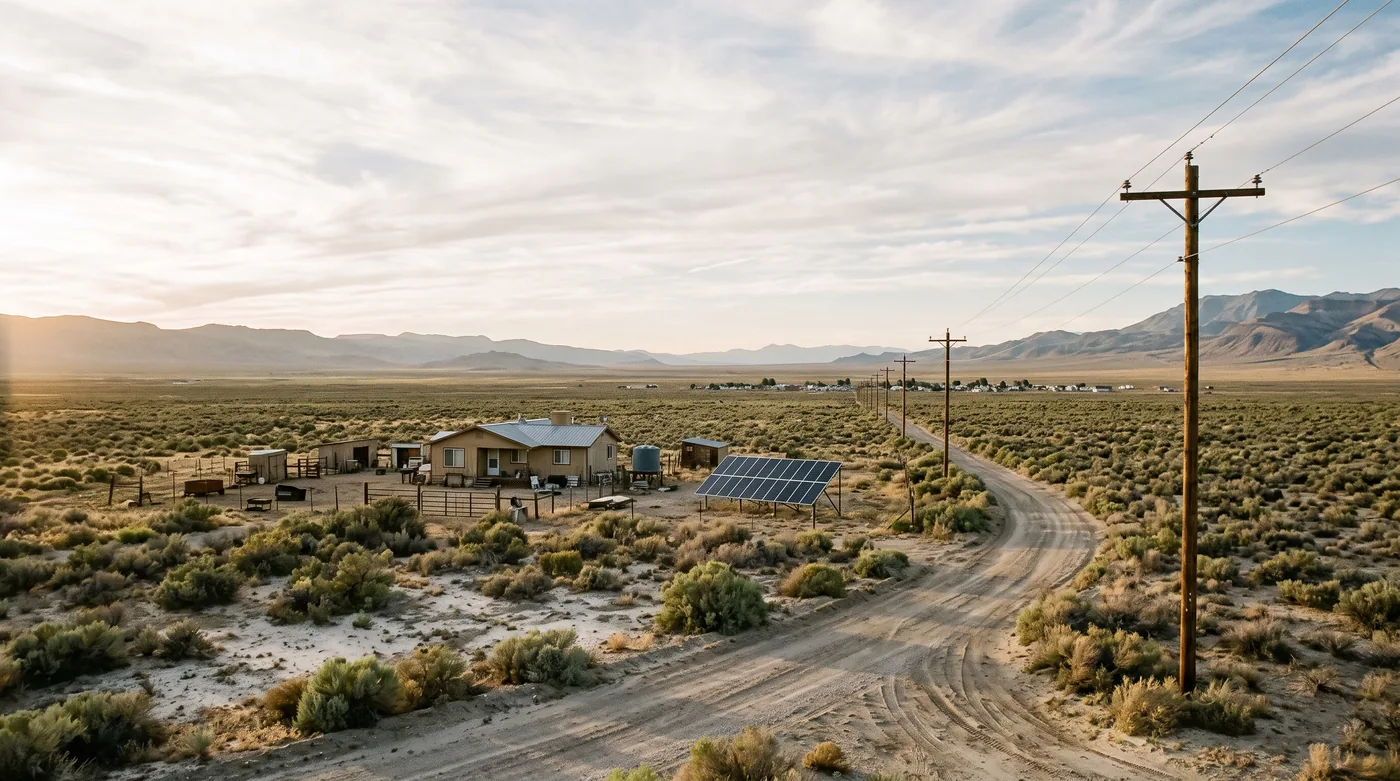
If your electric bill comes from Boulder City, Overton Power District No. 5, Valley Electric Association or Lincoln County Power, you are not an NV Energy customer and Nevada's net metering law does not reach you. Solar still works on your roof. The credit you get for what you send back is set by your own utility, not by the state, and in every one of these four it is worth less than the retail rate.
Almost every solar page written about Southern Nevada assumes NV Energy. This one is for the addresses that are not.
Why the state law stops at the NV Energy line
Nevada's net metering rules live in NRS 704.766 to 704.776. NRS 704.773 is the section that requires a utility to offer net metering, and NRS 704.7732 is the section that sets what the credit is worth, in the tiers that end at 75 percent of retail today.
The word that decides who those sections apply to is in NRS 704.772: "Utility means a public utility that supplies electricity in this State."
A city that owns its own poles is not a public utility. Neither is a power district formed under state improvement district law, nor a member-owned rural cooperative. So the statute, the Public Utilities Commission of Nevada, and the 20 year rate lock that comes with an NV Energy net metering application all stop at the edge of NV Energy's service territory.
You do not have to take that reading from us. Lincoln County Power says it in its own policy, in writing:
Lincoln County Power is not subject to the requirements of NRS 704.773 requiring a utility to offer "net metering" to its retail electric service customers who produce renewable electric energy using solar or wind generators at their homes or businesses, or any regulation of the Public Utilities Commission of Nevada regarding "net metering". However, pursuant to this Policy, Lincoln County Power does voluntarily offer to purchase excess energy from its retail customers who install small-scale renewable generating facilities.
Read the second sentence as carefully as the first. These utilities do offer something. They offer it voluntarily, they set the terms themselves, and the terms can be changed by a board vote rather than by a rate case.
Find out who bills you before anything else
The test is the name at the top of the bill you already pay. Not your mailing city, not your zip code, not what the neighbourhood is called.
| Utility | What it is | Where its offices are |
|---|---|---|
| City of Boulder City | Electric utility owned and run by the city | 401 California Avenue, Boulder City |
| Overton Power District No. 5 | Power district serving the Moapa and Virgin Valleys | Overton and Mesquite |
| Valley Electric Association | Member-owned rural electric cooperative | Pahrump |
| Lincoln County Power District No. 1 | Power district serving much of Lincoln County and a small part of Clark County | Panaca |
Everything else in Clark County, including Las Vegas, Henderson, North Las Vegas, Summerlin, Enterprise, Spring Valley and Paradise, is NV Energy, and the rest of this site is written for you.
One thing does not change anywhere on this list. Your building permit still comes from the county or city your parcel sits in, with the same fire pathways, the same setbacks and the same inspection. That is set out in solar permits in Las Vegas, Henderson, North Las Vegas and Clark County. What changes is the second half of the job: instead of an NV Energy application, you go through your own utility's interconnection process.
Boulder City
Boulder City owns its electric system. The city's Electric Service Information page says it takes most of its power from hydroelectric sources, Hoover Dam and Glen Canyon Dam, and that it is a member of the Silver State Energy Association, which schedules power purchases for the city and for other entities in Southern Nevada.
The city publishes a net metering policy, and it is more detailed than most people expect.
How you get connected. You need an approved city building permit before construction starts and a passed inspection by the City Building Division afterwards. Then you execute an interconnection agreement with the city, pass an interconnection test witnessed by the city, and get final approval before the system is allowed to run in parallel with the grid.
What the credit is worth. In any month where you use more than you send back, you are billed normally. In a month where you send back more than you use, the policy says you are credited for the difference "at a rate equal to the city's average cost for wholesale electrical energy." The city calculates that figure each February for the summer months, May to October, and each August for the winter months, November to April.
What happens to the credit. Excess credits carry forward to later billing periods and expire 12 months after they are issued. The policy is explicit that you cannot take money for them, cannot transfer them to another customer or another property, and cannot use them to offset other charges such as the monthly customer charge.
How big a system you are allowed. Capacity must not exceed 80 percent of your yearly average consumption over the past three years. The policy adds that additional requirements may apply where capacity exceeds 10 kilowatts on a single-phase system or 100 kilowatts on a three-phase one.
Three conditions that catch people out.
- A disconnect switch accessible to city personnel at all times, load-break rated, checkable and operable from outside its enclosure and padlockable in the open position, within 10 feet of the net meter.
- The Building Division may require a special inspection at your expense if the system was not installed by a Nevada licensed C-2 or C-2g electrical contractor.
- You are required to run the periodic interconnection tests described in IEEE Standard 1547 at least once every two years, notify the city so it may witness them, keep the records, and make them available. That is an ongoing obligation for the life of the system, and no other utility on this page publishes one like it.
The city also states that the customer must maintain adequate insurance and indemnifies the city against loss arising from the design, construction, operation or maintenance of the system. That is a real difference from NV Energy territory, and it is covered in what your homeowners insurance does and does not cover once you have solar.
Renewable energy credits belong to you under the city's policy. The city will swap your revenue meter for a net meter at no charge if the existing equipment and location meet current codes.
Overton Power District No. 5
OPD5 serves the Moapa and Virgin Valleys. Its own history page describes the district being formed in 1935 out of Overton, Logandale, Moapa and Glendale, with Mesquite and Bunkerville joining the application so the region could apply as a single district. It runs offices in Overton and Mesquite.
A note on sourcing before the terms. The opd5.com website refuses our requests, so the two documents below are archived copies of OPD5's own published files held by the Internet Archive, with the snapshot dates given in the source list. Confirm the current terms with the district before you sign anything.
The regulation. Net metering at OPD5 is governed by Operating Regulation OPD S 9.101, revision 2, last revised April 7 2021.
System size. Total installed generation for a residential customer is limited to 10 kW. More is permitted only with the approval of the district's engineering department, and the customer pays for any power system upgrades needed to accommodate it. Generation must also be sized to the customer's average annual energy requirement and must not exceed the service entrance capacity.
What the credit is worth, and when it disappears. The regulation says the energy your system makes each month in excess of your usage is credited in dollars at the average cost of power, for use the following month. Then this: at the completion of your billing cycle in December, OPD5 zeroes the account of any excess credits. There is no credit or buyback for the excess.
That is the sentence to read twice before sizing a system out here. A system built to cover a hot Moapa Valley summer will bank credit through spring and lose whatever is left every December.
The base charge stands. A net metering customer is responsible for the monthly base charge, and the regulation states the base charge cannot be zeroed out using credits.
A district-wide ceiling. OPD5 will accept up to a total of 5,000 kW of renewable generation on its system, and reserves the right to refuse additional applications once that level is reached.
The rate. OPD5's rate schedule effective July 1 2026 lists a residential base charge of $36.40 per month, with energy at $0.09010 for the first 500 kWh, $0.11010 for the next 1,500 kWh and $0.12090 above 2,000 kWh. Residential Net Meter customers, Rate 9 and Rate 101, pay the same as residential and are shown with a Return Rate of $0.06000.
Put those two numbers next to each other. You buy at roughly nine to twelve cents and the return rate on the schedule is six cents. Every kilowatt hour your house uses as it is made is worth about twice as much to you as one you export. That single fact should drive the design of the system, the direction the panels face, and whether you run the pool pump and the laundry at noon.
You obtain the permits and the inspection from the county or city. OPD5 verifies the installation and requires a manual disconnect within three feet of the meter.
Valley Electric Association
Valley Electric is a member-owned nonprofit cooperative headquartered in Pahrump. Its media page says the service territory covers more than 6,800 square miles in Nevada and California, spanning several counties.
Valley Electric is the one utility on this page that has already finished the transition everyone else is arguing about. Its Distributed Generation Policy, effective October 2 2024, says in its own opening that it "replaces and combines the Association's previous 'Distributed Generation' and 'Net Metering' policies."
What replaced net metering. Net Billing. Energy you draw is billed at the retail rate at the time you use it. Energy you send back is credited at a Bill Credit for Over-Generation, which for residential systems up to 25 kW with applications completed after August 30 2024 equals the Avoided Cost, defined in the policy as the value the cooperative would have paid for that kilowatt hour from the market at the moment you fed it back.
The legacy window, and it has closed. A residential system of 25 kW or less with a valid application on or before August 30 2024, installed with permission to operate issued by March 31 2025, is a Legacy system for eight years from the date of installation. Legacy systems are credited at 75 percent of the retail rate for those first eight years and at Avoided Cost after that. The policy also says the net metering framework continues for Legacy systems until time of use rates are implemented, at which point net metering is retired and outstanding excess energy credits are purchased or retired.
If you are buying solar in Pahrump today, you are in the Avoided Cost group. Anyone quoting you a 75 percent number is quoting the closed window.
Metering and approvals. The member pays interconnection and any distribution upgrade costs. A net meter and a production meter are both required. You need a Permission to Construct letter before construction and a Permission to Operate letter before the system is energized, and the cooperative states it will lock out a system energized without them.
One clause worth knowing before you plan a battery. Any change in capacity or construction of an existing system, including adding panels or adding battery storage, is treated as a new system and requires a new application. That is the opposite of how NV Energy treats a storage-only addition, and it means a phased plan out here has to be priced as two projects.
The rate. Valley Electric's rates effective July 1 2025 show a residential basic service charge of $40 per bill and an energy charge of $0.145 per kWh, before the power cost adjustment the cooperative bills separately.
The cooperative also takes the portfolio energy credits from your system as a condition of participating.
Lincoln County Power District No. 1
Lincoln County Power says in Policy 403 that it provides retail electric service throughout much of Lincoln County, Nevada and to a small portion of Clark County, Nevada. Its offices are in Panaca.
What it offers. Policy 403, adopted October 12 2021, defines a small-scale renewable generating facility as photovoltaic panels or a wind turbine with a total combined rated capacity of 10 kilowatts or less, installed on the premises of a retail customer. The district's Solar Solutions page repeats the 10 kW DC residential limit and asks customers to contact it before purchasing or installing anything.
What the energy is worth. Policy 403 says Lincoln County Power will purchase energy delivered to it from a customer's small-scale renewable generating facility at Lincoln County Power's avoided cost rate. Metering is a single bi-directional meter, provided at the district's cost if your existing meter cannot measure flow in both directions.
The part that will surprise a Las Vegas reader. Residential customers who install solar behind the meter go onto rate schedule RS-R-AC2, Residential Service with Renewable Generating Facility, adopted October 12 2021 and effective November 1 2021. That schedule carries a facilities service charge of $20.00 per meter per month, a base energy rate of $0.04965 per kilowatt hour, and a demand rate of $7.47 per kilowatt per month, plus the purchased power adjustment.
A demand charge is a price applied to your highest measured power draw rather than to the energy you used. Lincoln County Power's own notice explains why it did this: it says its costs are not reduced when a customer installs solar, because it must still stand ready to supply the whole house the moment a cloud arrives, and that the previous residential rate structure shifted those fixed costs onto customers without solar. It states the change applies only to new solar installations after November of 2021 and that customers with solar before that date are grandfathered.
NV Energy has a daily demand charge of its own scheduled for January 1 2027, under appeal, which is set out in the NV Energy daily demand charge. Lincoln County Power has been billing residential solar customers on a demand rate since November 2021. If you want to know what a demand charge does to a solar payback in practice, the answer already exists up in Lincoln County, and it has five years of billing behind it.
What actually changes about buying solar out here
Four things, in the order they will affect your quote.
- The size cap is a hard design constraint, not a guideline. Overton Power District and Lincoln County Power both cap a residential system at 10 kW. Boulder City caps it at 80 percent of your three year average consumption and adds requirements above 10 kW on a single-phase service. Valley Electric treats a residential system above 25 kW as a commercial one. A quote that ignores the cap is a quote that will be rejected at interconnection.
- Exported energy is worth much less than energy you use yourself. Avoided cost, wholesale average cost and a six cent return rate are all a long way below retail. The value of the system moves toward what you consume during daylight, which moves the design toward a west-leaning array, a bigger emphasis on daytime loads, and a different battery conversation.
- A battery is not the same purchase. In NV Energy territory a battery is largely an answer to the evening peak and the coming demand charge. Out here it is mostly a self consumption tool, and at Valley Electric adding one later restarts the application.
- Credits can expire or be zeroed. OPD5 zeroes excess credits each December. Boulder City expires them 12 months after issue. Neither pays cash. Size to your own use, not to a bank balance.
Ask your utility these seven things in writing, before you sign
- What is the maximum system size you will approve at my service, and is that in kW DC or kW AC?
- What exactly do you pay for energy I export, what is the current number, and how often is it recalculated?
- Do credits carry forward, do they ever expire or get zeroed, and can they offset the base or facilities charge?
- Which rate schedule will I be moved to once the system is on, and may I have a copy of it?
- What is the interconnection application fee, and what does the inspection cost?
- Do you require a specific disconnect, its location, and any ongoing testing?
- Is the offer set by policy or by tariff, and what notice would I get if the board changed it?
Get the answers on letterhead or in an email you keep. In NV Energy territory the answers are in a published handbook and a tariff. Out here they are in a board policy that can be amended, and the copy you were given at the time is the only record of what you were told.
Where we work
We are a licensed Nevada electrical contractor in Las Vegas, and rooftop solar is electrical work before it is anything else. If your address is on one of these four systems, tell us that on the first call. The design, the interconnection paperwork and the value of the system are all different from the ones the mailers in your letterbox were written about, and the honest version of your quote starts with knowing which utility you are on.
Questions people ask us
Is Boulder City on NV Energy?
No. Boulder City runs its own electric utility. The city's Electric Service Information page says it takes most of its power from hydroelectric sources at Hoover Dam and Glen Canyon Dam and buys through the Silver State Energy Association. Because the utility belongs to the city rather than to a public utility company, the city writes its own net metering policy.
Does Nevada's net metering law apply outside NV Energy territory?
Generally no. NRS 704.773 requires a utility to offer net metering, and NRS 704.772 defines utility as a public utility that supplies electricity in this State. Lincoln County Power's own Policy 403 states plainly that it is not subject to NRS 704.773 or to any net metering regulation of the Public Utilities Commission of Nevada.
Can I still put solar on my house in Overton, Logandale or Mesquite?
Yes. Overton Power District No. 5 publishes a net metering regulation, OPD S 9.101, last revised April 7 2021. It caps residential generation at 10 kW unless the district's engineering department approves more, and it credits excess energy in dollars at the district's average cost of power rather than at the retail rate.
What is Valley Electric's solar credit worth?
It depends on your application date. Under Valley Electric's Distributed Generation Policy effective October 2 2024, residential systems up to 25 kW with applications completed after August 30 2024 are credited at Avoided Cost. Systems with applications on or before that date, energized by March 31 2025, get 75 percent of retail for eight years from installation, then Avoided Cost.
Why does Lincoln County Power charge solar customers a demand rate?
Its own notice explains it. Lincoln County Power says it adopted new rates in the autumn of 2021 to remove what it describes as a cost shift, and put all new residential customers who install solar behind the meter on a demand rate. The rate is RS-R-AC2, effective November 1 2021. Installations before November 2021 are grandfathered.
How do I find out which utility serves my address?
Read the top of the bill you already pay. That is the only test that never gets it wrong. The four in Southern Nevada that are not NV Energy are the City of Boulder City's own utility, Overton Power District No. 5 in Overton and Mesquite, Valley Electric Association in Pahrump, and Lincoln County Power District No. 1 in Panaca.
Does the building permit change outside NV Energy territory?
The building permit still comes from the county or the city your parcel sits in, and that does not change. What changes is the second half. Instead of an NV Energy application in PowerClerk, you deal with your own utility's interconnection process, which is a different form, a different fee and a different inspection.
Where these numbers come from
- Boulder City, Net Metering Policy, Public Works and Utilities, City of Boulder City official website checked 2026-09-20
- Boulder City, Electric Service Information, Utilities Administration, City of Boulder City official website checked 2026-09-20
- Overton Power District No. 5, Operating Regulation OPD S 9.101, Net Metering, revision 2, last revised 4/7/2021, archived copy of opd5.com, snapshot 2024-06-17 checked 2026-09-20
- Overton Power District No. 5, Rate Schedule effective July 1 2026, archived copy of opd5.com, snapshot 2026-06-10 checked 2026-09-20
- Overton Power District No. 5, History, archived copy of opd5.com, 2026 snapshot, which names the Moapa and Virgin Valley communities the district was formed to serve checked 2026-09-20
- Valley Electric Association, Distributed Generation Policy, reviewed and approved 10/2/2024, effective 10/2/2024 checked 2026-09-20
- Valley Electric Association, Distributed Generation member page, application sequence, Permission to Construct and Permission to Operate checked 2026-09-20
- Valley Electric Association, VEA Electric Rates effective July 1 2025 checked 2026-09-20
- Valley Electric Association, Media Resources, which states the service territory is more than 6,800 square miles in Nevada and California checked 2026-09-20
- Lincoln County Power District No. 1, Policy No. 403, Small-Scale Renewable Generating Facilities, original and last revised date October 12 2021, revision 1 checked 2026-09-20
- Lincoln County Power District No. 1, Rate Schedule RS-R-AC2, Residential Service with Renewable Generating Facility, Rural, adopted October 12 2021, effective November 1 2021 checked 2026-09-20
- Lincoln County Power District No. 1, New Rates for Residential Net-Metered Installations, district notice checked 2026-09-20
- Lincoln County Power District No. 1, Solar Solutions, which states the 10 kW residential limit checked 2026-09-20
- NRS 704.772, Utility defined, and NRS 704.773, Utility required to offer net metering, Nevada Revised Statutes as posted by the Nevada Legislature checked 2026-09-20
- NV Energy, Net Metering and Energy Storage Interconnection Handbook, version 7 dated 10/16/2025 checked 2026-09-20
Actual utility rates may go up or down and actual savings may vary. Every figure on this page is an estimate based on the sources listed below, not a promise about your home.
We recheck this page quarterly. Last checked 2026-09-20. If a number here has moved, tell us and we will fix it the same week.