
Buying solar
How many solar panels a Las Vegas house needs
The sizing arithmetic in four steps, the Nevada rule that caps how big a system may be, and why a panel count on its own tells you almost nothing.
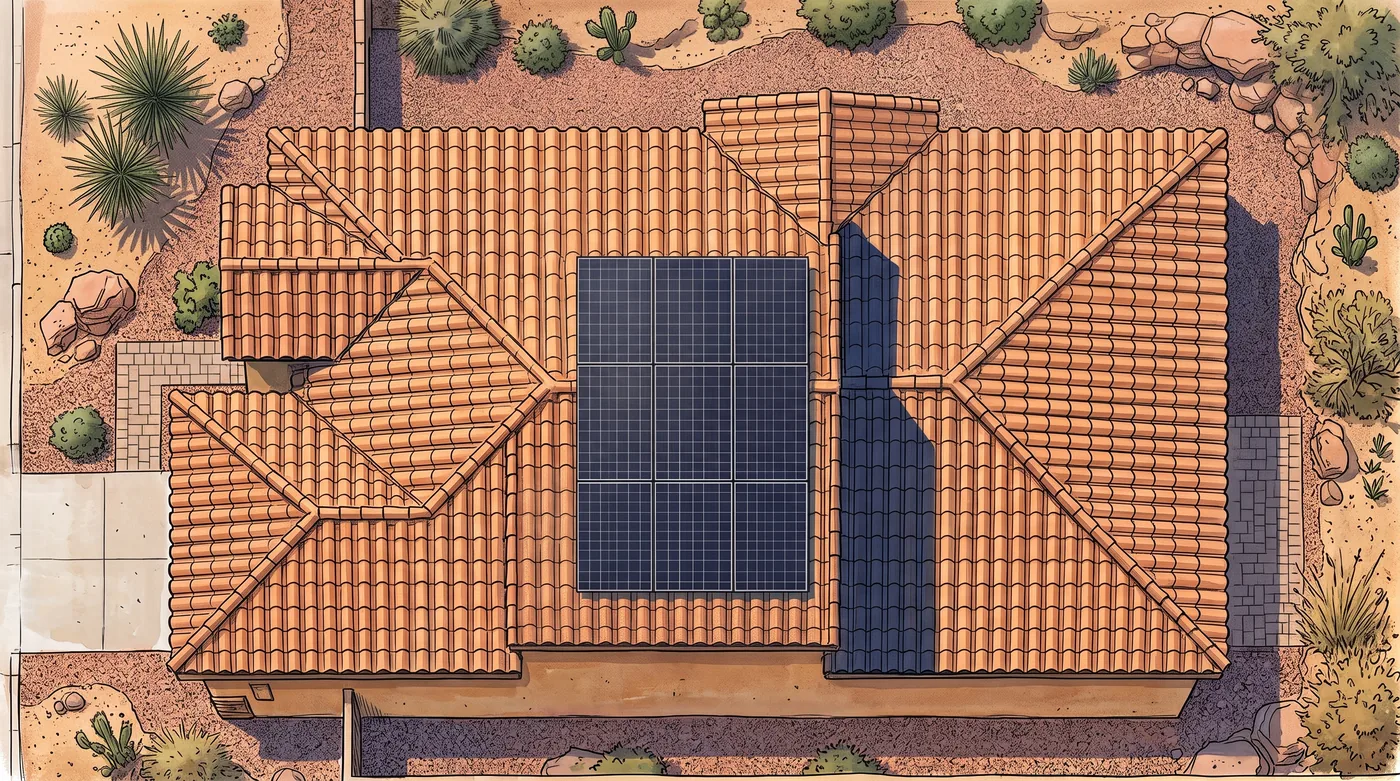
A panel count on its own tells you almost nothing, and it is the first thing everybody asks.
Twenty panels at 400 watts is 8 kW. Twenty panels at 455 watts is 9.1 kW. Same count, 14 percent more system. So the honest sequence runs the other way round: your usage decides the system size, the system size decides the panel count, and the count is the last thing you work out rather than the first.
For scale, EnergySage puts the average Las Vegas system at 13.49 kW as of September 2026. That is an average across many houses, not a target.
The rule that caps it before your roof does
You cannot simply fill the roof.
NV Energy's interconnection handbook requires a net metering system to be sized to meet no greater than 100 percent of your annual electricity needs, and that is checked against your own billing history when the application is reviewed. Nevada law points the same way: a net metering system is defined as one intended primarily to offset part or all of your own requirements for electricity.
So the binding limit is usually your bill, not your roof. People are often surprised by that, because every other part of the sales conversation is about roof space.
Step one, and there is no shortcut
Get twelve months of your own kilowatt hours.
Not one bill. Not a summer average. A Las Vegas house in July and the same house in January are effectively two different buildings, and a system sized off either one alone will be wrong in a predictable direction. How to pull your last 12 months of NV Energy usage walks through getting it, including the interval data.
Add the twelve months together. That annual total is the number everything else works from, and it is the same number NV Energy will check.
Step two: production per kilowatt is modelled, not assumed
To turn an annual usage figure into a system size you need to know roughly what a kilowatt of panels will produce on your roof in a year.
That figure is not a constant. It moves with which way your roof faces, its pitch, and what shades it and when. A south facing plane and a west facing plane on the same house do not produce the same amount, and a rule of thumb quoted at a kitchen table is not a substitute for modelling your actual roof.
Ask every company for its first year production estimate and the assumptions behind it, in writing. That single document is what makes two quotes comparable, and Nevada requires a production estimate on a purchase agreement anyway.
Then the arithmetic is simply your annual usage divided by the modelled production per kilowatt, capped at your annual need.
Step three: the panel count, finally
Divide the system size by the wattage of the panel actually being quoted.
| System size | At 400 W panels | At 455 W panels |
|---|---|---|
| 8 kW | 20 panels | 18 panels |
| 10 kW | 25 panels | 22 panels |
| 13.5 kW | 34 panels | 30 panels |
Neither column is better. A quote with fewer panels is not a smaller system and a quote with more is not a more generous one. Compare kilowatts and price per watt, which is what what solar costs in Las Vegas in 2026 is about.
Why the last few panels are worth less than the first few
This is the part that changes how people think about size.
Once a system is covering what you actually use during daylight, the extra generation goes out to the grid, and under NMR-405 Tier 4 it is credited at $0.08717 per kilowatt hour against the $0.11935 you pay for power on Schedule RS. Every panel beyond your own daytime use is earning at the lower rate.
So returns taper. The first panels displace power you would have bought. The last ones sell power at a discount. That is not an argument for a small system, it is an argument for sizing against how you actually use electricity rather than maximising the roof.
What "75% of retail" actually costs you has the consequence in full, and is solar worth it in Las Vegas puts it into the payback question.
What else can shrink the answer
- Usable roof area on the right planes. Total square footage is not the same as usable area once setbacks, vents, and pathways are taken out.
- Shading, from a tree, a parapet or a neighbour's second storey.
- Roof age and condition. A roof near the end of its life should be dealt with first.
- Your main electrical panel. If it cannot take the interconnection it needs upgrading, and that is real electrical work with a real cost.
If you expect your usage to grow
An electric vehicle or a new pool pump changes the picture, and you cannot simply build ahead because of the 100 percent cap.
Say so at the quoting stage and ask specifically how it is handled. It matters beyond the size, because adding generation to an existing system later can move you off the net metering rate you started on. Adding panels changes your net metering rate is the long version of why that is worth getting right the first time.
We size from twelve months of your own bills and your own roof, and you get the production estimate and the assumptions in writing before any of it becomes a price.
Questions people ask us
How many solar panels does a Las Vegas house need?
There is no single answer, and a company that gives you one before seeing your bill is guessing. The size comes from your own annual kilowatt hours, and the panel count then comes from the wattage of the panel being used. The same system size can be 20 panels or 26 depending on the panel.
Can I just build the biggest system that fits on my roof?
No. NV Energy's interconnection rules require a net metering system to be sized to meet no more than 100 percent of your annual electricity needs, and that is checked against your own billing history during application review. Roof space is a second limit, not the first one.
Why does the panel count differ between two quotes for the same house?
Usually panel wattage. A 10 kW system is 25 panels at 400 watts or 22 at 455. Neither is better because of the count. Compare the system size in kilowatts and the price per watt, and treat the panel count as a detail rather than the headline.
Should I size for my current bill or for future use?
Nevada caps you at your annual need, so you cannot build ahead speculatively. If you know an electric vehicle or a pool pump is coming, say so at the quoting stage and ask how it is treated, because adding generation later can move you off the net metering rate you started on.
Does a bigger system always save more?
Not proportionately. Once you are covering your own daytime use, the extra generation is exported and credited at less than you pay for power, so each additional panel returns less than the one before it. That is the point where more panels stops being the obvious answer.
What limits the size besides my usage?
Usable roof area on the right planes, shading, the condition and age of the roof, and whether your main electrical panel can take the interconnection. Any of those can reduce the system below what your usage would otherwise justify.
Where these numbers come from
- NV Energy, Net Metering and Energy Storage Interconnection Handbook, on the requirement that a net metering system be sized to meet no greater than 100 percent of the customer's annual electricity needs, checked against billing history at application review checked 2026-09-21
- NRS 704.771, definition of a net metering system, including that it is intended primarily to offset part or all of the customer-generator's own requirements for electricity checked 2026-09-21
- NV Energy, southern Nevada net metering rate schedule effective July 1 2026, NMR-405 Tier 4 Excess Energy Credit $0.08717 per kWh, against the Schedule RS total effective rate of $0.11935 checked 2026-09-21
- EnergySage, solar panel cost data for Las Vegas, Clark County, Nevada, as of September 2026: average system size 13.49 kW checked 2026-09-21
Actual utility rates may go up or down and actual savings may vary. Every figure on this page is an estimate based on the sources listed below, not a promise about your home.
We recheck this page quarterly. Last checked 2026-09-21. If a number here has moved, tell us and we will fix it the same week.