
Net metering and the daily demand charge
Adding panels changes your net metering rate
Adding panels to an existing Las Vegas system moves you to the net metering rate open today. Repairing it or adding a battery does not. The rules and the cents.
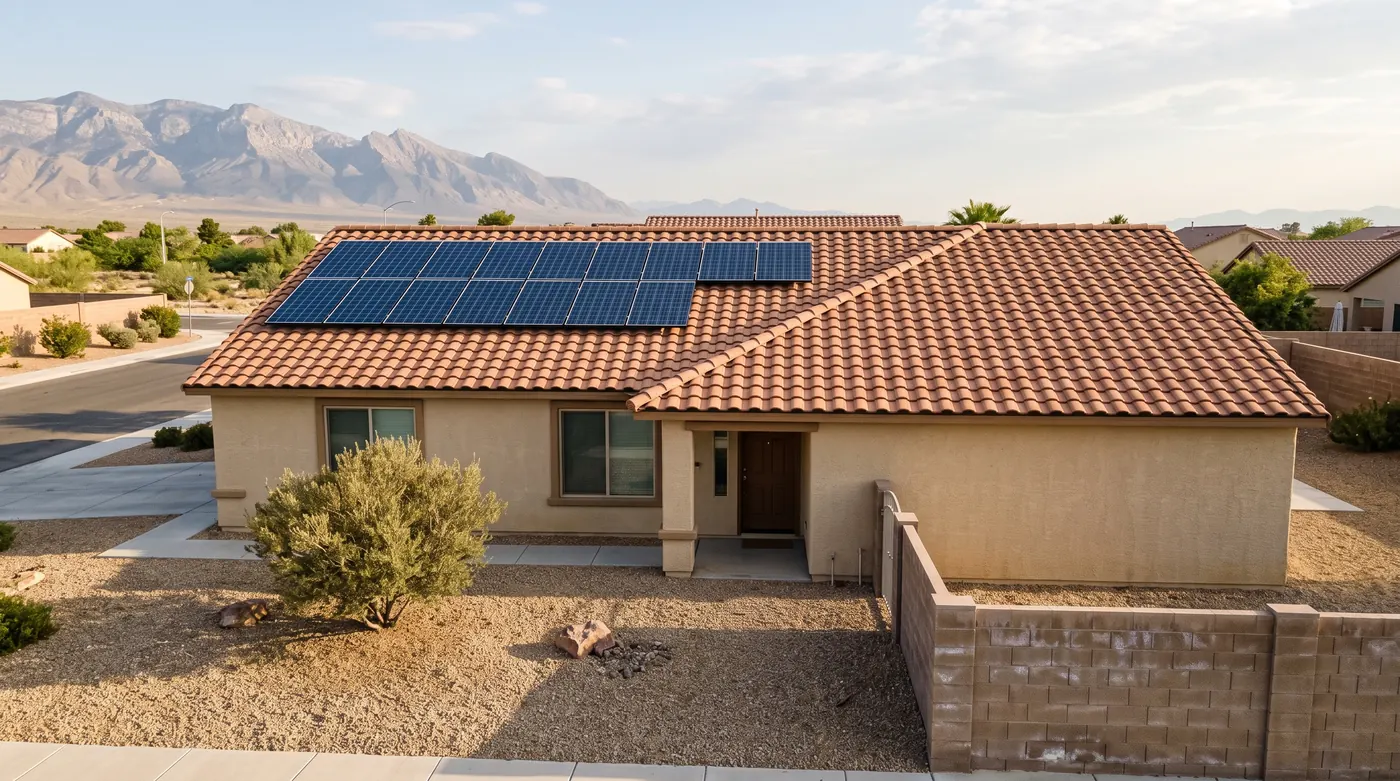
Adding panels to a solar system you already have can move you to the net metering rate that is open today, which is Tier 4 at 75 percent. Repairing or replacing what broke usually does not. Adding a battery with no new panels does not. If your original application went in before June 2020, the difference is money on every bill for the rest of your 20 years.
If your system went in after June 2020, you are already on Tier 4 and the rate question does not apply to you. The sizing limits further down still do.
Three jobs, three different answers
NV Energy's Net Metering and Energy Storage Interconnection Handbook, revision 7 dated October 16 2025, has a short section called System Expansions / System Replacements. It sets the rules in three sentences.
| What you are doing | What the handbook says happens to your rate |
|---|---|
| Adding panels | "A system expansion that adds additional renewable capacity to an existing system will result in a net metering rate change if the customer is not already on the applicable net metering rate." |
| Adding a battery only | "A system expansion that only adds an energy storage system and does not add any additional renewable capacity will not result in a net metering rate change." |
| Replacing a failed system or part | "A system replacement may allow a customer to keep their existing closed net metering rate: NMR G, NMR A, NMR-405 Tier 1, NMR-405 Tier 2, or NMR-405 Tier 3. All system replacement applications will go through Engineering Review to determine if remaining on the same net metering is allowable." |
Two words in the last row matter. "May allow" is not "will". A replacement keeps your closed rate only if NV Energy's engineers decide, on your application, that it can. The handbook's section on system additions ends with the same advice, more plainly: "Ask before you add!"
The law protects replacement. It says nothing about making the system bigger.
NRS 704.773 subsection 8 is your 20 year right. It requires the Commission and the utility to let you continue net metering at the location where the system was originally installed for 20 years, and it says continuing includes two things: keeping your tier percentage, and "replacing the originally installed net metering system, as needed, at any time before 20 years after the date of the installation of the originally installed net metering system."
Replacement is written into the statute. Expansion is not mentioned there at all. Neither the statute nor the handbook says what happens to the years left on your clock when an expansion moves you to a new rate. We will not guess that in your favour. Get it from NV Energy in writing before anything is designed.
Which rate you are on now
Your tier was set by a date, not by your hardware. NRS 704.7732 subsection 5 says you are treated as accepting the utility's offer on the day you submit a complete application. The Public Utilities Commission of Nevada publishes when each tier opened and closed.
| Tier | Credit, as a share of the retail rate | When it applied |
|---|---|---|
| 1 | 95 percent | From June 15 2017 until it reached 80 MW in August 2018 |
| 2 | 88 percent | From August 2018 until June 2019 |
| 3 | 81 percent | From June 2019 until June 2020 |
| 4 | 75 percent | From June 2020, open, no capacity limit |
Older systems may be on NMR-G or NMR-A, both of which the handbook lists among the closed rates a replacement may keep. NV Energy's October 1 2026 net metering insert shows NMR-G as "Banking": exported kilowatt hours banked rather than paid at a percentage. If you are on either of those, the stakes of an expansion are different and larger, so ask before you do anything.
The rate is printed on your bill. How to read your NV Energy bill once you have solar shows where.
What the move costs, in cents
NV Energy's NMR-405 page says the credit applies to the exported energy that remains after monthly netting, at a percentage of the retail volumetric rate, which it defines as the consumption rate plus the DEAA component. The October 1 2026 net metering insert prints the result for each tier on Schedule RS:
| Tier | Excess energy credit, cents per kWh, schedule effective October 1 2026 | Gap against Tier 4, cents |
|---|---|---|
| 1 | 10.573 | 2.226 |
| 2 | 9.794 | 1.447 |
| 3 | 9.015 | 0.668 |
| 4 | 8.347 | none |
The gap only applies to excess: what is left after the whole month has been netted. A kilowatt hour you export at noon and use back at eight the same month is settled against your usage and never meets the percentage. Net metering in Nevada explains why.
So the honest arithmetic uses your own bills. Add up the excess kilowatt hours across your last twelve statements and multiply by the gap. Our worked example, on the October 1 2026 figures:
- A Tier 1 house with 1,500 excess kWh a year: 1,500 × $0.02226 = $33.39 a year.
- A Tier 2 house with the same excess: 1,500 × $0.01447 = $21.71 a year.
- A Tier 3 house with the same excess: 1,500 × $0.00668 = $10.02 a year.
Two things make it bigger than that. The new panels are there to make more power, so your excess grows, and all of it is credited at the lower rate. And the rate underneath moves every time NV Energy's rates reset. If your bills show almost no excess, the tier move is small. If they show a large surplus every spring and autumn, it is real money for every remaining year.
Before you buy panels to fix something else
Many people who want more panels have a system that is making less than it used to. A failed inverter, a dead optimiser, a tripped breaker or a string left disconnected after a roof repair looks exactly like an array that is too small. Fixing that is a repair, not an expansion, and it does not touch your rate the way new panels would.
Check that first. Is my solar system working is the check we would run, and if the company that installed it has closed, what to do when your installer goes out of business covers who can still help.
If the house really does need more
The handbook limits how big the expanded system may be.
- A net metering system "must be sized to meet no greater than one hundred percent of a customer's annual electricity needs." The ceiling comes from "the highest energy usage that occurred in 12 consecutive months out of the last 24 months."
- If your loads have changed and the bills have not caught up, the handbook allows an energy audit report instead, by an auditor with an active licence from the Nevada Real Estate Division, following NRS 645D.300.
- An expansion is a new application. The handbook lists the southern Nevada initial review fee at $189 per application, and the application is cancelled if the fee is not received within 30 days of submission.
There is one kind of expansion that leaves your rate alone. A battery adds no renewable capacity, so by the handbook's own sentence it changes nothing about your percentage. Adding a battery to the solar you already have and why the 6 to 9 pm window matters work through whether that is worth it for you.
If you are buying a house on an old tier, the same rules apply to you from the day you close. Buying a Las Vegas house that already has solar covers that side.
Five questions to ask before anyone adds a panel
- Which net metering rate am I on today, and on what date did NV Energy receive the original application?
- Is this an expansion or a replacement in NV Energy's terms, and which will the application say?
- If it is an expansion, what does my excess energy credit go from and to, in cents per kilowatt hour?
- How many excess kilowatt hours did I export in the last twelve months, so we can multiply?
- What happens to the years left on my 20, confirmed by NV Energy in writing, before I sign anything?
We are a licensed Nevada electrical contractor. Ask us those five and you get the answers in writing, with the handbook open and your own bills on the table. If adding panels costs you more than it returns, that is the answer you will get.
Questions people ask us
Will adding solar panels change my NV Energy net metering rate?
It can. NV Energy's interconnection handbook, revision 7 dated October 16 2025, says a system expansion that adds renewable capacity results in a net metering rate change if you are not already on the applicable rate. If your application went in before Tier 4 opened in June 2020, adding panels can move you to the 75 percent rate.
Does adding a battery change my net metering tier?
No. The same handbook says an expansion that only adds an energy storage system, with no additional renewable capacity, does not result in a net metering rate change. A battery alone keeps whatever tier you have. It is the added panels, not the added equipment in general, that trigger the change.
Can I replace broken panels or an inverter and keep my old tier?
Probably, but it is not automatic. NRS 704.773 subsection 8 says continuing net metering includes replacing the originally installed system within 20 years of installation. The handbook says a replacement may allow you to keep a closed rate, and every replacement application goes through NV Energy's Engineering Review, which decides.
How much would I lose moving from Tier 1 to Tier 4?
On NV Energy's schedule effective October 1 2026, the Schedule RS excess energy credit is $0.10573 per kWh on Tier 1 and $0.08347 on Tier 4, a gap of about 2.2 cents. Multiply that by the excess kilowatt hours on your own bills over a year. For 1,500 excess kWh that is about $33 a year.
How big can the expanded system be?
The handbook caps a net metered system at 100 percent of your annual electricity needs, measured from the highest 12 consecutive months of usage in the last 24. If your loads changed recently, an energy audit report from an auditor licensed by the Nevada Real Estate Division can be used instead.
What does it cost to apply for an expansion?
An expansion is a new net metering application. The handbook lists the initial review fee for southern Nevada at $189 per application, paid by you or your installer, and says the application is cancelled if the fee is not received within 30 days of submission. The equipment and labour are on top of that.
Where these numbers come from
- NV Energy, Net Metering and Energy Storage Interconnection Handbook, revision 7 dated 10/16/2025: System Expansions / System Replacements, System Additions, system sizing (consumption history, energy audit report), and the application fee table (Southern Nevada $189) checked 2026-09-28
- NRS 704.773 subsection 8 (20 years at the original location, retaining the tier percentage, and replacing the originally installed system), NRS 704.7732 subsections 3 and 5 (the four percentages and acceptance on the date of a complete application), NRS 704.775 (monthly billing period and excess electricity) checked 2026-09-28
- Public Utilities Commission of Nevada, Net Metering in Nevada: the four AB 405 tiers, Tier 1 reaching 80 MW in August 2018, Tier 3 opening in June 2019 and closing in June 2020, Tier 4 with no capacity limit checked 2026-09-28
- NV Energy, NMR-405 page (southern Nevada, content endpoint): credit for remaining exported energy after monthly netting, 75 percent of the retail volumetric rate made up of the consumption rate and DEAA, credits tied to the premise checked 2026-09-28
- NV Energy, southern Nevada net metering rate schedules effective October 1 2026, Schedule RS excess energy credits: NMR-405 Tier 1 10.573 cents, Tier 2 9.794 cents, Tier 3 9.015 cents, Tier 4 8.347 cents per kWh; NMR-G shown as banking checked 2026-09-28
Actual utility rates may go up or down and actual savings may vary. Every figure on this page is an estimate based on the sources listed below, not a promise about your home.
We recheck this page quarterly. Last checked 2026-09-28. If a number here has moved, tell us and we will fix it the same week.