
Buying solar
Selling a house with leased or financed solar in Las Vegas
Owned panels sell with the house. A loan, lease or PPA has to be paid off in escrow or taken over by your buyer. What Nevada makes you disclose, and when.
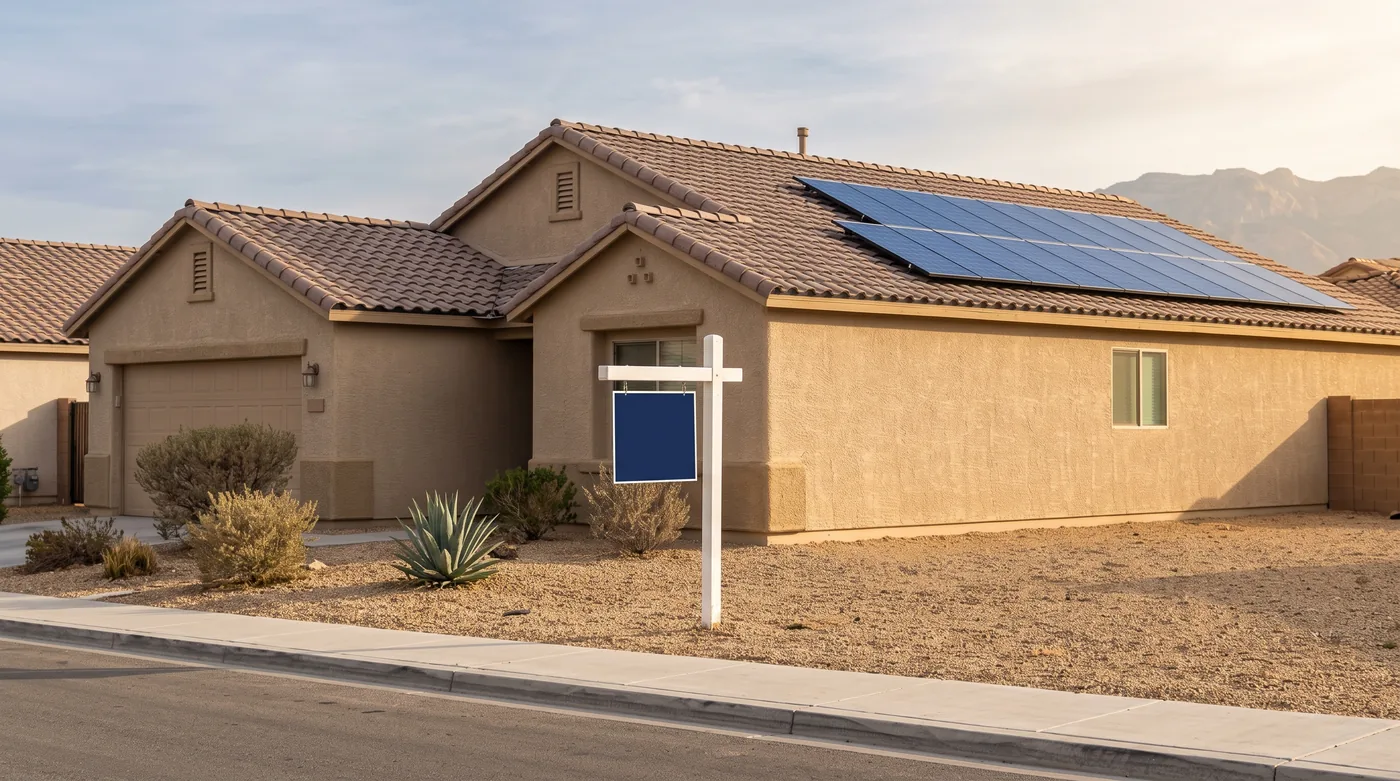
If you own your panels outright, they sell with the house like the water heater does. If there is a loan, a lease or a power purchase agreement on them, one of two things has to happen before escrow closes: your buyer takes the contract over, or you pay it off from your proceeds. Nevada makes you disclose which one you have on the state disclosure form, and your buyer's lender will read the contract whether you like it or not.
Sort this out before you list. The sales that go wrong are the ones where the solar paperwork turns up in week three of escrow.
First, find out what you actually have
Homeowners ask the same questions over and over: do I have to make the buyer take over my lease, can I just pay it off at closing, will it wreck my buyer's loan. The answer to all three starts with which of four structures you signed.
| What you signed | Who owns the panels | What has to happen when you sell |
|---|---|---|
| Cash purchase | You | Nothing special. The panels convey with the house. |
| Solar loan | You, with a lender's security interest | Paid off from your proceeds in escrow, or transferred only if the loan allows it. |
| Lease | A third party | Your buyer takes over the payments with the provider's approval, or you pay off or buy out the lease. |
| Power purchase agreement | A third party | Your buyer takes over buying the power with the provider's approval, or you buy the system out. |
If you are not sure, the latest statement you receive names the company, and the contract names the structure. Fannie Mae's selling guide makes the same split: panels a borrower owns are treated under standard rules, panels that are collateral for a separate debt are treated one way, and leased or power purchase panels another. Prepaid PPA vs lease vs loan sets the four side by side if your paperwork is hard to read.
Your contract already says how a sale works
You do not have to negotiate the rules from scratch. Nevada requires them to be written into the agreement.
- A lease. NRS 598.9811, subsection 19 in the version in force through December 31 2027, requires the lease to describe all options available to you on a sale or transfer of the property, including whether you may transfer the obligations to the buyer, the conditions of any transfer, and the process to complete a payoff of any amount owed.
- A power purchase agreement. NRS 598.9817 subsection 15 requires the same description for the host customer.
- The separate disclosure. NRS 598.9812 for a lease, and NRS 598.9818 for a power purchase agreement, require a short disclosure document that describes the transferability of the agreement and any conditions on transferring it when you sell.
- A solar loan. NRS 598.98211, added to the statutes in 2025, requires a solar loan agreement to describe the options on a sale or transfer of the property, including whether the loan can go to the buyer, the conditions and the payoff process. A loan signed before that section existed may not contain this, so ask the lender directly.
So the first job is to find three documents: the agreement, the separate Nevada disclosure that came with it, and a current payoff or buyout quote from whoever services it today. Your rights under a Nevada solar contract explains what else those documents are required to contain.
Transfer or pay off in escrow
Both routes work. They suit different sellers.
Transfer means your buyer signs up with the provider and takes over the remaining term. It costs you nothing at closing, but it depends on a stranger's credit and on the buyer wanting the contract. Read the agreement for the provider's credit requirement, any transfer fee and who pays it, the remaining term, and the yearly escalator if there is one. A buyer's agent will price years eleven to twenty, not year one.
Payoff or buyout means the amount comes out of your proceeds and the buyer gets a house with panels they own outright. It is the cleaner close and it removes the lending questions below. The cost is the figure on the payoff quote. Get that quote in writing before you set your price, because it changes your net.
A common middle path is to offer the buyer the choice, with the payoff figure disclosed up front. What does not work is saying nothing and hoping the buyer assumes it.
The fixture filing will be found
Many solar loans, leases and power purchase agreements come with a UCC fixture filing, which is a public notice that somebody has a claim on equipment attached to your house. The Nevada disclosure for a lease and for a power purchase agreement has to tell you the owner intends to file one.
NRS 104.9501 says a fixture filing goes in the office where mortgages are recorded, which in Clark County is the County Recorder, and any other financing statement goes to the Secretary of State. Your buyer's title company searches the land records as a matter of routine. If there is a filing there, it will appear on the preliminary title report.
Fannie Mae's guide treats the three cases differently:
- A loan with a fixture filing in the land records. The debt counts, and if the filing is senior to the new mortgage it must be subordinated. In practice the simplest fix is paying the loan off.
- A lease or power purchase agreement with a precautionary filing that describes only the solar equipment, not the home or the land. The guide calls that acceptable and a minor impediment to title, as long as the loan is underwritten under that topic.
- A paid off loan with a filing still on record. This is the one that stalls closings for no reason. NRS 104.9513 says that once nothing is owed, the secured party must file or send a termination statement within 20 days after receiving your signed demand. Send that demand the week you list, not the week you close.
Who owns my solar panels walks through searching the Clark County Recorder and the Secretary of State yourself. Run the search before your buyer's title company does.
What Nevada makes you disclose
The Seller's Real Property Disclosure Form, form 547, revised June 1 2023, asks it directly at question 15: are any solar panels installed on the property, and if yes, are they owned, leased or financed.
NRS 113.130 requires you, the seller, to complete that form yourself and serve it on the buyer or the buyer's agent at least 10 days before the property is conveyed. Your agent is not allowed to fill it in for you. A buyer cannot waive it, and you cannot make waiving it a condition of the sale. If something new comes to light after you serve the form, you have to tell the buyer in writing before closing.
The consequences are written down too. Under NRS 113.150, if the form is not served as required, the buyer may rescind before conveyance without penalty. If you convey without disclosing a defect you knew about, the buyer can recover treble the cost of repair or replacement plus court costs and attorney's fees. A solar contract is not a defect in itself, but a leak under an array you knew about is, and an undisclosed lease the buyer then has to deal with is exactly the argument nobody wants.
Two exemptions in NRS 113.130 subsection 2 matter for solar houses. The requirement does not apply to a foreclosure sale, and it does not apply to the first sale of a residence built by a licensed contractor. That second one is why some buyers of new Las Vegas homes with builder installed solar say they never saw the contract before closing. If you bought that way and are now reselling, you are no longer the first sale, and question 15 applies to you.
NRS 113.140 adds that the form is not a warranty, and that it does not relieve the buyer of the duty to exercise reasonable care. Buyers should still read the contract, and buying a Las Vegas house that already has solar is the buyer's side of this page.
Your buyer's lender and the debt to income ratio
This is the part sellers rarely hear about until the buyer's loan officer calls.
Fannie Mae's selling guide, topic B2-3-04, sets the rules most conventional lenders follow for a house with leased or power purchase panels:
- The lender must obtain and review the lease or power purchase agreement.
- The monthly lease payment is included in the buyer's debt to income ratio, unless the lease delivers a specific amount of energy at a fixed payment with a production guarantee that compensates the buyer on a prorated basis if the system falls short.
- Power purchase payments calculated solely on the energy produced may be excluded from the debt to income ratio.
- The panels add nothing to the appraisal. For a lease or power purchase system, their value cannot be included in the appraised value or the loan to value calculation.
For a separately financed system whose fixture filing is in the land records, the guide requires the lender to include the debt in the debt to income ratio. So an assumed solar loan counts against your buyer too.
What this means in practice: a buyer who qualifies comfortably can take over a lease. A buyer at the edge of their approval may not, and a lease payment added late in escrow can push them over. Offering a payoff, or at least telling buyers the monthly figure in the listing, protects your closing date.
The net metering rate goes with the house, the credit bank does not
Two things sellers often promise buyers, one of which is true.
True: NRS 704.773 subsection 8 lets net metering continue at the location where the system was originally installed for 20 years, and that includes keeping the tier percentage. An address on one of the older, closed tiers carries a better export credit than any new system can get today. That is a genuine selling point, and what 75 percent of retail actually costs you explains why. The 20 years run from the original installation, so say how many are left, not "20 years."
Not supported: a bank of credits passing to the buyer. NRS 704.775 says a customer is not entitled to compensation for excess electricity that remains once they cease to be a customer at the premises or transfer the system to another person. Do not advertise the credit balance.
NV Energy's interconnection handbook names three parties on every interconnection agreement: the Host Customer, the Property Owner and the System Owner. On a leased house the System Owner is the provider. Your buyer opens their own NV Energy account at closing, and the provider handles its side of the transfer. Ask the provider what paperwork it needs from the buyer before you open escrow.
If the company you signed with is gone
Some Las Vegas systems were sold by companies that have since closed. The contract does not close with them: a lease, a power purchase agreement or a loan is an asset somebody still holds or services. The company on your most recent statement, not the one on the yard sign years ago, is who issues the payoff quote and signs the transfer. The fixture filing in the county records names the secured party of record, which helps when a statement is missing. Solar company bankrupt, still paying the loan covers who to contact.
Before you list: the seller's checklist
- Find the agreement and the separate Nevada disclosure. Read the sale and transfer clause.
- Get a written payoff or buyout quote from the current servicer, with the date it is good through.
- Ask the provider for its transfer requirements: the buyer's credit test, the fee, the forms and how long approval takes.
- Search the Clark County Recorder and the Secretary of State for a fixture filing in your name. If a paid off loan still shows one, send the signed demand for a termination statement now.
- Complete form 547 yourself, question 15 answered, and serve it at least 10 days before closing.
- Pull twelve months of NV Energy statements and the permission to operate date, so a buyer can see what the system does and how many years of its tier are left. How to read your NV Energy bill once you have solar shows where to look.
- Have the array and the roof under it inspected before the buyer's inspector does it for you.
If you want an independent read of the system before you list, a licensed electrical contractor can inspect it and tell you what a buyer's inspector is likely to find. If you are still deciding whether panels are worth it on the house you are moving to, is solar worth it in Las Vegas runs the 2026 numbers.
Questions people ask us
Can I sell my Las Vegas house if the solar panels are leased?
Yes. Your buyer either takes over the lease, which usually needs the provider to approve their credit, or you pay it off or buy the system out in escrow from your proceeds. Nevada law requires the lease itself to describe those options, the conditions of any transfer and how a payoff works, so read that clause before you list.
Do I have to tell the buyer the solar is leased?
Yes. Nevada's Seller's Real Property Disclosure Form, revised June 1 2023, asks at question 15 whether solar panels are installed and whether they are owned, leased or financed. NRS 113.130 requires the completed form to be served at least 10 days before the property is conveyed, and a buyer cannot waive it.
Should I pay off the solar loan in escrow?
Usually, if the loan is secured by a fixture filing on the house. The filing sits in the county records and the buyer's title company and lender will find it. Fannie Mae's guide says a fixture filing senior to the new mortgage must be subordinated. Paying it off from proceeds, and getting the filing terminated, is the cleanest close.
Does a solar lease hurt my buyer's mortgage approval?
It can. Fannie Mae's selling guide requires the lender to review the lease and to count the monthly lease payment in the buyer's debt to income ratio, unless it is a fixed payment with a production guarantee. Power purchase payments calculated solely on energy produced may be excluded. Leased panels also add nothing to the appraised value.
Does my net metering rate go to the buyer?
The rate belongs to the address. NRS 704.773 lets net metering continue at the location where the system was originally installed for 20 years, including the tier percentage. The 20 years run from the original installation, not from the sale. Banked credits are different: NRS 704.775 says a customer who leaves the premises is not paid for leftover excess.
What if the solar company went out of business?
Somebody still owns the contract. A lease, a power purchase agreement or a loan is an asset that another company holds or services after the installer closes, and that company is who issues the payoff quote and the transfer paperwork. Find the current servicer from your latest statement, and search the county records for a fixture filing in their name.
Where these numbers come from
- Nevada Real Estate Division, Seller's Real Property Disclosure Form 547, revised 6/1/2023, question 15: are any solar panels installed, and are they owned, leased or financed checked 2026-09-28
- NRS 113.130 (form completed by the seller and served at least 10 days before conveyance; exemptions at subsection 2 including foreclosure and the first sale of a residence built by a licensed contractor; no waiver at subsection 3), NRS 113.140 (the form is not a warranty) and NRS 113.150 (rescission and remedies) checked 2026-09-28
- NRS 598.9811 subsection 19 (lease contents on sale or transfer of the property, version effective through December 31 2027), NRS 598.9812 (lease disclosure: intent to file a fixture filing, transferability and conditions on transfer when the lessee sells), NRS 598.9817 subsection 15 (power purchase agreement contents on sale), NRS 598.9818 (power purchase disclosure), and NRS 598.98211 (added 2025: a solar loan agreement must describe the options on a sale or transfer of the property) checked 2026-09-28
- NRS 104.9501 (a fixture filing is filed where mortgages are recorded; other financing statements with the Secretary of State) and NRS 104.9513 (termination statement within 20 days of a signed demand once nothing is owed) checked 2026-09-28
- Fannie Mae Selling Guide B2-3-04, Special Property Eligibility Considerations, Properties with Solar Panels, as posted on the checked date: ownership structures, debt to income treatment of lease and power purchase payments, appraisal and LTV exclusions, subordination of a senior fixture filing, and precautionary UCC filings checked 2026-09-28
- NRS 704.773 subsection 8 (net metering continues at the original location for 20 years, including the tier percentage) and NRS 704.775 subsection 2 (no compensation for remaining excess once the customer leaves the premises or transfers the system) checked 2026-09-28
- NV Energy, Net Metering and Energy Storage Interconnection Handbook, revision 7 dated 10/16/2025: Host Customer, Property Owner and System Owner, and the Property Transfer Agreement checked 2026-09-28
Actual utility rates may go up or down and actual savings may vary. Every figure on this page is an estimate based on the sources listed below, not a promise about your home.
We recheck this page quarterly. Last checked 2026-09-28. If a number here has moved, tell us and we will fix it the same week.